An intelligence officer with the 4th Battalion of the Dublin Brigade of the IRA in the Ranelagh area, Fovargue is captured by the British Army in Dublin. Under interrogation, he allegedly leaks information that results in the arrest of the other members of his unit a few days later. In return for this information, the Intelligence Corps allegedly allows him to escape during a staged ambush in Dublin’s South Circular Road.
This attempted ruse however does not go unnoticed by Michael Collins‘s many moles inside the Crown’s security forces. On the night of the escape, Detective ConstableDavid Neligan of the Dublin Metropolitan Police‘s G Division is on duty in Dublin Castle when a telephone message on a police form is passed to him. The message, issued by the British Military Headquarters, states that a “Sinn Féin” suspect named Fovargue has escaped from three Intelligence Corps officers in a car while en route to prison. It gives a description of his appearance and asks that the British Army be notified in the event of his recapture by the Dublin Metropolitan Police.
Joe Kinsella is the I/O of the 4th Battalion. He is temporarily transferred to take care of munitions under Seán Russell for a few weeks and Fovargue is put in his place. From Joe Kinsella’s own statement to the Irish Bureau of Military History:
“From the outset I personally did not place a lot of trust in him, because on the morning that he took over from me he appeared to me, to be too inquisitive about the movements of Michael Collins and the G.H.Q. staff generally. He wanted to know where they could be located at any time. He said that he had big things in view, and that it would be to the advantage of the movement generally if he was in a position to get in touch with the principal men with the least possible delay. From his attitude I there and then formed the opinion, rightly or wrongly, that he was inclined to overstep his position. I did not feel too happy about him and I discussed him with Sean Dowling. It transpired that my impressions of this man were correct. I told him of two meeting places of Intelligence staff, one of Company Intelligence held at Rathmines Road and one of Brigade Intelligence held at Saville Place. A short time after giving him this information both these places were raided…I was now confirmed in my suspicions that Fovargue was giving away information. He was later shot in England by the IRA.”
Neither was Neligan fooled by this, as he explains:
“Now if they had said that this man (who was completely unknown to both of us) had escaped from one I.O. it might have sounded reasonable enough. But to tell us that an unarmed man had escaped out of a motorcar in the presence of three presumably armed men was imposing a strain on our credulity. Both of us thought this story too good to be true.”
The two men retype the message and pass it to Collins the following day. Meanwhile, Fovargue has been sent to England where he adopts the alias of Richard Staunton. He has in fact been sent to England by Intelligence Corps Colonel Ormonde Winter to infiltrate the IRA in Britain.
Sean Kavanagh, a Kilkenny IRA man, claims that Fovargue is put in a cell with him in Kilmainham Gaol in 1921 in order to try to extract information from him.
On April 2, 1921, a boy walking on the golf links of the Ashford Manor Golf Club in Ashford, Middlesex discovers the body of Fovargue, who had been shot through the chest. Discovered near the corpse is a small piece of paper on which has been scribbled in blue pencil the words “Let spies and traitors beware – IRA.”
(Pictured: Dublin Brigade IRA officer’s cap badge in white metal, “FF” (Fianna Fáil) at centre, surrounded by a garter bearing the motto “Drong Átha Cliath” (Dublin Brigade), all on an eight-pointed rayed star)
IRA intelligence establishes that an Auxiliary patrol usually leaves Victoria Barracks (in the north of the city) each night at 8:00 p.m. and makes its way to the city centre via Dillon’s Cross. On December 11, IRA commander Seán O’Donoghue receives intelligence that two lorries of Auxiliaries will be leaving the barracks that night and travelling with them will be British ArmyIntelligence Corps Captain James Kelly.
A unit of six IRA volunteers commanded by O’Donoghue take up position between the barracks and Dillon’s Cross, a “couple of hundred yards” from the barracks. Their goal is to destroy the patrol and capture or kill Captain Kelly. Five of the volunteers hide behind a stone wall while one, Michael Kenny, stands across the road dressed as an off-duty British officer. When the lorries near he is to beckon the driver of the first lorry to slow down or stop.
At 8:00 p.m., two lorries, each carrying 13 Auxiliaries, emerge from the barracks. The first lorry slows when the driver spots Kenny and, as it does so, the IRA unit attacks with grenades and revolvers. The official British report says that 12 Auxiliaries are wounded and that one, Spencer Chapman, a former Officer in the 4th Battalion London Regiment (Royal Fusiliers), dies from his wounds shortly after. As the IRA unit makes its escape, some of the Auxiliaries fire on them while others drag the wounded to the nearest cover: O’Sullivan’s pub.
The Auxiliaries break into the pub with weapons drawn. They order everyone to put their hands over their heads to be searched. Backup and an ambulance are sent from the nearby barracks. One witness describes young men being rounded up and forced to lie on the ground. The Auxiliaries drag one of them to the middle of the crossroads, strip him naked and forced him to sing “God Save the King” until he collapses on the road.
Angered by an attack so near their headquarters and seeking retribution for the deaths of their colleagues at Kilmichael, the Auxiliaries gather to wreak their revenge. Charles Schulze, an Auxiliary and a former British Army Captain in the Dorsetshire Regiment during World War I, organizes a group of Auxiliaries to burn the centre of Cork.
At 9:30 p.m., lorries of Auxiliaries and British soldiers leave the barracks and alight at Dillon’s Cross, where they break into houses and herd the occupants onto the street. They then set the houses on fire and stand guard as they are razed to the ground. Those who try to intervene are fired upon and some are badly beaten. Seven buildings are set on fire at the crossroads. When one is found to be owned by Protestants, the Auxiliaries quickly douse the fire.
British forces begin driving around the city firing at random as people rush to get home before the 10:00 p.m. curfew. A group of armed and uniformed Auxiliaries surround a tram at Summerhill, smash its windows, and forced all the passengers out. Some of the passengers, including at least three women, are repeatedly kicked, hit with rifle butts, threatened, and verbally abused. The Auxiliaries then force the passengers to line up against a wall and search them, while continuing the physical and verbal abuse. Some have their money and belongings stolen. One of those attacked is a Catholicpriest, who is singled out for sectarian abuse. Another tram is set on fire near Father Mathew‘s statue. Meanwhile, witnesses report seeing a group of 14–18 Black and Tans firing wildly for upwards of 20 minutes on nearby MacCurtain Street.
Soon after, witnesses report groups of armed men on and around St. Patrick’s Street, the city’s main shopping area. Most are uniformed or partially uniformed Auxiliaries and some are British soldiers, while others wear no uniforms. They are seen firing into the air, smashing shop windows and setting buildings on fire. Many report hearing bombs exploding. A group of Auxiliaries are seen throwing a bomb into the ground floor of the Munster Arcade, which houses both shops and flats. It explodes under the residential quarters while people are inside the building. They manage to escape unharmed but are detained by the Auxiliaries.
The Cork City Fire Brigade is informed of the fire at Dillon’s Cross shortly before 10:00 p.m. and are sent to deal with it at once. On finding that Grant’s department store on St. Patrick’s Street is ablaze, they decide to address it first. The fire brigade’s Superintendent, Alfred Hutson, calls Victoria Barracks and asks them to tackle the fire at Dillon’s Cross so that he can focus on the city centre. The barracks take no heed of his request. As he does not the resources to deal with all the fires at once, he has to prioritize the order in which the fires are addressed. He oversees the operation on St. Patrick’s Street and meets The Cork Examiner reporter Alan Ellis. He tells Ellis that “all the fires were being deliberately started by incendiary bombs, and in several cases, he had seen soldiers pouring cans of petrol into buildings and setting them alight.”
British forces hindered the firefighter’s attempts to tackle the blazes by intimidating them and cutting or driving over their hoses. Firemen are also shot at, and at least two are wounded by gunfire. Shortly after 3:00 a.m. on December 12, reporter Alan Ellis comes upon a unit of the fire brigade pinned down by gunfire near City Hall. The firemen say that they are being shot at by Black and Tans who have broken into the building. They also claim to see uniformed men carrying cans of petrol into the building from nearby Union Quay barracks.
At about 4:00 a.m. there is a large explosion and City Hall and the neighbouring Carnegie Library go up in flames, resulting in the loss of many of the city’s public records. According to Ellis, the Black and Tans had detonated high explosives inside City Hall. When more firefighters arrive, British forces shoot at them and refuse them access to water. The last act of arson takes place at about 6:00 a.m. when a group of policemen loot and burn the Murphy Brothers’ clothes shop on Washington Street.
After the ambush at Dillon’s Cross, IRA commander Seán O’Donoghue and volunteer James O’Mahony make their way to the farmhouse of the Delaney family at Dublin Hill on the northern outskirts of the city, not far from the ambush site. Brothers Cornelius and Jeremiah Delaney are members of F Company, 1st Battalion, 1st Cork Brigade IRA. O’Donoghue hides some grenades on the farm and the two men go their separate ways.
At about 2:00 a.m., at least eight armed men enter the house and go upstairs into the brothers’ bedroom. The brothers get up and stand at the bedside and are asked their names. When they answer, the gunmen open fire. Jeremiah is killed outright, and Cornelius dies of his wounds on December 18. Their elderly relative, William Dunlea, is wounded by gunfire. The brothers’ father says the gunmen wore long overcoats and spoke with English accents. It is thought that, while searching the ambush site, Auxiliaries had found a cap belonging to one of the volunteers and had used bloodhounds to follow the scent to the family’s home.
Over 40 business premises and 300 residential properties are destroyed, amounting to over five acres of the city. Over £3 million worth of damage (1920 value) is caused, although the value of property looted by British forces is not clear. Many people become homeless and 2,000 are left jobless. Fatalities include an Auxiliary killed by the IRA, two IRA volunteers killed by Auxiliaries, and a woman who dies from a heart attack when Auxiliaries burst into her house. Several people, including firefighters, are reportedly assaulted or otherwise wounded.
Conservative Party leader Bonar Law says, “in the present condition of Ireland, we are much more likely to get an impartial inquiry in a military court than in any other.” Greenwood announces that a military inquiry would be carried out by General Peter Strickland. This results in the “Strickland Report,” but Cork Corporation instructs its employees and other corporate officials to take no part. The report blames members of the Auxiliaries’ K Company, based at Victoria Barracks. The Auxiliaries, it is claimed, burned the city centre in reprisal for the IRA attack at Dillon’s Cross. The British Government refuses to publish the report.
(Pictured: Workers clearing rubble on St. Patrick’s Street in Cork after the fires)
On July 30, 1919, the first assassination authorised by Michael Collins is carried out by The Squad, also known as the Twelve Apostles, when Detective Sergeant “the Dog” Smith is shot near Drumcondra, Dublin.
On April 10, 1919, the First Dáil announces a policy of ostracism of Royal Irish Constabulary (RIC) men. At the time Sinn Féin official policy is against acts of violence. Boycotting, persuasion and mild intimidation succeed against many officers. However, others escalate their activities against republicans and in March 1920 Collins asks Dick McKee to select a small group to form an assassination unit.
When The Squad is formed, it comes directly under the control of the Director of Intelligence or his deputy and under no other authority. The Squad is commanded by Mick McDonnell.
The original “Twelve Apostles” are Mick McDonnell, Tom Keogh, Jimmy Slattery, Paddy Daly, Joe Leonard, Ben Barrett, Vincent Byrne, Sean Doyle, Paddy Griffin, Eddie Byrne, Mick Reilly and Jimmy Conroy. After some time, The Squad is strengthened with members Ben Byrne, Frank Bolster, Mick Keogh, Mick Kennedy, Bill Stapleton and Sam Robinson. Owen Cullen, a member of 2nd Battalion, is driver for a short time, and Paddy Kelly of County Clare for a short time. They are employed full-time and received a weekly wage.
Sometimes, as occasion demands, The Squad is strengthened by members of the IRA Intelligence Staff, the Active Service Unit, munition workers and members of the Dublin Brigade, TipperaryFlying Column men, Dan Breen, Séumas Robinson, Seán Treacy and Seán Hogan, and also Mick Brennan and Michael Prendergast of County Clare. The IRA Intelligence Staff consists of the Director of Intelligence Michael Collins, the Deputy Director of Intelligence Liam Tobin, the Second Deputy Director of Intelligence Tom Cullen, the Third Director of Intelligence Frank Thornton, and members Joe Dolan, Frank Saurin, Ned Kelleher, Joe Guilfoyle, Paddy Caldwell, Paddy Kennedy, Charlie Dalton, Dan McDonnell and Charlie Byrne. The munitions workers include Mat Furlong, Sean Sullivan, Gay McGrath, Martin O’ Kelly, Tom Younge and Chris Reilly.
Other members include Mick Love, Gearoid O’Sullivan, Patrick Caldwell, Charlie Dalton, Mick O’Reilly, Sean Healy, James Ronan, Paddy Lawson, John Dunne, Johnny Wilson and James Heery. Seán Lemass and Stephen Behan, the father of Irish writers Brendan and Dominic Behan, have also been listed as members of the Apostles. There is no hard evidence to support the inclusion of many of the names, but those who subsequently serve in the Irish Army have their active service recorded in their service records held in the Military Archives Department in Cathal Brugha Barracks, Rathmines. Andrew Cooney is also reported to have been associated with The Squad. Stephen Behan’s involvement is first made public in 1962, when the BBC broadcasts an episode of This Is Your Life dedicated to Behan. During the broadcast, remaining members of the squad joined Behan on the set of the show.
Following “The Dog” Smith’s assassination, The Squad continues to target plainclothes police, members of the G Division of the Dublin Metropolitan Police, and, occasionally, problematic civil servants. Organisationally it operates as a subsection of Collins’ Intelligence Headquarters. Two of the executions by The Squad are the killing on January 21, 1920, of RIC Inspector William Redmond of the DMP “G” Division and on March 2, 1920, a British double agent John Charles Byrnes.
One of the Apostles’ particular targets is the Cairo Gang, a deep-cover British intelligence group, so called since it has either been largely assembled from intelligence officers serving in Cairo or from the Dublin restaurant called The Cairo, which the gang frequents. Sir Henry Wilson brings in the Cairo Gang in the middle of 1920, explicitly to deal with Michael Collins and his organization. Given carte blanche in its operations by Wilson, the Cairo Gang adopts the strategy of assassinating members of Sinn Féin unconnected with the military struggle, assuming that this will cause the IRA to respond and bring its leaders into the open.
The most well-known operation executed by the Apostles occurs on what becomes known as Bloody Sunday, November 21, 1920, when British MI5 officers, linked to the Cairo Gang and significantly involved in spying, are shot at various locations in Dublin with fourteen killed and six wounded. In addition to the The Squad, a larger number of IRA personnel are involved in this operation. The only IRA man captured during the operation is Frank Teeling. In response to the killings, the Black and Tans retaliate by shooting up a Gaelic football match between Dublin and Tipperary at Croke Park, the proceeds from which are for the Irish Republican Prisoners Fund. Fourteen civilians are killed including one of the players, Michael Hogan, and 68 are wounded. The Hogan stand at Croke Park is named after Hogan.
The elimination of the Cairo Gang is seen in Dublin as an intelligence victory, but British Prime MinisterDavid Lloyd George comments dismissively that his men “… got what they deserved, beaten by counterjumpers…”. Winston Churchill adds that they were “.. careless fellows … who ought to have taken precautions.”
Some members of The Squad are hanged in 1921 for the killings on Bloody Sunday, including Thomas Whelan and Patrick Moran. Moran had killed a vet, Patrick MacCormack, who seems to have been an innocent victim.
In May 1921, after the IRA’s Dublin Brigade takes heavy casualties during the burning of the Custom House, The Squad and the Brigade’s Active Service Unit are amalgamated into the Dublin Guard, under Paddy Daly. Under the influence of Daly and Michael Collins, most of the Guard take the Free State side and join the National Army in the Irish Civil War of 1922–23. During this conflict some of them are attached to the Criminal Investigation Department and are accused of multiple assassinations of Anti-Treaty fighters. They are also involved in several atrocities against Republican prisoners, particularly after the death of Collins, due to many of them having personal ties with him.
Bill Stapleton goes on to become a director in Bord na Móna, Charles Dalton and Frank Saurin become directors in the Irish Sweepstakes. In October 1923, Commandant James Conroy is implicated in the murder of two Jewish men, Bernard Goldberg and Emmanuel ‘Ernest’ Kahn. He avoids arrest by fleeing to Mexico, returning later to join the Blueshirts. A later application for an army pension is rejected. The killings are the subject of a 2010 investigative documentary by RTÉ, CSÍ: Murder in Little Jerusalem.
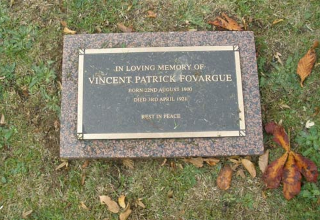
Fovargue is born on August 22, 1900, at 2 Rutland Place, Clontarf, Dublin, to Robert Fovargue, an engineer/fitter, and Elizabeth (Lillie) Larkin.
An intelligence officer with the 4th Battalion of the Dublin Brigade of the IRA in the Ranelagh area, he is captured by the British Army in Dublin. Under interrogation, he allegedly leaks information that results in the arrest of the other members of his unit a few days later. In return for this information, the Intelligence Corps allegedly allow him to escape during a staged ambush in Dublin’s South Circular Road.
This attempted ruse however does not go unnoticed by Michael Collins‘ informants in the Crown’s security forces. On the night of the escape, Detective ConstableDavid Neligan of the Dublin Metropolitan Police‘s “G” Division is on duty in Dublin Castle when he is passed a telephone message on a police form. The message, issued by the British Military Headquarters, states that a “Sinn Féin” suspect named Fovargue had escaped from three Intelligence Corps officers in a car while en route to prison. It gives a description of his appearance and asks that the British Army be notified in the event of his recapture by the Dublin Metropolitan Police.
Joe Kinsella is the I/O of the 4th Battalion. He is temporarily transferred to take care of munitions under Seán Russell for a few weeks and Fovargue is put in his place. In Kinsella’s statement to the BMH, he writes:
“From the outset I personally did not place a lot of trust in him, because on the morning that he took over from me he appeared to me, to be too inquisitive about the movements of Michael Collins and the GHQ staff generally. He wanted to know where they could be located at any time. He said that he had big things in view, and that it would be to the advantage of the movement generally if he was in a position to get in touch with the principal men with the least possible delay. From his attitude I there and then formed the opinion, rightly or wrongly, that he was inclined to overstep his position. I did not feel too happy about him and I discussed him with Sean Dowling. It transpired that my impressions of this man were correct. I told him of two meeting places of Intelligence staff, one of Company Intelligence held at Rathmines Road and one of Brigade Intelligence held at Saville Place. A short time after giving him this information both these places were raided…I was now confirmed in my suspicions that Fovargue was giving away information. He was later shot in England by the IRA.”
Neligan is not fooled by this either, as he explains:
“Now if they had said that this man (who was completely unknown to both of us) had escaped from one I.O. it might have sounded reasonable enough. But to tell us that an unarmed man had escaped out of a motor-car in the presence of three presumably armed men was imposing a strain on our credulity. Both of us thought this story too good to be true.”
The two men retype the message and pass it to Collins the following day. Meanwhile, Fovargue has been sent to England where he adopts the alias of Richard Staunton. Fovargue has in fact been sent to England by Intelligence Corps Colonel Ormonde Winter to infiltrate the IRA in Britain.
Sean Kavanagh, a Kilkenny IRA man, claims that Fovargue is put in a cell with him in Kilmainham in 1921 in order to try to extract information from him.
On April 2, 1921, a boy walking on the golf links of the Ashford Manor Golf Club in Ashford, Middlesex discovers the body of Fovargue, who had been shot through the chest. Discovered near the corpse is a small piece of paper on which had been scribbled in blue pencil the words “Let spies and traitors beware – IRA.”


 seamus dubhghaill