

The Great Dublin Lockout, a major industrial dispute between approximately 20,000 workers and 300 employers, begins in Dublin on August 26, 1913, and lasts until January 18, 1914. It is often viewed as the most severe and significant industrial dispute in Irish history.
Irish workers live in terrible conditions in tenements. The infant mortality rate among the poor is 142 per 1,000 births, extraordinarily high for a European city. Poverty is perpetuated in Dublin by the lack of work for unskilled workers, who lack any form of representation before trade unions are founded.
James Larkin, the main protagonist on the side of the workers in the dispute, is a docker in Liverpool and a union organiser. In 1907 he is sent to Belfast as local organiser of the British-based National Union of Dock Labourers (NUDL). His tactic of the sympathetic strike is deemed highly controversial and as a result Larkin is transferred to Dublin.
Larkin sets about organising the unskilled workers of Dublin, which is a cause of concern for the NUDL, who are reluctant to engage in a full-scale industrial dispute with the powerful Dublin employers. They suspended Larkin from the NUDL in 1908. Larkin then leaves the NUDL and sets up the Irish Transport and General Workers’ Union (ITGWU), the first Irish trade union to cater for both skilled and unskilled workers.
Another important figure in the rise of an organised workers’ movement in Ireland at this time is James Connolly, an Edinburgh-born Marxist of Irish parentage. In 1911, Connolly is appointed the ITGWU’s Belfast organiser. In 1912, Connolly and Larkin form the Irish Labour Party to represent workers in the imminent Home Rule Bill debate in Parliament.
Foremost among employers opposed to trade unionism in Ireland is William Martin Murphy, Ireland’s most prominent capitalist, born in Castletownbere, County Cork. In 1913, Murphy is chairman of the Dublin United Tramway Company and owns Clery’s department store. Murphy is vehemently opposed to trade unions, which he sees as an attempt to interfere with his business. In particular, he is opposed to Larkin, whom he sees as a dangerous revolutionary.
The resulting industrial dispute is the most severe in Ireland’s history. Employers in Dublin lock out their workers and employ blackleg labour from Britain and elsewhere in Ireland. Dublin’s workers apply for help and are sent £150,000 by the British Trades Union Congress (TUC) and other sources in Ireland, doled out dutifully by the ITGWU.
The “Kiddies’ Scheme,” allowing for the starving children of Irish strikers to be temporarily looked after by British trade unionists, is blocked by the Roman Catholic Church and especially the Ancient Order of Hibernians, who claim that Catholic children will be subject to Protestant or atheist influences when in Britain. The Church supports the employers during the dispute, condemning Larkin as a socialist revolutionary.
Guinness, the largest employer and biggest exporter in Dublin, refuses to lock out its workforce. It has a policy against sympathetic strikes and expects its workers, whose conditions are far better than the norm in Ireland, not to strike in sympathy. Six who do strike are dismissed.
Strikers use mass pickets and intimidation against strike breakers, who are also violent towards strikers. The Dublin Metropolitan Police baton charge worker’s rallies, including a rally on Sackville Street which results in two deaths and over 300 injuries. James Connolly, Larkin, and ex-British Army Captain Jack White form a worker’s militia, the Irish Citizen Army, to protect workers’ demonstrations.
For seven months, the lockout affects tens of thousands of Dublin families. The lock-out eventually concludes in January 1914, when the Trades Union Congress (TUC) in Britain rejects Larkin and Connolly’s request for a sympathetic strike. Most workers, many of whom are on the brink of starvation, go back to work and sign pledges not to join a union. The ITGWU is badly damaged by its defeat in the Lockout and is further hit by the departure of Larkin to the United States in 1914 and the execution of Connolly, one of the leaders of the Easter Rising in 1916.
Although the actions of the ITGWU are unsuccessful in achieving substantially better pay and conditions for workers, they mark a watershed in Irish labour history. The principle of union action and workers’ solidarity has been firmly established. No future employer would ever try to “break” a union in the way that Murphy attempted with the ITGWU.
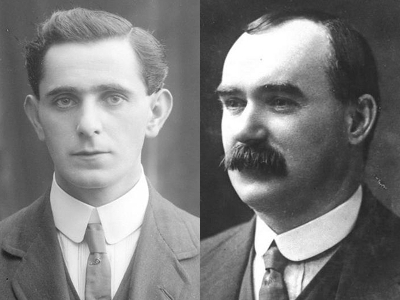
 seamus dubhghaill