seamus dubhghaill

Promoting Irish Culture and History from Little Rock, Arkansas, USA


Leave a comment

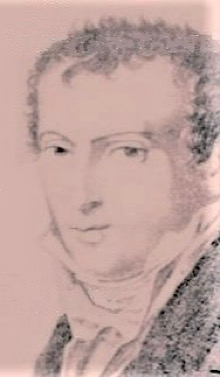
Death of David Bailie Warden, United Irishman & Diplomat

David Bailie Warden, United Irishman, diplomat, and bibliographer, dies in Paris on October 9, 1845, where he had lived for the previous thirty-eight years.

Warden is born in the townland of Ballycastle, near Newtownards in County Down, the eldest among three sons of Robert Warden, tenant farmer, and Elizabeth Warden (née Bailie). Educated locally, he studies for the Presbyterian ministry, despite being told by a clergyman that he is a “blockhead.” Entering the University of Glasgow, he wins a silver medal for his work on barometers, receives a certificate in midwifery, and graduates MA in April 1797. Returning to Ireland, he accepts a provisional license to preach from the Presbytery of Bangor, County Down, and becomes a popular preacher in the region. A patriot in politics, he joins the United Irishmen. Because of this a warrant was issued for his arrest in 1798 and he surrenders himself to the government. Banished from Ireland, he decides to emigrate to the United States and writes a pamphlet explaining his decision, A farewell address to the junto of the presbytery of Bangor, in which he accuses the church leaders of “meanness, injustice and cruelty.”

On his arrival in New York City in 1799, Warden decides to abandon his career as a clergyman and become a teacher. Interested in mathematics, science and literature, he becomes principal of the Columbia Academy in Kinderhook, New York, and is appointed in 1801 the head tutor at Kingston Academy in Ulster County, New York. Employed by General John Armstrong, Jr. to teach his children, he makes useful connections in American society. He becomes a citizen in 1804 and is asked to accompany Armstrong to France when he is appointed ambassador. Arriving in Paris in 1806, he gives strong support to Armstrong and defends him from criticism in the American press. He is appointed acting consul in 1808, and serves as head of the legation on two occasions when Armstrong is absent. Surprisingly, despite their ties of friendship, Armstrong does not recommend Warden to succeed him permanently, and advises President Thomas Jefferson that although “honest and amiable” he is “not well qualified for business.” Stung by these comments, Warden reacts angrily and his friendship with Armstrong ends acrimoniously. As a result he is swiftly recalled from Paris.

Once back in America, Warden lobbies vigorously to be appointed French consul. Supported by Jefferson, now out of office, he returns to Paris in August 1811 having convinced the government of his credentials. Befriending the new ambassador, Joel Barlow, he soon allows pride to get the better of him. Arrogantly styling himself “consul general” after Barlow dies in December 1812, he provokes much anger and is dismissed from office on June 10, 1814. He never holds a diplomatic appointment again.

Deciding to remain in France, he resumes his scholarly activities and publishes his first book, On the Origin, Nature, Progress and Influence of Consular Establishments in 1813. A friend of many of the leading French writers and intellectuals, he also offers assistance to visiting scholars from America, providing a bridge between the European and American intellectual communities. His reputation increases with the publication of Chorographical and Statistical Description of the District of Columbia (1816) and A Statistical, Political and Historical Account of the United States of North America (3 vols., 1819). The publishers of a series, L’art de vérifier les dates, commissions him to research the volumes on North and South America in 1821. These run to ten volumes and are written over thirteen years.

Beset by financial difficulties, Warden is twice forced to sell part of his vast library to raise money. He dies on October 9, 1845, in Paris, after a long illness. He never marries.

(From: “Warden, David Bailie” by Patrick M. Geoghegan, Dictionary of Irish Biography, http://www.dib.ie, October 2009)

Leave a comment

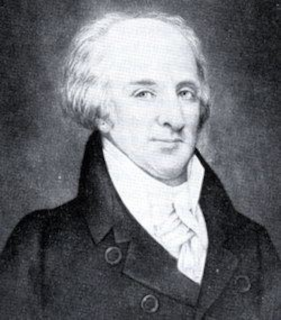
John Armstrong, Sr. Appointed Brigadier General in the Continental Army

John Armstrong, Sr., an Irish American civil engineer and soldier, is appointed a brigadier general in the Continental Army on March 1, 1776. He also serves as a major general in the Pennsylvania Militia during the American Revolutionary War.

Armstrong is born on October 13, 1717, in Brookeborough, County Fermanagh, parents not determined, who married in 1704. He is one of approximately fifteen children born to his parents that included: Margaret Armstrong (1737–1817), who marries Rev. George Duffield (1732–90), and Rebecca Armstrong (1738–1828), who marries James Turner (1737–1803).

Armstrong is educated in Ireland and becomes a civil engineer before emigrating to Pennsylvania, with his brother-in-law, John Lyon, around 1740. He comes to Pennsylvania as a surveyor for the Penn family, the proprietary owners of the colony. In 1750, he lays out the first plat or plan for the town of Carlisle, Pennsylvania, and is one of its first settlers. He is later appointed surveyor for the newly established Cumberland County.

In 1756, during the Seven Years’ War, Armstrong leads the Kittanning Expedition. In 1758, he leads 2,700 Pennsylvania provincial troops on the Forbes Expedition, the approach of which compels the French to vacate and blow-up Fort Duquesne. He becomes a good friend to the other militia commander in this expedition, Colonel George Washington.

James Smith writes that in the fall of 1763, “I went on the Susquehannah campaign, against the Indians, under the command of General Armstrong. In this route we burnt the Delaware and Monsey towns, on the West Branch of the Susquehannah, and destroyed all their corn.”

In the early stages of the American Revolutionary War (1775-83), Armstrong is a brigadier general in the Pennsylvania militia. On March 1, 1776, the Continental Congress appoints him to that same rank in the Continental Army. He is sent south to begin preparations for the defense of Charleston, South Carolina. He contributes his engineering talents to the construction of defenses that enable them to withstand the Battle of Sullivan’s Island later that year. When General Charles Lee arrives to take command, Armstrong returns to his duties with the main army and with the Pennsylvania militia. Pennsylvania names him major general in charge of the state militia. This ends his service in the Continental Army, but not the war or his cooperation with General George Washington.

At the Battle of Brandywine on September 11, 1777, Armstrong’s militia holds the far left of the American line. They also guard the army’s supplies. After a hard day’s fighting, the Americans are forced to withdraw, or face being surrounded. He brings the supplies and his militia out from Pyle’s Ford after dark.

In the Battle of Germantown on October 4, Armstrong leads the American right. His mission is to skirt the British left flank and attack there and in their rear. Despite delays and the troubles some units have in moving, the overall attack is going well, until the center is held up at the Benjamin Chew House. The attack then collapses after a friendly fire incident in the fog in which General Adam Stephen‘s men fire on Anthony Wayne‘s troops causing their withdrawal. Armstrong, whose men have advanced nearly to the center of Germantown but are not greatly involved in the fight later complains that it was “…. a glorious victory fought for, and eight tenths won, …. mysteriously lost, for to this moment no one man can …. give any good reason for the flight.”

After Germantown, Armstrong is granted permission to give up active command. At aged sixty, his health is declining, and old wounds are troubling him. He serves until April 4, 1778.

After his service in the War ends, Armstrong returns home to Carlisle, where he is elected to the Continental Congress by the Pennsylvania Assembly. As a delegate from 1779 to 1780, he is a strong supporter of Washington and the army. He is firm in his support for a new United States Constitution and is returned to the Congress of the Confederation during its final days in 1787 and 1788.

Throughout his life Armstrong serves in a number of local or civic offices. One of these, the Carlisle school board, leads him to originally oppose Dr. Benjamin Rush‘s proposal to start a college in the town. He later relents and becomes a member of the first Board of Trustees for Dickinson College from 1783 to 1794.

In 1747, Armstrong marries Rebecca Lyon Armstrong (1719–97), daughter of Archibald Lyon and Ann Lyon. Together, they are the parents of:

Armstrong dies at his home in Carlisle, Pennsylvania, on March 9, 1795, and is buried in the Old Carlisle Cemetery. In 1800, when Pennsylvania creates a new county with its seat at Kittanning, it is named Armstrong County in his honor.