seamus dubhghaill

Promoting Irish Culture and History from Little Rock, Arkansas, USA


Leave a comment

David Cameron Issues Formal State Apology for Bloody Sunday

cameron-bloody-sunday-apology

On June 15, 2010, David Cameron, Prime Minister of the United Kingdom, issues a formal state apology for the “unjustified and unjustifiable” killing of fourteen civil rights marchers in Derry, County Londonderry, Northern Ireland by British soldiers on Bloody Sunday, January 30, 1972. Cameron says Lord Saville inquiry’s long-awaited report shows soldiers lied about their involvement in the killings and that all of those who died were innocent.

Bloody Sunday, as the events on January 30, 1972, come to be known, is one of the most controversial moments of the Troubles. Paramilitary open fire while trying to police a banned civil rights march. They kill 13 marchers outright, and, according to Saville, wound another 15, one of whom subsequently dies later in the hospital.

In the House of Commons of the United Kingdom, Cameron begins his statement by saying he is “deeply patriotic” and does not want to believe anything bad about his country. Cameron says the inquiry, a 5,000-page, 10-volume report, which takes twelve years to compile at a cost of almost £191m, is “absolutely clear” and there are “no ambiguities” about the conclusions. He adds, “What happened on Bloody Sunday was both unjustified and unjustifiable. It was wrong.”

The report concludes there is no justification for shooting at any of those killed or wounded on the march. “None of the firing by the Support Company [Paratroopers] was aimed at people posing a threat or causing death or serious injury.” The report adds that the shootings “were not the result of any plan to shoot selected ringleaders” and that none of those killed by British soldiers was armed with firearms and no warning was given by the soldiers.

“The government is ultimately responsible for the conduct of the armed forces, and for that, on behalf of the government and on behalf of the country, I am deeply sorry,” says Cameron. The inquiry finds that the order sending British soldiers into the Bogside “should not have been given.” Cameron adds the casualties were caused by the soldiers “losing their self-control.”

The eagerly awaited report does not hold the British government at the time directly responsible for the atrocity. It finds that there is “no evidence” that either the British government or the unionist-dominated Northern Ireland administration encouraged the use of lethal force against the demonstrators. It also exonerates the army’s then commander of land forces, Major General Robert Ford, of any blame.

Most of the damning criticism against the military is directed at the soldiers on the ground who fired on the civilians. Saville says that on Bloody Sunday there had been “a serious and widespread loss of fire discipline among the soldiers.” He concludes that many of the soldiers lied to his inquiry. “Many of these soldiers have knowingly put forward false accounts in order to seek to justify their firing.” Under the rules of the inquiry this conclusion means that soldiers could be prosecuted for perjury.

The report also focuses on the actions of two Republican gunmen on the day and says that the Official Irish Republican Army (IRA) men had gone to a prearranged sniping position. But Saville finds that their actions did not provoke in any way the shootings by the paramilitary regiment.

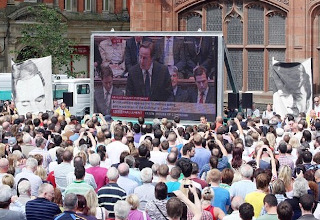
Relatives cheer as they watch the statement, relayed to screens outside the Guildhall in Derry. A minute of silence is held as thousands of supporters fill the square outside, waiting to be told about the report’s contents. A representative of each of the families speaks in turn and a copy of the hated report by Lord Widgery, which in 1972 accuses the victims of firing weapons or handling bombs, is torn apart by one of the families’ representatives.

Denis Bradley, who played a key part in secret talks that brought about the IRA ceasefire of 1994 and who was on the Bloody Sunday march in 1972, welcomes the report’s findings. The former Derry priest, who narrowly escaped being shot on the day, says he is “amazed” at how damning the findings are against the soldiers. He adds, “This city has been vindicated, this city has been telling the truth all along.”

(Pictured: Family and supporters watch David Cameron’s formal state apology in Guildhall Square in Derry, County Londonderry, Northern Ireland)

Leave a comment

The Arrest of the Birmingham Six

the-birmingham-six

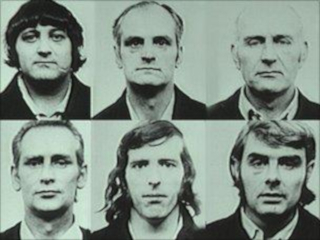
Hugh Callaghan, Patrick Hill, Robert Hunter, Noel McIlkenny, William Power, and John Walker, known as the “Birmingham Six,” are arrested on November 22, 1974, in connection with pub bombings which took place earlier in the week.

The Birmingham pub bombings take place on November 21, 1974, and are attributed to the Provisional Irish Republican Army. Explosive devices are placed in two central Birmingham pubs, the Mulberry Bush at the foot of the Rotunda and the Tavern in the Town in New Street. The resulting explosions, at 8:25 PM and 8:27 PM, collectively are the most injurious attacks in England since World War II. Twenty-one people are killed and 182 are injured. A third device, outside a bank in Hagley Road, fails to detonate.

Five of the six arrested are Belfast-born Roman Catholics, while John Walker is a Roman Catholic born in Derry. All six have lived in Birmingham since the 1960s. All the men except for Callaghan leave the city early on the evening of November 21 from New Street Station, shortly before the explosions. They are travelling to Belfast to attend the funeral of James McDade, a Provisional IRA member who had accidentally killed himself on November 14 when his bomb detonates prematurely while he is planting it at a telephone exchange in Coventry.

When they reach Heysham they and others are subject to a Special Branch stop and search. The men do not tell the police of the true purpose of their visit to Belfast, a fact that is later held against them. While the search is in progress the police are informed of the Birmingham bombings. The men agree to be taken to Morecambe police station for forensic tests.

On the morning of November 22, after the forensic tests and questioning at the hands of the Morecambe police, the men are transferred to the custody of West Midlands Serious Crime Squad police unit. Callaghan is taken into custody on the evening of November 22.

The Birmingham Six are charged with murder and conspiracy to cause explosions on May 12, 1975. The trial begins on June 9, 1975, at the Crown Court sitting at Lancaster Castle, before Justice Nigel Bridge and a jury. The jury finds the six men guilty of murder. On August 15, 1975, they are each sentenced to twenty-one life sentences.

On November 28, 1974, the Birmingham Six appear in court for a second time after they had been remanded into custody at HM Prison Winson Green, all showing bruising and other signs of ill-treatment. Fourteen prison officers are charged with assault in June 1975 but are ultimately acquitted. The Six bring a civil claim for damages against the West Midlands Police in 1977, but it is struck out on January 17, 1980, by the Court of Appeal (Civil Division).

In March 1976 the Birmingham Six’s first application for leave to appeal is dismissed by the Court of Appeal, presided over by John Widgery. Their second full appeal, in 1991, is allowed. New evidence of police fabrication and suppression of evidence, the successful attacks on both the confessions and the 1975 forensic evidence causes the Crown to decide not to resist the appeals. The Court of Appeal states that in light of the fresh scientific evidence, the convictions are both unsafe and unsatisfactory. On March 14, 1991, the Birmingham Six are set free.

In 2001, a decade after their release, the six men are awarded compensation ranging from £840,000 to £1.2 million.


Leave a comment

The Bloody Sunday Inquiry

CREATOR: gd-jpeg v1.0 (using IJG JPEG v62), quality = 75

The Bloody Sunday Inquiry, also known as the Saville Inquiry or the Saville Report after its chairman, Mark Saville, Baron Saville of Newdigate, is launched on April 3, 1998, by British Prime Minister Tony Blair. The inquiry follows campaigns for a second inquiry by families of those killed and injured in Derry on Bloody Sunday during the peak of ethno-political violence known as The Troubles. The inquiry is set up to establish a definitive version of the events of Sunday, January 30, 1972, superseding the tribunal set up under John Widgery, Baron Widgery that had reported on April 19, 1972, eleven weeks after the events, and to resolve the accusations of a whitewash that had surrounded it.

The inquiry takes the form of a tribunal established under the Tribunals of Inquiry (Evidence) Act 1921, and consists of Lord Saville, the former Chief Justice of New Brunswick William L. Hoyt and John L. Toohey, a former Justice of the High Court of Australia.

The judges finish hearing evidence on November 23, 2004, and reconvene once again on December 16 to listen to testimony from another witness, known as Witness X, who had been unavailable earlier.

The report is published on June 15, 2010. That morning thousands of people walk the path that the civil rights marchers had taken on Bloody Sunday before fourteen were killed, holding photos of those who had been shot. The families of the victims receive advance copies of the report inside the Guildhall.

Then British prime minister David Cameron addresses the House of Commons that afternoon where he describes what British soldiers had done as “both unjustified and unjustifiable, it was wrong.” He acknowledges, among other things, that the paratroopers had fired the first shot, had fired on fleeing unarmed civilians, and shot and killed one man who was already wounded. He then apologises on behalf of the British Government by saying he is “deeply sorry.”

(Pictured: Lord Saville and his colleagues visit the Bogside during their first day in the city on April 3, 1998. Credit: Derry Journal)