seamus dubhghaill

Promoting Irish Culture and History from Little Rock, Arkansas, USA


Leave a comment

The Irish Brigade Fights at the Battle of Chiari

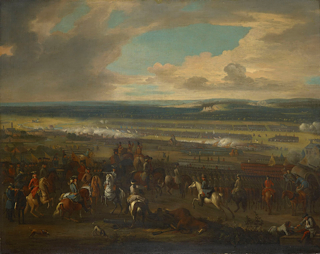
On September 1, 1701, the Irish Brigade of France fights at the Battle of Chiari in northern Italy during the War of the Spanish Succession. The engagement is part of Prince Eugene of Savoy‘s campaign to seize the Spanish controlled Duchy of Milan in the Italian peninsula, and follows his victory over Marshal Nicolas Catinat at the Battle of Carpi in July. Marshal François de Neufville, 2nd Duke of Villeroy, replaces Catinat as commander of the Franco–Spanish–Savoyard forces in the theatre, carrying with him orders from King Louis XIV to push the Imperialists out of Italy.

Eugene welcomes the prospect of a decisive battle, and waits on the eastern side of the Oglio to be attacked. The Imperial commander has chosen his ground carefully, entrenching his troops and guns in front of the small fortress of Chiari. Streams protect his position on three sides so, as there is not enough room for a cavalry engagement, Eugene can count on a frontal attack by the French infantry. Two battalions and a few pieces of artillery are placed in Chiari itself.

Villeroy ignores Catinat’s warning that Eugene is in a strong position, remarking that the King, “had not sent so many brave men just to look at the enemy through their spy glasses.” On September 1, the Franco-Spanish infantry advances. Deceived by the report of spies that the Imperialists are retiring, Villeroy crosse the Oglio and pushes on to Chiari expecting to attack their rearguard. The attack begins around 2:00 p.m. when three French brigades approach Chiari and overpower the Imperial troops there without much difficulty. However, instead of facing the rearguard, the French commander encounters the whole Imperial army securely entrenched in their positions. As the Bourbons’ army approaches the Imperial positions, Eugene forbids his men to fire. Loading their artillery with canister shot, they only unleash a withering fire when the Bourbon army enters point-blank range. This disorders the attackers and chaos ensues which the French and Spanish commanders cannot suppress. While this is going on, Chiari is recaptured by the Imperials after a fierce struggle. The Bourbons are driven back with heavy casualties in a contest as destructive as any battle during the war in Italy. With only minor losses, the Imperial army inflicts over 3,000 casualties in the ranks, and over 250 officers. This number grows rapidly as fever attacks the wounded.

Villeroy loses personal control during the battle, and Catinat, despite being wounded, has to organise a retreat. The French dig themselves in only a mile or so away from the Austrians on the same side of the Oglio. Here, the two opposing sides remain for the next two months: the French are too much discouraged by their repulse to resume the assault, and Eugene is unwilling to risk the advantages he had gained by attacking the French in their strong defensive position. However, as autumn advances, conditions deteriorate in both camps: fodder is so short that Eugene’s horses are forced to eat fallen leaves. But the French, whose camp is built on marshy ground, suffers most, and they move out first in mid-November, crossing the Oglio before entering winter quarters in the Duchy of Milan.

In Milan, the French presence proves increasingly unpopular: five million French livres for soldiers’ pay and lodgings, and two million for fodder, has soon been imposed on the local population, most of which has to be taken by force. For his winter quarters, Eugene proceeds to reduce the whole Duchy of Mantua, except the capital and Goito, which he closely blockades. Shortly after he occupies Mirandola and Guastalla. Eugene’s relationship with the local population has been good and he has kept a tight control: he has executed 48 of his men for looting, telling the Emperor that he had “imposed more severe discipline than has possibly ever been seen in an army.” Eugene receives little cash from the Emperor, far less than he expects, but he secures a sound footing in northern Italy and, as hoped, his success helps to encourage the Maritime Powers to come to the aid of Leopold I. Since the beginning of the year Count Johann Wenzel Wratislaw von Mitrowitz has been in London as Imperial minister, pressing for assistance. With Eugene’s two victories (Carpi and Chiari), Leopold I has proven he would fight to protect his interests, giving Wratislaw the arguments he needs to push through the alliance with the Maritime Powers. On September 7, 1701, within a week of the battle, England and the Dutch Republic sign the second treaty of the Grand Alliance, backing the Emperor’s claims to the Spanish possessions in Italy.

The French are still in Milan, but their position is weak: morale is poor and desertion is high. Louis XIV writes to Villeroy urging him to work closely with Catinat and “not again to attack the enemy without advantage.” “If you do … the King, my grandson, will lose Italy.” By October, French optimism for the campaign is gone, but Louis XIV hopes to send reinforcements for the next year’s campaign, believing the Emperor will not be able to make a comparable increase in Eugene’s strength. However, the campaign season is not yet over. As Villeroy settles down for the winter, Eugene is preparing to attack him at his headquarters in Cremona.


Leave a comment

The Capture of Alcoy During the War of Spanish Succession

Elements of the Irish Brigade of France under Daniel O’Mahony help capture the town of Alcoy, Spain on January 9, 1708, during the War of Spanish Succession.

O’Mahony comes from a distinguished Munster family. One brother, Dermod, had been a colonel and another, Daniel, a captain in the Irish Jacobite army that left Limerick for the continent in 1691 in what is known as the Flight of the Wild Geese. Daniel is also a brother-in-law of another famous officer of the Irish Brigade of France, the Marshal James FitzJames, 1st Duke of Berwick. Holding the rank of major, O’Mahony achieves great fame for his part in the Battle of Cremona, where the Irish Brigade foils Prince Eugene of Savoy‘s surprise attack on the city in 1702, and has steadily risen through the ranks.

During the War of Spanish Succession, many officers and units of the Irish Brigade serve in Spain fighting the Allies’ attempt to place Archduke Charles, son of Habsburg (Austrian) Emperor Leopold I, on the Spanish throne. In the early part of 1707, O’Mahony commands an unsuccessful attempt to capture the town of Alcoy with a force of about 1,800 men. On January 2, 1708, he arrives at the gates of the city again, but this time he commands a force of over 6,000, including the Irish battalions of Dillon, Berwick and Bourke.

By January 4, O’Mahony’s six guns have breached the walls of Alcoy, but the Allied garrison fights well and repulses attempts to take it on the 5th and 7th with much loss of life on the Franco-Spanish side. With no relief in sight, the garrison’s situation is hopeless. O’Mahony accepts the garrison’s surrender on January 9.

Daniel O’Mahony is one of the finest commanders of all The Wild Geese. After Alcoy he serves in Sicily and then back in Spain again. He is created a Count of Castile and promoted to lieutenant general. One of the Count’s sons, James, also reaches the rank of lieutenant general in the Spanish army and the other, Dermod, becomes the Ambassador of Spain to Austria.

(Pictured: The flag of the Duke of Berwick’s regiment of the Irish Brigade of France)


1 Comment

The Battle of Cremona

The Irish Brigade of France adds to its growing reputation as elements of the Brigade fight at the Battle of Cremona on February 1, 1702, during the War of the Spanish Succession between a French force under François de Neufville, duc de Villeroy, and an Imperial/Austrian army led by Prince Eugene of Savoy.

The Duchies of Milan and Mantua are strategically important as the key to southern Austria. The French take possession of both in early 1701 but Emperor Leopold then sends Prince Eugene to recapture them. He is an extremely capable general who easily out manoeuvres his French counterparts, winning battles at Carpi and Chieri, after which his army takes up winter quarters in the pro-French Duchy of Mantua. Lack of funds and supplies from Vienna means Eugene has to improvise; since campaigning in the winter months is not usually done, he hopes to take the French by surprise.

Eugene has a contact inside Cremona, a priest named Cuzzoli. On the night of January 31, 1702, he admits a party of Imperial grenadiers by means of a hidden culvert and they seize control of the St. Margaret Gate. Once open, approximately 4,000 troops led by Prince Eugene in person take the French by surprise, many being killed as they emerge from their barracks, and François de Neufville captured in his quarters.

A second and larger force under Charles Thomas, Prince of Vaudémont intends to storm the Po gate and the Citadel but is late in arriving. This gives the garrison time to destroy a vital bridge and prepare, the assault being repulsed by two units of the Irish Brigade, the Régiment de Dillon and the Régiment de Bourke. The defenders now regroup and counterattack. With daylight and a French relief force arriving, Prince Eugene orders his troops to withdraw, the Austrians having suffered an estimated 1,600 casualties, the French around 1,100.

The two Irish units lose an estimated 350 out of 600 men engaged. Their commander, Major Daniel O’Mahoney, is later presented to Louis XIV and knighted by the Stuart exile James III. He goes on to have a distinguished career, fighting in Spain and Sicily. He ends as a Lieutenant-General and dies in Ocaña, Spain in 1714.

François de Neufville is soon released but his capture is commemorated in verse; Par la faveur de Bellone, et par un bonheur sans égal, nous avons conservé Crémone et perdu notre général (By the favour of Bellone, and a happiness without equal, we saved Crémone and lost our general).

The battle is also commemorated as a march entitled ‘The Battle of Cremona’ later used in the Irish Brigade.


Leave a comment

The Battle of Blenheim

battle-of-blenheim

The Irish Brigade of France fights at the Battle of Blenheim, a major battle of the War of the Spanish Succession, on August 13, 1704. The overwhelming Allied victory ensures the safety of Vienna from the Franco-Bavarian army, thus preventing the collapse of the Grand Alliance.

Louis XIV of France seeks to knock Leopold I, Holy Roman Emperor, out of the war by seizing Vienna, the Habsburg capital, and gain a favourable peace settlement. The dangers to Vienna are considerable as Maximilian II Emanuel, Elector of Bavaria and Marshal of France Ferdinand de Marsin‘s forces in Bavaria threaten from the west and Marshal Louis Joseph, Duke of Vendôme‘s large army in northern Italy poses a serious danger with a potential offensive through the Brenner Pass. Vienna is also under pressure from Francis II Rákóczi‘s Hungarian revolt from its eastern approaches. Realising the danger, the John Churchill, 1st Duke of Marlborough resolves to alleviate the peril to Vienna by marching his forces south from Bedburg and help maintain Emperor Leopold within the Grand Alliance.

A combination of deception and skilled administration, designed to conceal his true destination from friend and foe alike, enables Marlborough to march 250 miles unhindered from the Low Countries to the River Danube in five weeks. After securing Donauwörth on the Danube, Marlborough seeks to engage the Elector’s and Marsin’s army before Marshal Camille d’Hostun, duc de Tallard can bring reinforcements through the Black Forest. However, with the Franco-Bavarian commanders reluctant to fight until their numbers are deemed sufficient, the duke enacts a policy of plundering in Bavaria designed to force the issue. The tactic proves unsuccessful, but when Tallard arrives to bolster the Elector’s army, and Prince Eugene of Savoy arrives with reinforcements for the Allies, the two armies finally meet on the banks of the Danube in and around the small village of Blindheim, from which the English “Blenheim” is derived.

Blenheim is one of the battles that alters the course of the war, which until then was leaning for Louis’ coalition, and ends French plans of knocking the emperor out of the war. France suffers as many as 38,000 casualties including the commander-in-chief, Marshal Tallard, who is taken captive to England. Before the 1704 campaign ends, the Allies have taken Landau, and the towns of Trier and Traben-Trarbach on the Moselle in preparation for the following year’s campaign into France itself. The offensive never materialises as the Grand Alliance’s army has to depart the Moselle to defend Liège from a French counteroffensive. The war would rage on for another decade.

(Pictured: The Duke of Marlborough Signing the Despatch at Blenheim. Oil by Robert Alexander Hillingford)