seamus dubhghaill

Promoting Irish Culture and History from Little Rock, Arkansas, USA


Leave a comment

Final Day of the Lismore Christian Brother Monastery Tradition

On November 16, 1999, a deeply rooted tradition in Lismore, County Waterford, comes to a close when Patrick Ryan, the last remaining Christian Brother in the community, turns the key in the front door of the monastery for the final time.

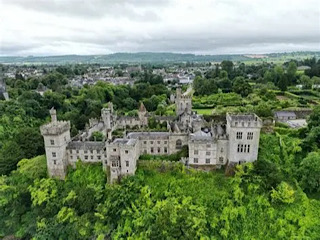
The Christian Brothers’ presence in Lismore is tied to the town’s long ecclesiastical heritage. Lismore’s history is closely linked to Lismore Abbey, founded around 632 by St. Mochuda on the southern bank of the River Blackwater. The site later becomes Lismore Castle (pictured), and the area remains a centre of learning, pilgrimage, and religious life for centuries. The Christian Brothers’ work in the 20th century continues this tradition of education and community service, with the monastery serving as a focal point for local life.

Patrick Ryan’s final act of turning the monastery’s key symbolises the end of an era — the last remaining Brother in the community, marking the conclusion of a nearly 130‑year tradition of Christian Brother activity in Lismore. This closure is not only a personal farewell but also a cultural milestone, as it signals the end of a long-standing chapter in the town’s religious and educational history.

The event is both symbolic and historic. It marks the end of a personal and institutional legacy, with Ryan as the last living link to the Brothers’ work in the area and it reflects the changing landscape of religious life in Ireland, where many monastic and community institutions are closing or ceasing operations in the late 20th century.

While the monastery’s physical role may have changed, the memory of the Christian Brothers’ contributions in Lismore remains part of the town’s heritage, tied to its deep roots in Christian history and the enduring influence of Lismore Abbey’s legacy.

In short, November 1, 1999, is a day when a 130‑year tradition in Lismore is sealed with a single turn of a key, closing a chapter in the town’s story and in the life of Patrick Ryan.


Leave a comment

Death of Saint Mo Chutu mac Fínaill

sts-carthage-catherine-patrick

Saint Mo Chutu mac Fínaill, also known as Carthach or Carthach the Younger (a name Latinized as Carthagus and Anglicized as Carthage), dies on May 14, 637. Mo Chutu is abbot of Rahan, County Offaly and subsequently, founder and first abbot of Lismore, County Waterford.

Through his father, Fínall Fíngein, Mo Chutu belongs to the Ciarraige Luachra, while his mother, Finmed, is of the Corco Duibne. Notes added to the Félire Óengusso, the Martyrology of Óengus, claim that his foster father is Carthach mac Fianáin, also known as Carthach the Elder, whose period of activity can be assigned to the late 6th century.

Mo Chutu first becomes abbot of Rahan, a monastery which lays in the territory of the southern Uí Néill. He composes a rule for his monks, an Irish metrical poem of 580 lines, divided into nine separate sections, a notable literary relic of the early Irish Church.

According to the Annals of Ulster, he is expelled from the monastery during the Easter season of 637. The incident is connected with the Easter controversy in which Irish churches are involved during the 7th century. Through his training in Munster, Mo Chutu is possibly a supporter of the Roman system of calculation, which likely brought him into conflict with adherents of the “Celtic” reckoning in Leinster.

Following his expulsion, Mo Chutu journeys to the Déisi, where he founds the great monastery of Lismore in modern day County Waterford. The Latin and Irish lives make very little of Mo Chutu’s earlier misfortune and focus instead on the saint’s resistance to the oppressive Uí Néill rulers and his joyous reception among the Déisi. He is portrayed in a heroic light in Indarba Mo Chutu a r-Raithin (The expulsion of Mo Chutu from Rahan).

His foundation at Lismore flourishes after his lifetime, eclipsing the reputation of the saint’s earlier church. It is able to withstand the Viking depredations which plague the area and benefit from the generosity of Munster kings, notably the Mac Carthaig of Desmond. In the 12th century, St. Déclán‘s foundation of Ardmore aspires to the status of episcopal see in the new diocese, but the privilege goes instead to Lismore.

His feast day in the Irish martyrologies is May 14, as well as in the Great Synaxaristes of the Orthodox Church. In the present calendar of the Catholic Church in Ireland, in which May 14 is the feast of Saint Matthias, the memorial of Saint Carthage is celebrated on May 15.

The photograph above is from an altar tomb of 1543 in St. Carthage’s cathedral in Lismore and depicts Mo Chutu along with St. Catherine and St. Patrick.