seamus dubhghaill

Promoting Irish Culture and History from Little Rock, Arkansas, USA


Leave a comment

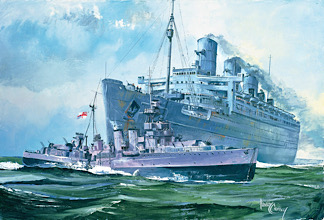
RMS Queen Mary Collides with HMS Curacoa

Twenty miles off the coast of County Donegal on October 2, 1942, the luxury Cunard liner RMS Queen Mary, converted into a troop carrier for World War II, smashes into her escort ship, the British Royal Navy cruiser HMS Curaçoa (D41). The HMS Curacoa, which had connected with the RMS Queen Mary to escort her for the final two hundred miles to the port of Greenock, Scotland, sinks with the loss of 338 men. As are his orders, Captain Cyril Illingworth of the RMS Queen Mary, which is carrying an estimated 15,000 U.S. troops, does not stop to mount a rescue operation.

On a near perfect afternoon, the RMS Queen Mary is off the Irish coast. The vessel is setting a zigzag course to help evade U-boats and long-range German bombers. The RMS Queen Mary has caught up with her 4,290 tonne escort vessel, the HMS Curacoa, and is set to overtake her.

Aboard the HMS Curacoa, seaman Ernest Watson is admiring the RMS Queen Mary’s majestic lines when he notices the bow is swinging toward the cruiser. To his horror, she continues to swing and is soon on a collision course. The gap narrows inexorably as the stunned Watson finally finds his vocal cords and screams, “She’s going to ram us.” Later Watson describes how many of his mates are so shocked they cannot move.

Within seconds, there is a screech of twisted metal followed by the hiss of steam and the screams of those injured or trapped below. The RMS Queen Mary, twenty times larger than the cruiser, has been traveling at top revs giving her a speed of 28.5 knots. The impact swings the HMS Curacoa broadside on and the troopship slices through her 10 cm armour plating. It is all over in seconds, and the troopship continues on her zigzag course leaving the HMS Curacoa cut in two with the forward and aft sections separated by 100 metres of ocean.

At the moment of impact, as the HMS Curacoa reels in the water, Watson and many other seaman on deck are thrown into the freezing water. Even as they surface they watch in horror as the stern quickly sinks, taking with it the men trapped behind the water-tight doors. The forward section follows soon after, leaving the men in the murky water surrounded by debris, oil and drowned or mutilated bodies. It is every man for himself as survivors cling to floating wreckage. They are about 20 nautical miles off the Irish coast which, had boats or rafts been launched, would put them within easy reach of safety.

The survivors believe the RMS Queen Mary will turn back to pick them up, however, it is with obvious despair that they watch her disappear over the horizon. To sail on is probably the toughest decision Captain Illingworth ever has to make. The World War I veteran has many years of experience by the time he has risen to become Cunard-White Star Line’s senior commander and master of the RMS Queen Mary. He is obeying orders that under no circumstances is he to stop until the RMS Queen Mary has safely delivered the troops to Britain. His only option is to signal nearby British destroyers to rescue survivors.

Two destroyers react to Captain Illingworth’s message and steam toward the wreckage where two hours after the collision, they find many bodies of sailors who have died of hypothermia. Only the hardiest live long enough to land in Londonderry, County Londonderry, Northern Ireland, the next day. Of the HMS Curacoa’s 430 personnel, only 99 seamen and two officers survive. Because of war-time security the official inquiry is delayed until the war in Europe is over. Then, in June 1945, only a few weeks after VE Day, the Admiralty Commissioners sued Cunard-White Star Line claiming the RMS Queen Mary had been responsible.

It appears to be a clear-cut case. The HMS Curacoa’s captain, John Boutwood, gives evidence to a Royal Navy inquiry and is acquitted without a reprimand. Later he gains the Distinguished Service Order (DSO). Boutwood says the HMS Curacoa steamed at some 3 knots slower than the larger vessel which had been in the process of overtaking at the time of the collision. He says he had been amazed when the troopship continued turning to starboard and closed the gap between the vessels. When the collision occurred he, and all others on the bridge, had clung to whatever was nearest.

At first, Boutwood vainly hopes the damaged ship will stay afloat. He also says it was impossible to give orders because of the noise of escaping steam from the boiler room. The RMS Queen Mary’s first officer gives evidence that he had taken over the helm less than two minutes before she rams the cruiser. She is about 500m away and on the starboard bow. He is unconcerned at the narrow gap because he expects HMS Curacoa to take evasive action. He believes the cruiser, a more manoeuvrable vessel, would change course.

The first officer had also been reassured by Captain Illingworth, that the cruiser was “experienced in escorting and would keep out of the way.” At a later hearing some months after the opening, Illingworth says he had felt a bump at the time of the collision and had asked the quartermaster if they had been hit by a bomb. The answer was: “No sir, we have hit the cruiser.”

The judge holds the cruiser responsible saying the normal rules of an overtaking vessel keeping clear of the other does not apply in this case. He says the cruiser could have avoided the collision up to seconds before it occurred. The Admiralty, faced with huge compensation to the families of the dead sailors, appeals. In appeal the ruling is that the cruiser was responsible for two-thirds of the damage and the RMS Queen Mary for one-third. Still not satisfied, the case goes to the House of Lords where the verdict of the Appeal Court is upheld in February 1949. No survivor comes out unscathed but above all others, Illingworth has to live with the memory of leaving British sailors to fight for their lives in the ocean.

However, when asked at the first hearing if he felt Illingworth had made the right decision, the captain of the HMS Curacoa says, “I would say, yes.” The RMS Queen Mary continues as a troopship until August 11, 1945. The vessel is now a floating attraction at Long Beach, California.

(From: “SS Queen Mary & the loss of HMS Curacoa 1942” by A. N. Other and NHSA Webmaster, Naval Historical Society of Australia, https://navyhistory.au)


Leave a comment

Birth of Production Designer Cedric Gibbons

cedric-gibbons

Austin Cedric Gibbons, Irish American art director and production designer for the film industry, is born in Dublin on March 23, 1893. He also makes a significant contribution to motion picture theater architecture from the 1930s to 1950s.

Gibbons was born to architect Austin P. Gibbons and Veronica Fitzpatrick Simmons. He is privately tutored and studies at the Art Students League of New York. In 1911 he begins working in his father’s office as a junior draftsman. From 1915 he serves as art director at Edison Studios in New Jersey and then serves in the United States Navy during World War I. He then joins Goldwyn Studios and begins a long career with Metro-Goldwyn-Mayer in 1924, the year the studio is founded.

Gibbons is one of the original 36 founding members of the Academy of Motion Picture Arts and Sciences and oversees the design of the Academy Awards statuette in 1928, a trophy for which he himself would be nominated 38 times for Best Production Design, winning eleven.

In 1930, Gibbons marries actress Dolores del Río and co-designs their house in Santa Monica, an intricate Art Deco residence influenced by Rudolf Schindler. They divorce in 1941. Three years later he marries actress Hazel Brooks, with whom he remains until his death.

Gibbons’s set designs, particularly those in such films as Born to Dance (1936) and Rosalie (1937), heavily inspire motion picture theater architecture in the late 1930s through 1950s. The style is found very clearly in the theaters that are managed by the Skouras brothers, whose designer Carl G. Moeller uses the sweeping scroll-like details in his creations. Among the more classic examples are the Loma Theater in San Diego, The Crest in Long Beach and Fresno, and the Culver Theater in Culver City. The style is sometimes referred to as Art Deco and Art Moderne.

Gibbons retires in 1956 with about 1,500 films credited to him, however, his contract with MGM dictates that he receives credit as art director for every MGM film released in the United States, even though other designers might do the bulk of the work. Even so, his actual hands-on art direction is believed to be about 150 films.

Gibbons’ second cousin, Frederick Gibbons, a musician, orchestra conductor, and entertainer who works with him at MGM, is the father of Billy Gibbons of the rock band ZZ Top.

Cedric Gibbons dies in Los Angeles on July 26, 1960, at the age of 67. He is buried in the Calvary Cemetery, East Los Angeles.


Leave a comment

Transatlantic Flight of “Wrong Way” Corrigan

Douglas Corrigan, an American aviator born in Galveston, Texas, earns the nickname “Wrong Way” Corrigan on July 17, 1938. After a transcontinental flight from Long Beach, California, to New York City, he flies from Floyd Bennett Field in Brooklyn, New York, to Ireland, though his flight plan is filed to return to Long Beach. He claims his unauthorized flight is due to a navigational error, caused by heavy cloud cover that obscures landmarks and low-light conditions, causing him to misread his compass. However, he is a skilled aircraft mechanic and has made several modifications to his own plane, preparing it for his transatlantic flight. He had been denied permission to make a nonstop flight from New York to Ireland, and his “navigational error” is seen as deliberate. Nevertheless, he never publicly admits to having flown to Ireland intentionally.

On July 9, 1938, Corrigan departs California in his 1929 Curtiss Robin OX-5 monoplane bound for Floyd Bennett Field, Brooklyn, New York. With the Robin cruising at 85 miles per hour (137 km/h) for maximum fuel efficiency, the outward journey takes him 27 hours. Fuel efficiency becomes critical towards the end of the flight as a gasoline leak develops, filling the cockpit with fumes.

Upon his unannounced arrival at Floyd Bennett Field, in the midst of Howard Hughes‘s preparations for takeoff on a world tour, Corrigan decides repairing the leak will take too long if he is to meet his schedule. His logged flight plan has him returning to California on July 17. Before takeoff, Corrigan asks the manager of Floyd Bennett Field, Kenneth P. Behr, which runway to use, and Behr tells him to use any runway as long as he does not take off to the west, in the direction of the administration building where Behr has his office. As recorded in Corrigan’s autobiography, Behr wishes him “Bon Voyage” prior to take-off, perhaps in a nod to Corrigan’s intentions to fly the Atlantic. Upon take off at 5:15 on the morning of July 17 with 320 US gallons of gasoline and 16 US gallons of oil, Corrigan heads east from the 4,200-foot runway of Floyd Bennett Field and keeps going. Behr later swears publicly that he has no foreknowledge of Corrigan’s intentions.

Corrigan claims to have noticed his “error” after flying for about 26 hours. This is not entirely consistent with his claim that after 10 hours, he feels his feet go cold. The cockpit floor is awash with gasoline leaking from the unrepaired tank. He uses a screwdriver to punch a hole through the cockpit floor so that the fuel will drain away on the side opposite the hot exhaust pipe, reducing the risk of a midair explosion. Had he been truly unaware he was over ocean, it seems likely he would descend at this point. Instead, he claims to increase the engine speed by almost 20% in the hope of decreasing his flight time.

Corrigan lands at Baldonnel Aerodrome, County Dublin, on July 18, after a 28-hour, 13-minute flight. His provisions for the flight consisted of just two chocolate bars, two boxes of fig bars, and 25 US gallons of water. Corrigan’s plane has fuel tanks mounted on the front, allowing him to see only out of the sides. He has no radio, and his compass is 20 years old.

Aviation officials require 600 words to list the regulations broken by his flight in a telegram, a medium that encourages brevity by charging at a rate per word. Despite the extent of Corrigan’s illegality, he receives only a mild punishment and his pilot’s certificate is suspended for 14 days. He and his plane return to New York on the steamship Manhattan and arrive on August 4, the last day of his suspension. His return is marked with great celebration. More people attend his Broadway ticker tape parade than had honored Charles Lindbergh after his triumph. He is also given a ticker tape parade in Chicago.