

Patrick Quinlan, Irish Army officer who commands the Irish UN force that fights at the Siege of Jadotville in Katanga in 1961, is born in Reeneragh, Caherdaniel, County Kerry, on December 30, 1919.
Quinlan goes to school in nearby Loher. He and his wife Carmel have a son, Leo, who is sixteen when his father serves in the Congo, and later becomes a commandant, the same rank his father held when in Katanga, although the father retires with the higher rank of colonel.
The Siege of Jadotville (modern Likasi) takes place in September 1961, during the United Nations intervention in the Katanga conflict in Congo-Léopoldville, in Central Africa.
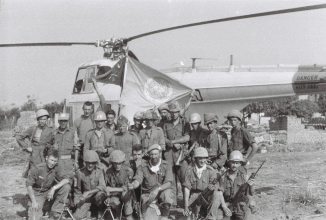
“A” Company, 35th Battalion (UN service) of the Irish Army United Nations Operation in the Congo (ONUC) contingent, commanded by Quinlan, is attacked by Katangese Gendarmerie troops loyal to President Moïse Tshombe and the State of Katanga. Quinlan’s lightly armed company is besieged in Jadotville, and resists Katangese assaults for six days. A relief force of Irish, Indian and Swedish troops is unsuccessful in their attempts to reach Quinlan’s position.
Quinlan’s company suffers five wounded in action during the six-day siege. On the other hand, up to 300 Katangese troops are killed, including thirty mercenaries, and an indeterminate number are wounded, with figures ranging from 300 to 1,000. Quinlan, however, has no access to resupply and reinforcements and, with his transport destroyed by Katanga’s Fouga Magister jet, a breakout is virtually impossible. In the end, with his position untenable, without any clear orders or promise of assistance, having run out of ammunition and food and low on water, he accepts a second offer to surrender to the Katangese.
Although suffering no loss of life, Quinlan’s company are held as prisoners of war and hostages for approximately one month. The Katangese barter the Irish soldiers for prisoners in the custody of the Congolese government. After being released, “A” Company are returned to their base in Elisabethville (now Lubumbashi). Some weeks later, Quinlan finds himself involved in active combat again, this time with his company in support of Swedish UN troops. Eventually they are reinforced with fresh troops from Ireland. After weeks of fighting and their six-month tour of duty now complete, “A” Company is rotated home to Ireland that December.
In its immediate aftermath, the Irish state does not give much recognition to the Battle of Jadotville, and no Irish soldier receives any decoration for actions at Jadotville. This may have been because of a perceived shame that “A” Company had surrendered and an unwillingness to highlight political or strategic errors at higher levels by the UN mission. Quinlan, however, recommends a number of his men for the Military Medal for Gallantry (MMG), Ireland’s highest award for military valour, for their actions during the battle.
Quinlan never serves overseas again and retires as a full colonel after forty years with the Irish Army.
Quinlan dies on August 27, 1997, unaware that his reputation will be restored nine years after his death. His wife does not live to see his official rehabilitation either, dying two years after her husband.
The veterans of Jadotville are dissatisfied with the Irish Defence Forces‘ refusal to acknowledge the battle and the implied black mark on the reputation of their commander. Following a long campaign for recognition, in 2004 the then Minister for Defence, Willie O’Dea, agrees to hold a review of the battle. An inquiry by the Defence Forces clears Quinlan and “A” Company of allegations of soldierly misconduct. A commemorative stone recognising the soldiers of “A” Company is erected on the grounds of Custume Barracks in Athlone in 2005. A commissioned portrait of Quinlan is installed in the Congo Room of the Irish Defence Forces’ UN School.
In 2016, the Irish government awards a Presidential Unit Citation to “A” Company, the first in the State’s history. In October 2017, a plaque commemorating Quinlan is unveiled by former Taoiseach Enda Kenny at Coomakista Pass, County Kerry.
In November 2020, an Independent Review Group commissioned by Irish Defence Minister Simon Coveney recommends that Quinlan receive the Distinguished Service Medal (DSM).
Quinlan’s tactics at Jadotville influence subsequent training programmes, and are, according to RTÉ, “cited in military textbooks worldwide as the best example of the use of the so-called perimeter defence.”
Quinlan is played by Jamie Dornan in the film The Siege of Jadotville (2016), which is adapted from Declan Power‘s book, The Siege at Jadotville: The Irish Army’s Forgotten Battle (2005). His wife Carmel is played by Fiona Glascott. Colonel Quinlan’s son, Commandant Leo Quinlan, says that Dornan bears an uncanny resemblance to his father, and gets everything about him right except his County Kerry accent, which is so strong that “if he had done my father’s accent, you’d need subtitles.” Quinlan’s grandson Conor is a member of the film’s cast.
 seamus dubhghaill