seamus dubhghaill

Promoting Irish Culture and History from Little Rock, Arkansas, USA


Leave a comment

Birth of Francis Rawdon-Hastings, 1st Marquess of Hastings

Francis Rawdon-Hastings, 1st Marquess of Hastings, Anglo-Irish politician and military officer, is born on December 9, 1754, at Moira, County Down. As Governor-General of India, he conquers the Maratha states and greatly strengthens British rule in India.

Rawdon-Hastings is the son of John Rawdon, 1st Earl of Moira, and Elizabeth Hastings, 13th Baroness Hastings, who is a daughter of Theophilus Hastings, 9th Earl of Huntingdon. He is baptised at St. Audoen’s Church, Dublin, on January 2, 1755. He grows up in Moira and in Dublin. He attends Harrow School and matriculates at University College, Oxford, but drops out. While there, he becomes friends with Banastre Tarleton.

He joins the British Army on August 7, 1771, as an ensign in the 15th Regiment of Foot. With his uncle Francis Hastings, 10th Earl of Huntingdon, he goes on the Grand Tour. On October 20, 1773, he is promoted to lieutenant in the 5th Regiment of Foot. He returns to England to join his regiment, and sails for America on May 7, 1774.

He serves in the American Revolutionary War (1775–81), first seeing action at the Battles of Lexington and Concord and the Battle of Bunker Hill. He is rewarded with an English peerage in 1783. He succeeds his father as Earl of Moira in 1793. When the Whigs come to power in 1806, he is appointed Master-General of the Ordnance, a post he resigns on the fall of his party in 1807. Taking an active part in the business of the House of Lords, he belongs to the circle of the Prince of Wales (later George IV), through whose influence he is appointed Governor-General of India, on November 11, 1812. He lands at Calcutta (Kolkata) and assumes office in October 1813. Facing an empty treasury, he raises a loan in Lucknow from the nawab-vizier there and defeats the Gurkhas of Nepal in 1816. They abandon disputed districts, cede some territory to the British, and agree to receive a British resident (administrator). For this success, in 1817 he is raised to the rank of Marquess of Hastings together with the subsidiary titles Viscount Loudoun and Earl of Rawdon.

He then has to deal with a combination of Maratha powers in western India whose Pindaris, bands of horsemen attached to the Maratha chiefs, are ravaging British territory in the Northern Sarkars, in east-central India. In 1817, he offers the Marathas the choice of cooperation with the British against the Pindaris or war. The Peshwa, the Prime Minister of the Maratha Confederacy, the raja of Nagpur, and the army under Holkar II, ruler of Indore, chose war and are defeated. The Pindari bands are broken up, and, in a settlement, the Peshwa’s territories are annexed, and the Rajput princes accept British supremacy. By 1818 these developments establish British sovereignty over the whole of India east of the Sutlej River and Sindh. Rawdon-Hastings also suppresses pirate activities off the west coast of India and in the Persian Gulf and the Red Sea. In 1819, Sir Stamford Raffles, under his authority, obtains the cession by purchase of the strategic island of Singapore.

In internal affairs, Rawdon-Hastings begins the repair of the Mughal canal system and brings the pure water of the Yamuna River (Jumna) into Delhi, encourages education in Bengal, begins a process of Indianization by raising the status and powers of subordinate Indian judges, and takes the first measures for the revenue settlement of the extensive “conquered and ceded” provinces of the northwest.

Rawdon-Hastings’s competent administration, however, ends under a cloud because of his indulgence to a banking house. Though he is cleared of any corrupt motive, the home authorities censure him. He resigns and returns to England in 1823, receiving the comparatively minor post of Governor of Malta in 1824. He dies at sea off Naples on November 28, 1826, aboard HMS Revenge, while attempting to return home with his wife. She returns his body to Malta, and following his earlier directions, cuts off his right hand and preserves it, to be buried with her when she dies. His body is then laid to rest in a large marble sarcophagus in Hastings Gardens, Valletta. His hand is eventually interred, clasped with hers, in the family vault at Loudoun Kirk.

In 1828, two years after Rawdon-Hastings’s death, members of the India House, to make some amends for their vote of censure, give £20,000 to trustees for the benefit of Hastings’s son.

(Pictured: “Portrait of Francis Rawdon, 2nd Earl of Moira, later 1st Marquess of Hastings (1754 – 1826)” possibly by Martin Archer Shee, oil on canvas, National Gallery of Ireland)

Leave a comment

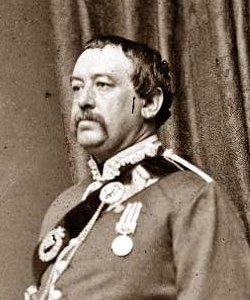
Death of War Correspondent William Howard Russell

william-howard-russell

Sir William Howard Russell, an Irish reporter with The Times and considered to be one of the first modern war correspondents, dies in London, England on February 11, 1907.

Russell is born in Tallaght, County Dublin on March 28, 1820. As a young reporter, he reports on the First Schleswig War, a brief military conflict between Prussian and Danish troops in Denmark in 1850.

Initially sent by editor John Delane to Malta to cover British support for the Ottoman Empire against Russia in 1854, Russell despises the term “war correspondent” but his coverage of the conflict brings him international renown, and Florence Nightingale later credits her entry into wartime nursing to his reports. The Crimean medical care, shelter and protection of all ranks by Mary Seacole is also publicised by Russell and by other contemporary journalists, rescuing her from bankruptcy.

His dispatches are hugely significant as for the first time the public can read about the reality of warfare. Shocked and outraged, the public’s backlash from his reports leads the Government to re-evaluate the treatment of troops and leads to Florence Nightingale’s involvement in revolutionising battlefield treatment.

On September 20, 1854, Russell covers the battle above the Alma River, writing his missive the following day in an account book seized from a Russian corpse. The story, written in the form of a letter to Delane, is supportive of the British troops and pays particular attention to the battlefield surgeons’ “humane barbarity” and the lack of ambulance care for wounded troops. He later covers the Siege of Sevastopol where he coins the phrase “thin red line” in referring to British troops at Balaclava.

Following Russell’s reports of the appalling conditions suffered by the Allied troops conducting the siege, including an outbreak of cholera, Samuel Morton Peto and his partners build the Grand Crimean Central Railway, which is a major factor leading to the success of the siege.

Russell spends December 1854 in Constantinople on holiday, returning in early 1855. He leaves Crimea in December 1855 to be replaced by the Constantinople correspondent of The Times.

In 1856 Russell is sent to Moscow to describe the coronation of Tsar Alexander II and in the following year is sent to India where he witnesses the final re-capture of Lucknow.

In 1861 Russell goes to Washington, D.C., returning to England in 1863. In July 1865 he sails on the SS Great Eastern to document the laying of the transatlantic telegraph cable and writes a book about the voyage with color illustrations by Robert Dudley. He publishes diaries of his time in India, the American Civil War and the Franco-Prussian War, where he describes the warm welcome given him by English-speaking Prussian generals such as Leonhard Graf von Blumenthal.

Russell retires as a battlefield correspondent in 1882 and founds the Army and Navy Gazette. He is knighted in May 1895 and is appointed a Commander of the Royal Victorian Order (CVO) by King Edward VII on August 11, 1902.

Sir William Howard Russell dies on February 11, 1907, and is buried in Brompton Cemetery, London.


Leave a comment

Birth of War Reporter William Howard Russell

william-howard-russell

Sir William Howard Russell, reporter with The Times and considered to be one of the first modern war correspondents, is born at Lily Vale, Tallaght, County Dublin, on March 28, 1820.

As a young reporter, Russell reports on a brief military conflict between Prussian and Danish troops in Denmark in 1850. Sent by editor John Delane to Malta in 1854 to cover British support for the Ottoman Empire against Russia, Russell despises the term “war correspondent” but his coverage of the conflict brings him international renown. Florence Nightingale later credits her entry into wartime nursing to his reports. The Crimean medical care, shelter, and protection of all ranks by Mary Seacole is also publicised by Russell and by other contemporary journalists, rescuing her from bankruptcy.

Russell is described by one of the soldiers on the frontlines as “a vulgar low Irishman, who sings a good song, drinks anyone’s brandy and water, and smokes as many cigars as a Jolly Good Fellow. He is just the sort of chap to get information, particularly out of youngsters.” This reputation leads to Russell being blacklisted from some circles, including British commander Lord Raglan who advises his officers to refuse to speak with the reporter.

His dispatches are hugely significant. For the first time the public is able to read about the reality of warfare. Shocked and outraged, the public’s backlash from his reports leads the Government to re-evaluate the treatment of troops and lead to Florence Nightingale’s involvement in revolutionising battlefield treatment.

On September 20, 1854, Russell covers the battle above the Alma River. The story, written in the form of a letter to Delane, is supportive of the British troops though pays particular attention to the battlefield surgeons’ “humane barbarity” and the lack of ambulance care for wounded troops. He later covers the Siege of Sevastopol.

Following Russell’s reports of the appalling conditions suffered by the Allied troops conducting the siege, including an outbreak of cholera, Samuel Morton Peto and his partners build the Grand Crimean Central Railway, which is a major factor leading to the success of the siege. Russell leaves Crimea in December 1855.

In 1856, Russell is sent to Moscow to describe the coronation of Tsar Alexander II and in the following year is sent to India where he witnesses the final re-capture of Lucknow.

In 1861, Russell goes to Washington, returning to England in 1863. In July 1865, he sails on the SS Great Eastern to document the laying of the Transatlantic Telegraph Cable and writes a book about the voyage with color illustrations by Robert Dudley. He publishes diaries of his time in India, the American Civil War, and the Franco-Prussian War, where he describes the warm welcome given him by English-speaking Prussian generals such as Leonhard Graf von Blumenthal.

He is awarded the title of Commander of the Royal Victorian Order by King Edward VII. Russell later accuses fellow war correspondent Nicholas Woods of the Morning Herald of lying in his articles about the war to try to improve his stories.

In the 1868 General Election, Russell runs unsuccessfully as a Conservative candidate for the borough of Chelsea. He retires as a battlefield correspondent in 1882 and founds the Army and Navy Gazette. He is knighted in May 1895.

Russell dies on February 11, 1907, and is buried in Brompton Cemetery, London.