seamus dubhghaill

Promoting Irish Culture and History from Little Rock, Arkansas, USA


Leave a comment

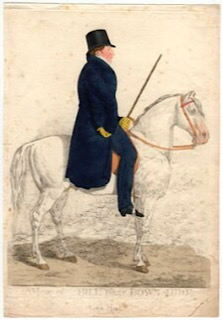
Death of Arthur Hill, 3rd Marquess of Downshire

Arthur Blundell Sandys Trumbull Hill, 3rd Marquess of Downshire KP, an Anglo-Irish peer, styled Viscount Fairford from 1789 until 1793 and Earl of Hillsborough from 1793 to 1801, dies on September 12, 1845, in Blessington, County Wicklow.

Hill is born in Hanover Square, on October 8, 1788, the eldest son of Arthur Hill, 2nd Marquess of Downshire, and his wife, Mary Sandys. He becomes Marquess of Downshire on the early death of his father in 1801. He is educated at Eton College and Christ Church, Oxford, gaining his MA in 1809 and a DCL in 1810.

During his early political career, Hill is identified with the Whigs and supports the reform of Parliament. After the Grey Ministry comes to power, he receives a succession of appointments, becoming Colonel of the South Down Militia on March 25, 1831, and carrying the second sword at the coronation of William IV on September 8. He is appointed a deputy lieutenant of Berkshire on September 20, Lord Lieutenant of Down on October 17 (a new office replacing the Governor of Down), and finally a Knight of the Order of St Patrick on November 24, 1831. He receives an honorary LL.D. from the University of Cambridge on July 6, 1835.

Hill is a very strong supporter of the Irish language, and is president of the Ulster Gaelic Society (est. 1830). In this capacity he plays an important role in helping preserve records of the language, poetry, folk and song collections and much else.

Hill is disliked by Elizabeth Smith, diarist at Baltyboys HouseCounty Wicklow, who feels snubbed by him when she and her husband first move into the area. Writing of him after his death she recalls “The late Lord never called upon me when I first came here although the Colonel waited upon him. The Colonel never went near him again.”

High-minded, if also at times high-handed in manner and self-important, Hill works hard himself and expects all his employees and tenants to be equally conscientious. Naturally, he is often disappointed. He is particularly concerned about his failure, despite all efforts and exhortations, to make his southern estates as efficient and well behaved as those in the north. Though an absentee owner in the south, he visits both Blessington and Edenderry regularly. It is during one of these periodic tours of inspection that he drops dead at Blessington on September 12, 1845. He is buried in St. Malachy Parish Churchyard at Royal Hillsborough, County Down. The funeral attracts an enormous crowd of mourners and is reported at some length in The Illustrated London News. His memory is perpetuated in an impressive pillar monument, with his statue on top, erected at Hillsborough in 1848.


1 Comment

Death of Arthur Hill, 2nd Marquess of Downshire

Arthur Hill, 2nd Marquess of Downshire PC, FRS, British peer and MP styled Viscount Fairford until 1789 and Earl of Hillsborough from 1789 to 1793, dies by suicide on September 7, 1801.

Hill is born on March 3, 1753, the eldest son of Wills Hill, 1st Earl of Hillsborough (later Marquess of Downshire). He matriculates at Magdalen College, Oxford, in 1771, and receives his MA in 1773.

Hill sits as a Tory for the rotten borough of Lostwithiel from 1774 to 1780, and then for Malmesbury until 1784. He also represents County Down in the Irish House of Commons from 1776 until succeeding to the peerage in 1793.

Hill enjoys a number of civil and military appointments in both England and Ireland during this period. He is commissioned a captain in the Hertfordshire Militia on March 22, 1775, and a lieutenant colonel in the regiment on May 4, 1787, resigning his commission on June 4, 1794. Appointed the deputy governor of County Down on August 6, 1779, he is picked as High Sheriff of Down in 1785. He is chosen a Fellow of the Royal Society on January 22, 1790, and a deputy lieutenant of Berkshire on May 12, 1792.

Upon the death of his father on October 7, 1793, Hill succeeds him as Marquess of Downshire, in the Peerage of Ireland, as well as in his other subsidiary titles, including that of Earl of Hillsborough in the Peerage of Great Britain. He also succeeds his father as Hereditary Constable of Hillsborough Fort, and as Custos Rotulorum of County Down (October 16) and Governor of Down (October 17). On November 7, he is appointed to the Privy Council of Ireland.

Hill vigorously exerts himself against the Union of Great Britain and Ireland in 1800 and is punished by the Government for his opposition by being dismissed from the Governorship of Down and the colonelcy of the Downshire Militia and struck off the roll of the Privy Council on February 12, 1800.

On June 29, 1786, Hill marries Mary Sandys, by whom he has seven children:

Hill’s last son, Lord George Hill, is born posthumously, as he dies by suicide on September 7, 1801. His widow, Mary, feels his early death is in part due to his humiliation by the Government, and thereafter is a bitter enemy to Robert Stewart, Viscount Castlereagh. She is the heiress of her uncle, Edwin Sandys, 2nd Baron Sandys, and to the estates of her grandfather, William Trumbull, including Easthampstead Park. In 1802, after Hill’s death, she is created Baroness Sandys, with a special remainder to her younger sons and their male heirs in succession and then to her eldest son and his male heirs.

Hill also has a son, William Arthur Dore-Hill, born in 1778, with his mistress Sarah Dore (who later marries William Garrow).