seamus dubhghaill

Promoting Irish Culture and History from Little Rock, Arkansas, USA


Leave a comment

Death of Danny Blanchflower, Northern Ireland Footballer

Robert Dennis “Danny” Blanchflower, former Northern Ireland international footballer and football manager, dies of pneumonia in Staines-upon-Thames, Surrey, England, on December 9, 1993.

Blanchflower is born on February 10, 1926, in the Bloomfield district of Belfast, the first of five children born to John and Selina Blanchflower. He is educated at Ravenscroft public elementary school and is awarded a scholarship to Belfast College of Technology. He leaves school early to become an apprentice electrician at Gallaher’s cigarette factory in Belfast. He also joins the Air Raid Precautions (ARP) and, in 1943, joins the Royal Air Force after lying about his age. By 1946, after a trainee navigator course at the University of St. Andrews in Scotland and further training in Canada, he is back at Gallaher’s in Belfast and building a reputation as an outstanding footballer.

Blanchflower signs with Glentoran F.C. in 1946 before crossing the Irish Sea and signing with Barnsley F.C. for £6000 in 1949 at the age of 23. He transfers from Barnsley to Aston Villa F.C. for a fee of £15,000 and makes his First Division debut in March 1951. He makes 155 senior appearances for Villa before being bought by Tottenham Hotspur F.C. in 1954 for a fee of £30,000. During his ten years playing at White Hart Lane he makes 337 League appearances and 382 total appearances.

The highlight of Blanchflower’s time with the Spurs comes in the 1960–61 season, while serving as captain, the Spurs win their first 11 games and eventually win the league by 8 points. They beat Leicester City F.C. in the final of the FA Cup, becoming the first team in the 20th century to win the League and Cup double and a feat not achieved since Aston Villa in 1897.

In 1962, Blanchflower again captains the Spurs team to victory in the FA Cup in 1962, narrowly missing out on a second double when they finish a close third in the league behind Ipswich Town F.C. and Burnley F.C. In 1963, he captains the team to victory over Atlético Madrid in the final of the European Cup Winners’ Cup, making Spurs the first English team to win a European trophy.

Between 1949 and 1963, Blanchflower earns 56 caps for Northern Ireland, often playing alongside his brother Jackie until the younger Blanchflower’s playing career is cut short as a result of injuries sustained in the Munich air disaster of February 1958. In 1958, he captains his country when they reached the quarter-finals of the FIFA World Cup.

On December 4, 1957, Blanchflower captains the Northern Ireland team against Italy in Belfast in a bad tempered game that comes to be known as the “Battle of Belfast.” He attempts to keep the peace as the game turns nasty.

Blanchflower announces his retirement as a player on April 5, 1964, having played nearly 400 games in all competitions for the Spurs and captains them to four major trophies.

Following his retirement as a player, Blanchflower coachs for the Spurs for a number of years. Manager Bill Nicholson intends for Blanchflower to be his successor but, when Nicholson resigns in 1974, Blanchflower is passed over in favour of Terry Neill. He leaves the Spurs and becomes manager of Northern Ireland for a brief spell in 1978 before being appointed boss of Chelsea F.C. The team wins only three of fifteen games under his charge and he leaves the team in September 1979.

On May 1, 1990, Tottenham holds a testimonial match for Blanchflower at White Hart Lane, but at this point he is in the early stages of what is later diagnosed as Alzheimer’s disease and Parkinson’s disease. He is eventually placed in a nursing home in Staines-upon-Thames where he dies as a result of pneumonia on December 9, 1993, at the age of 67.

Blanchflower’s hometown of Belfast has honoured him with an Ulster History Circle plaque, located at his childhood home at 49 Grace Avenue, recognising the late sportsman as one of the greatest players in the history of Tottenham Hotspur FC.

2 Comments

Birth of Billy Whelan, Irish Footballer

William Augustine Whelan, known as Billy Whelan or Liam Whelan, Irish footballer who plays as an inside-forward, is born at 28 St. Attracta’s Road, Cabra, Dublin, on April 1, 1935. He dies at the age of 22, as one of eight Manchester United players who are killed in the Munich air disaster.

Whelan is the fourth of seven children born to John and Elizabeth Whelan. His father is an accomplished centre half-back for Dublin club Brunswick and is instrumental in winning the FAI Junior Shield in 1924. His mother is an avid Shamrock Rovers supporter. His father dies in 1943 when Whelan is just eight years old.

Whelan plays Gaelic games, winning a medal for St. Peter’s national school in nearby Phibsborough. After leaving school at the age of fourteen, he works in Cassidy’s, an outfitter on South Great George’s Street. He is an accomplished Gaelic footballer and hurler, but association football is his first love.

Whelan begins his career at the age of twelve when he joins Home Farm before joining Manchester United as an 18-year-old in 1953. He is capped four times for the Republic of Ireland national football team, including a surprising 4–1 victory against Holland in Rotterdam in 1956, but does not score. His brother John plays for Shamrock Rovers and Drumcondra and his eldest brother Christy plays for Transport.

Whelan makes his first appearance for Manchester United during the 1954–55 season and quickly becomes a regular first-team player. He goes on to make 98 first-team appearances in four seasons at United, scoring 52 goals. He is United’s top scorer in the 1956–57 season, scoring 26 goals in the First Division and 33 in all competitions as United wins their second successive league title and reaches the semi-finals of the 1957-58 European Cup. He also gives a commanding display in the 1957 FA Cup final despite losing 2–1 to Aston Villa. Such is the strength of the competition in the United first team that he is soon being kept out of the side by Bobby Charlton. He is a traveling reserve for United’s ill-fated European Cup match against Red Star Belgrade in Belgrade on February 6, 1958, and is one of eight players to die in the subsequent air crash that destroys Matt Busby‘s young team and claims twenty-three lives. Fellow Irishman Harry Gregg, United’s goalkeeper and a survivor and hero of the Munich air crash, recalls Whelan’s last words as the plane is attempting take-off for the third and final time as “Well, if this is the time, then I’m ready.”

Thousands attend Whelan’s funeral on February 12 in St. Peter’s Church, Phibsborough, Dublin, and line the streets as the funeral procession makes its way to his burial-place in Glasnevin Cemetery. In December 2006 Dublin Corporation unveils a commemorative plaque on a bridge at Faussagh Road, Cabra, which was renamed Liam Whelan Bridge.

Although of a cheerful disposition, Whelan is also modest and shy by nature, and a quietly devout Catholic. He has a particular dislike of swearing and tends to fix a look of pained disappointment on teammates who use bad language. Nobby Stiles admits that he “would rather be caught swearing by the pope than by Billy Whelan.” His religious devotion regularly fuels rumours that he is considering being a priest, although at the time of his death he is engaged to be married to Ruby McCullough.


Leave a comment

Shamrock Rovers Become 1st Irish Team to Play in European Competition

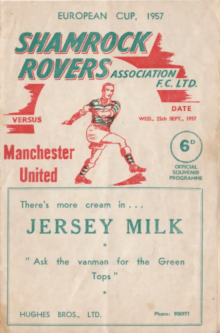
League of Ireland champions Shamrock Rovers become the first Irish team to play in European soccer competition on September 25, 1957, when they welcome Manchester UnitedBusby Babes” to Dublin for the first of two legs in the preliminary round. It is an interesting debut as they are hammered by the pre-Munich Manchester squad.

The Munich Air Disaster, which rips the heart out of Manchester United’s star-studded team, is still five months away and Duncan Edwards, Roger Byrne, David Pegg and Tommy Taylor all line out for the English champions.

The home side features future Republic of Ireland national football team manager Liam Tuohy in their ranks while 45,000 fans show up at Dalymount Park for the match.

In his programme notes, Rovers chairman Joseph Cunningham pays tribute to their opponents. “This evening it is my privilege and pleasure on the behalf of my Co-Directors, to extend Manchester United a sincere and hearty welcome to Dublin.”

“To the men who have substantially helped to put this team on the field — Directors, Manager, Coach, Trainer, Scouts, etc. — we owe a debt.”

“In this connection I sincerely suggest that when the Manchester United team make their appearance on the field of play tonight, we would like them to know that the welcome is not only a salute to a great team, but also salute to the “Backroom Boys” who have moulded the team to its present greatness.”

The game itself sees Manchester United win out comfortably, slamming six goals past the Rovers without reply. Two weeks later, however, the Hoops manage to save some face by going down by a single goal 3-2 at Old Trafford.

Less than five months later, most of the Manchester United team is wiped out in a British European Airways (BEA) plane crash in Munich, Germany, including Dubliner Liam Whelan, who did not play against the Rovers. Of the United greats featured in the Dublin game, only Bobby Charlton survives the Munich plane crash.

(From: “#OTD in 1957 – Shamrock Rovers are the First Irish Team to Play in European Soccer Competition,” Stair na hÉireann | History of Ireland, https://stairnaheireann.net)


Leave a comment

Birth of Jackie Blanchflower, Northern Irish Footballer

John “Jackie” Blanchflower, Northern Irish footballer, is born on March 7, 1933, in Belfast, Northern Ireland. He graduates from Manchester United‘s youth system and plays for the club on 117 occasions, winning two league titles, before his career is cut short due to injuries sustained in the Munich air disaster. He is also capped 12 times at senior level by Northern Ireland.

Blanchflower is the younger brother of Danny Blanchflower, the captain of the Tottenham Hotspur side that dominates English football in the early 1960s.

Blanchflower’s first appearance in a professional game is for Manchester United on November 24, 1951, against Liverpool, away at Anfield. He becomes a regular first team player in the 1953–54 season, when he plays in 27 out of 42 league games and scores 13 goals as an inside-forward.

Blanchflower helps the club win the league title in 1956 and again in 1957. Nicknamed “Twiggy” by his teammates, he is renowned for his versatility. He begins his career as a left-half before the emergence of Duncan Edwards in this position, at which time he switches to the forward positions. The Manchester United manager, Matt Busby, recognises his intelligent positioning sense and aerial power and chooses to play him at centre-half by the 1955–56 season, with John Doherty and Billy Whelan now competing for his former position. He faces fierce competition for the solitary centre-half place due to the presence of Mark Jones. He covers in goal in the 1957 FA Cup Final while Ray Wood receives treatment for an injury suffered in a collision with Peter McParland, who scores both of Aston Villa‘s goals as United loses 2–1. Blanchflower also plays in some of United’s first European Cup fixtures.

Blanchflower scores 27 goals during his time with Manchester United, most of them during his time as a forward.

On February 6, 1958, the Manchester United team that had travelled to Belgrade for the second leg of a European cup tie have their chartered plane stop in Munich to refuel. Weather conditions cause the plane to crash when the pilot attempts to take-off from Munich airport and 23 of the 44 people on board are killed. Blanchflower is severely injured, suffering from a fractured pelvis and arms and legs, and crushed kidneys, and his right arm is nearly severed. He is in hospital for two months and, although not a Catholic, is read the last rites but survives.

Blanchflower tries to return to football, but never makes a full recovery. Doctors advise him not to return to football because of fears he would damage his kidney and, a year later, he retires from football. The Munich air disaster means that he had played his last game of football when still only 24 years old, having earned 12 caps for Northern Ireland, played well over 100 times for Manchester United and won two league championship medals.

Blanchflower marries his wife Jean in 1956 and eventually pursues studies in finance and begins a career as an accountant. He later becomes an after-dinner speaker and is a regular on the after-dinner circuits until his death from cancer on September 2, 1998. He is 65 years old, and just two weeks prior to his death he attended the Munich air disaster testimonial match at Old Trafford.

He is survived by his three children; Krista, Senior (born 1958), Laurie (born 1961) and Andrew (born 1963), as well as his wife, Jean, who dies in 2002 following a long illness.


Leave a comment

The Munich Air Disaster

munich-air-disaster

The Munich air disaster occurs on February 6, 1958, when British European Airways Flight 609 crashes on its third attempt to take off from a slush-covered runway at Munich-Riem Airport, West Germany. On the plane is the Manchester United football team, nicknamed the “Busby Babes“, along with supporters and journalists. Twenty of the 44 on the aircraft die at the scene. The injured, some unconscious, are taken to the Rechts der Isar Hospital in Munich where three more die, resulting in 23 fatalities with 21 survivors. Among the Manchester United fatalities is inside forward Liam “Billy” Whelan who was born in Cabra on the northside of Dublin in 1935.

The team is returning from a European Cup match in Belgrade, Yugoslavia, having eliminated Red Star Belgrade to advance to the semi-finals of the competition. The flight stops to refuel in Munich because a non-stop flight from Belgrade to Manchester is beyond the Airspeed Ambassador‘s range. After refuelling, pilots James Thain and Kenneth Rayment twice abandon take-off because of boost surging in the left engine. Fearing they will get too far behind schedule, Captain Thain rejects an overnight stay in Munich in favour of a third take-off attempt. By then snow is falling, causing a layer of slush to form at the end of the runway. After the aircraft hits the slush, it ploughs through a fence beyond the end of the runway and the left wing is torn off after hitting a house. Fearing the aircraft might explode, Thain begins evacuating passengers while Manchester United goalkeeper Harry Gregg helps pull survivors from the wreckage.

An investigation by West German airport authorities originally blames Thain, saying he did not de-ice the aircraft’s wings, despite eyewitness statements to the contrary. It is later established that the crash is caused by the slush on the runway, which slows the plane too much to take off. Thain is cleared in 1968, ten years after the incident.

At the time of the disaster, Manchester United is trying to become the third club to win three successive English Football League titles. They are six points behind League leaders Wolverhampton Wanderers with 14 games to go. They also hold the Charity Shield and have just advanced into their second successive European Cup semi-final. The team has not been beaten in eleven consecutive matches. The crash not only derails their title ambitions that year but also virtually destroys the nucleus of what promised to be one of the greatest generations of players in English football history. It takes ten years for the club to recover, with Busby rebuilding the team and winning the European Cup in 1968 with a new generation of “Babes.”


Leave a comment

Birth of N.I. Footballer Robert Dennis “Danny” Blanchflower

danny-blanchflower

Robert Dennis “Danny” Blanchflower, former Northern Ireland international footballer and football manager, is born on February 10, 1926 in the Bloomfield district of Belfast, the first of five children born to John and Selina Blanchflower.

Blanchflower is educated at Ravenscroft public elementary school and is awarded a scholarship to Belfast College of Technology. He leaves school early to become an apprentice electrician at Gallaher’s cigarette factory in Belfast. He also joins the Air Raid Precautions and, in 1943, joins the Royal Air Force after lying about his age. By 1946, after a trainee navigator course at St. Andrews University and further training in Canada, he is back at Gallaher’s in Belfast and building a reputation as an outstanding footballer.

Blanchflower signs with Glentoran F.C. in 1946 before crossing the Irish Sea and signing with Barnsley F.C. for £6000 in 1949 at the age of 23. He transfers from Barnsley to Aston Villa F.C. for a fee of £15,000 and makes his First Division debut in March 1951. He makes 155 senior appearances for Villa before being bought by Tottenham Hotspur F.C. in 1954 for a fee of £30,000. During his ten years playing at White Hart Lane he makes 337 League appearances and 382 total appearances.

The highlight of his time with the Spurs comes in the 1960–61 season, while serving as captain, the Spurs win their first 11 games and eventually win the league by 8 points. They beat Leicester City F.C. in the final of the FA Cup, becoming the first team in the 20th century to win the League and Cup double and a feat not achieved since Aston Villa in 1897.

In 1962, Blanchflower again captains the Spurs team to victory in the FA Cup in 1962, narrowly missing out on a second double when they finish a close third in the league behind Ipswich Town F.C. and Burnley F.C. In 1963, he captains the team to victory over Atlético Madrid in the final of the European Cup Winners’ Cup, making Spurs the first English team to win a European trophy.

Between 1949 and 1963, he earns 56 caps for Northern Ireland, often playing alongside his brother Jackie until the younger Blanchflower’s playing career is cut short as a result of injuries sustained in the Munich air disaster of February 1958. In 1958, captains his country when they reached the quarter-finals of the World Cup.

On December 4, 1957, he captains the Northern Ireland team against Italy in Belfast in a bad tempered game that comes to be known as the “Battle of Belfast.” Blanchflower attempts to keep the peace as the game turns nasty.

Blanchflower announces his retirement as a player on April 5, 1964, having played nearly 400 games in all competitions for the Spurs and captains them to four major trophies.

Following his retirement as a player, Blanchflower coachs for the Spurs for a number of years. Manager Bill Nicholson intends for Blanchflower to be his successor but, when Nicholson resigns in 1974, Blanchflower is passed over in favour of Terry Neill. He leaves the Spurs and becomes manager of Northern Ireland for a brief spell in 1978 before being appointed boss of Chelsea F.C. The team wins only three of fifteen games under his charge and he leaves the team in September 1979.

On May 1, 1990, Tottenham holds a testimonial match for Blanchflower at White Hart Lane, but at this point he is in the early stages of what is later diagnosed as Alzheimer’s disease and Parkinson’s disease. He is eventually placed in a Staines nursing home where he dies as a result of pneumonia on December 9, 1993, at the age of 67.

Blanchflower’s hometown of Belfast has honoured him with an Ulster History Circle plaque, located at his childhood home at 49 Grace Avenue, recognising the late sportsman as one of the greatest players in the history of Tottenham Hotspur FC.