seamus dubhghaill

Promoting Irish Culture and History from Little Rock, Arkansas, USA


Leave a comment

Enactment of the Parliament (Qualification of Women) Act 1918

parliament-qualifications-of-women-act-1918

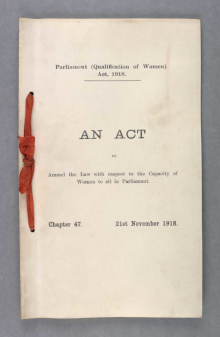
The Parliament (Qualification of Women) Act 1918, an Act of the Parliament of the United Kingdom, is given royal assent on November 21, 1918. It gives women over the age of 21 the right to stand for election as a Member of Parliament (MP). At 27 words, it is the shortest UK statute.

The Representation of the People Act 1918, passed on February 6, 1918, extends the franchise in parliamentary elections, also known as the right to vote, to women aged 30 and over who reside in the constituency or occupied land or premises with a rateable value above £5, or whose husbands do.

In March 1918, the Liberal Party MP for Keighley dies, causing a by-election on April 26. There is doubt as to whether women are eligible to stand for parliament. Nina Boyle makes known her intention to stand as a candidate for the Women’s Freedom League at Keighley and, if refused, to take the matter to the courts for a definitive ruling. After some consideration, the returning officer states that he is prepared to accept her nomination, thus establishing a precedent for women candidates. However, he rules her nomination papers invalid on other grounds: one of the signatories to her nomination is not on the electoral roll and another lives outside the constituency. The Lords of Appeal in Ordinary are asked to consider the matter and conclude that the Great Reform Act 1832 had specifically banned women from standing as parliamentary candidates and the Representation of the People Act had not changed that.

Parliament hurriedly passes the Parliament (Qualification of Women) Act in time to enable women to stand in the general election of December 1918. The act consists of only 27 operative words: “A woman shall not be disqualified by sex or marriage for being elected to or sitting or voting as a Member of the Commons House of Parliament.”

In the December 14, 1918, election to the House of Commons, seventeen women candidates stand, among them well-known suffragette Christabel Pankhurst, representing the Women’s Party in Smethwick. The only woman elected is the Sinn Féin candidate for Dublin St. Patrick’s, Constance Markievicz. However, in line with Sinn Féin abstentionist policy, she does not take her seat.

The first woman to take her seat in the House of Commons is Nancy Astor on December 1, 1919. She is elected as a Coalition Conservative MP for Plymouth Sutton on November 28, 1919, taking the seat her husband had vacated.

As Members of Parliament, women also gain the right to become government ministers. The first woman to become a cabinet minister and Privy Council member is Margaret Bondfield who is Minister of Labour in the second MacDonald ministry (1929–1931).


Leave a comment

Constance Markievicz Elected to British House of Commons

constance-markievicz

Constance Markievicz, while detained in Holloway Prison for her part in conscription activities, becomes the first woman to be elected to the House of Commons of the United Kingdom on December 28, 1918.

Markievicz, an Irish nationalist, who is elected for the Dublin St. Patrick’s constituency, refuses to take her seat in the House of Commons along with 72 other Sinn Féin MPs. Instead, her party, which wins the majority of Irish seats in Westminster, establishes the Dáil, a breakaway Dublin assembly, and triggers the Irish War of Independence.

Markievicz, who inherits the title of “countess” from her noble Polish husband, and 45 other MPs are in jail when the first meeting takes place on January 21, 1919. They are described in Gaelic as being “imprisoned by the foreign enemy” when their names are read out during roll call at the Mansion House.

The 27 MPs who attend the Dáil’s first session ratify the Proclamation of the Irish Republic of Easter 1916, which had not been adopted by an elected body but merely by the Easter rebels claiming to act in the name of the Irish people. They also claim there is an “existing state of war, between Ireland and England” in a Message to the Free Nations of the World.

When Markievicz is released in April 1919, she becomes Minister for Labour. Having also been part of the suffragette movement, her deep political convictions contrast deeply with Nancy Astor, Viscountess Astor, the first woman to sit in the House of Commons. She believes Astor, a Tory who is elected in a 1919 Plymouth by-election after her husband is forced to give up the seat when he becomes a peer, is “out of touch.”

Her political views are also influenced by Irish poet William Butler Yeats, who is a regular visitor to the family home, Lissadell House in County Sligo. She becomes involved in the women’s suffrage movement after studying art in London, where she meets and marries Count Casimir Markievicz. In 1903, the couple, who has one son, settles in Dublin, where she becomes involved in nationalist politics. She joins both Sinn Féin and Inghinidhe na hÉireann.

Like Astor, Markievicz has an irrepressible personality and is in no mood to play coy and simply blend in. She comes to her first Sinn Féin meeting wearing a satin ball-gown and a diamond tiara after attending a function at Dublin Castle, the seat of British rule in Ireland.

Markievicz spends a year in the Dáil before walking out along with Éamon de Valera, the future dominant figure in Irish politics, after opposing the Anglo-Irish Treaty. The document, which grants southern Ireland independence but keeps the north as part of the UK, splits Sinn Féin and triggers the Irish War of Independence.

Following the conflict, which the Pro-Treaty forces win, Markievicz is elected again to the Dáil, but does not take her seat in protest. In 1927, she is elected for a third time as part of de Valera’s new party Fianna Fáil, which pledges to return to the Irish parliament. But before she can take her seat, she dies at age 59 on July 15, 1927, of complications related to appendicitis.