seamus dubhghaill

Promoting Irish Culture and History from Little Rock, Arkansas, USA


Leave a comment

Death of William Archer, Naturalist, Librarian & Microscopist

William Archer, naturalist, librarian and microscopist especially interested in protozoa and desmids, dies in Dublin on August 14, 1897.

Archer is born in Magherahamlet, County Down, on May 6, 1827 (some sources say 1830), the eldest son of Rev. Richard Archer, vicar of Clonduff, and his wife, Jane Matilda (née Campbell). Nothing is known of his education, although his two younger brothers attend Trinity College Dublin (TCD). He apparently becomes estranged from his family, as he is not mentioned by H. B. Swanzy, who does mention his brothers as second and third sons in Richard Archer’s family.

Archer moves to Dublin around 1846, where for many years he pursues a business career. He achieves fame as a naturalist, founding in 1849 with eleven others, the Dublin Microscopical Club, of which he is the secretary and moving spirit for many years. Between 1858 and 1885 he writes over 230 scientific papers in the Quarterly Journal of Microscopical Science, the vast majority being short notes on desmids collected in Ireland.

Archer is a member of the Dublin University Zoological Association. He is elected Member of the Royal Irish Academy (MRIA) on January 10, 1870 and Fellow of the Royal Society (FRS) in 1875, on which occasion it is stated that he has “a knowledge of the minute freshwater organisms unparalleled among British naturalists and perhaps not surpassed for any other country.”

Archer begins a new career when he becomes librarian of the Royal Dublin Society (RDS) in January 1877. The bulk of the Society’s library is being taken over by the state to form the National Library of Ireland. He becomes the chief librarian of the new institution and has the task of overseeing the changes. Most of the ideas put forward in his pamphlet, Suggestions as to public library buildings . . . with especial reference to the National Library of Ireland (Dublin, 1881), are used by Sir Thomas Newenham Deane in his design for tthe new building, which opens in August 1890. His adoption of the Dewey system of classification and the inception of a dictionary catalogue, both novel in his day, are to prove of lasting value to users of the library.

In poor health, Archer retires in 1895. He dies, unmarried, at his home, 52 Lower Mount Street, Dublin, on August 14, 1897. Archer is a shy, modest man, who declines professorships at the Royal College of Science for Ireland and at TCD, and who is nominated for membership of the Royal Irish Academy and the Royal Society without his knowledge.

Leave a comment

Birth of William Archer, Naturalist & Librarian

William Archer FRS, Irish naturalist, librarian and microscopist especially interested in Protozoa and Desmids, is born on May 6, 1827 (some sources say 1830), in Maghera, County Down.

Archer is the eldest son of Rev. Richard Archer (1796? – 1849), perpetual curate of Maghera hamlet, County Down, and his wife, Jane Matilda (née Campbell). Nothing is known of his education, though his two younger brothers attend Trinity College Dublin (TCD). At some point, he apparently appears to become estranged from his family.

Archer moves to Dublin around 1846, where for many years he pursues a business career. He achieves fame as a naturalist, and in 1849, is one of the twelve founder members of the Dublin Microscopical Club, of which he is the secretary and moving spirit for many years. Between 1858 and 1885 he writes over 230 scientific papers on Irish fauna and flora in the Quarterly Journal of Microscopical Science, the vast majority of which are short notes on desmids collected in Ireland. Sometimes the same article is published in two or more journals.

Archer is a member of the Dublin University Zoological Association and is elected a member of the Royal Irish Academy (MRIA) on January 10, 1870, and Fellow of the Royal Society (FRS) in 1875, on which occasion it is stated that he has “a knowledge of the minute freshwater organisms unparalleled among British naturalists and perhaps not surpassed for any other country.”

Archer begins a new career when he becomes librarian of the Royal Dublin Society (RDS) in January 1877. The bulk of the society’s library is being taken over by the state to form the National Library of Ireland. He becomes the chief librarian of the new institution and has the task of overseeing the changes. Most of the ideas put forward in his pamphlet, Suggestions as to public library buildings . . . with especial reference to the National Library of Ireland (Dublin, 1881), are used by Sir Thomas Newenham Deane in his design for its new building, which opens in August 1890. His adoption of the Dewey Decimal Classification system and the inception of a dictionary catalogue, both novel in the day, are to prove of lasting value to users of the library.

In poor health, Archer retires in 1895. He dies, unmarried, at his home, 52 Mount Street Lower, Dublin, on August 14, 1897. He is a shy, modest man, who declines professorships at the Royal College of Science for Ireland and at Trinity College Dublin (TCD), and who is nominated for membership of the Royal Irish Academy (RIA) and the Royal Society without his knowledge.


Leave a comment

Birth of Robert Lloyd Praeger, Writer & Librarian

Robert Lloyd Praeger, Irish naturalist, writer and librarian, is born on August 25, 1865 in Holywood, County Down, in what is now Northern Ireland.

From a Unitarian background, Praeger is raised in Holywood and attends the school of the Reverend McAlister and then the nearby Sullivan Upper School.

Praeger works in the National Library of Ireland in Dublin from 1893 to 1923. He co-founds and edits The Irish Naturalist, and writes papers on the flora and other aspects of the natural history of Ireland. He organises the Lambay Survey in 1905-06 and, from 1909 to 1915, the wider Clare Island Survey. He is an engineer by qualification, a librarian by profession and a naturalist by inclination.

Praeger is awarded the Veitch Memorial Medal of the Royal Horticultural Society in 1921. He becomes the first President of both An Taisce and the Irish Mountaineering Club in 1948, and serves as President of the Royal Irish Academy for 1931–34.

Praeger is instrumental in developing advanced methodologies in Irish botany by inviting Knud Jessen, the acclaimed Danish expert in Glacial and Post-Glacial flora, to undertake research and teaching in Ireland. This leads to the establishment of ‘paleoecology‘ as a distinct field of study in Ireland.

A vice-county system is adopted by Praeger dividing Ireland into forty vice-counties based on the counties. However, the boundaries between them does not always correspond to the administrative boundaries and there are doubts as to the correct interpretation of them.

Praeger dies on May 5, 1953 and is buried in Deans Grange Cemetery, Dublin, together with his wife Hedwig. His younger sister Rosamond Praeger is a sculptor and botanical artist.

(Pictured: Portrait of Robert Lloyd Praeger by Sarah Cecilia Harrison, National Museums Northern Ireland)


Leave a comment

Birth of Sir Hans Sloane, Physician & Naturalist

Generated by IIPImage

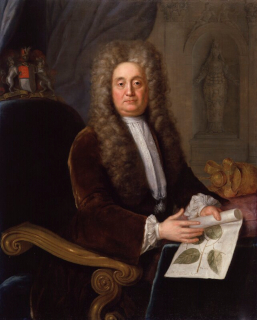
Sir Hans Sloane, Irish physician and naturalist whose collection of books, manuscripts, and curiosities form the basis for the British Museum in London, is born on April 16, 1660, in Killyleagh, County Down in what is now Northern Ireland.

As a child Sloane possesses a strong curiosity of nature, and he develops a particular interest in plants. After studying medicine in London, he travels in France, taking an M.D. degree at the University of Orange in 1683. In 1685 he returns to London and is elected a fellow of the Royal Society. He proceeds to practice medicine as an assistant to British physician Thomas Sydenham. He is made a fellow of the Royal College of Physicians in 1687. That same year he accepts an opportunity to visit Jamaica, traveling as personal physician to the Christopher Monck, 2nd Duke of Albermarle, who had been appointed to govern the island.

The journey to Jamaica provides Sloane with the chance to pursue his interest in the natural sciences. During the 15 months of his travels, he visits multiple islands in the West Indies, including Saint Kitts, Nevis, and Barbados. He ultimately collects specimens of about 800 plants. He also records information on and collects specimens of various fish, mollusks, and insects, and he observes the local peoples and contemplates the natural phenomena of the area. His observations and the specimens he collects during the voyage lay the foundation for his later contributions to botany and zoology and for his role in the formation of the British Museum. He returns to England in 1689, his trip having been cut short by Monck’s death. His collection of plants from the West Indies is one of the first from that region to reach England.

Sloane’s trip to Jamaica also leads to his invention of a milk chocolate beverage. While on the island, he encounters a local drink made from a cacao plant. The beverage apparently makes him nauseous. To avoid this, he decides to mix the cacao material with milk. He finds this concoction to be not only more tolerable but also tasty and healthy. Shortly after his return to England, his milk-based concoction is sold by apothecaries as a medicinal product. His recipe later forms the basis for a milk chocolate product manufactured by Cadbury.

In 1696 Sloane publishes in Latin an elaborate catalogue, Catalogus Plantarum Quae in Insula Jamaica, on the plants he collected in Jamaica. He later publishes Natural History of Jamaica (2 Vol., 1707 and 1725), a comprehensive account of his studies of the natural phenomena of the island country.

Sloane also makes important contributions to medicine. He is physician to Queen Anne, King George I, and King George II. He is created a baronet in 1716, becoming the first medical practitioner to receive a hereditary title. He is relatively progressive as a physician, and, while serving George I, he adopts the practice of inoculation against smallpox for members of the royal family. In 1719 he is elected president of the Royal College of Physicians, a post he serves until 1735. In 1727 he becomes president of the Royal Society, succeeding physicist and mathematician Sir Isaac Newton. He holds the position until 1741. He earns a reputation as a specialist in eye diseases, and he eventually publishes Account of a Medicine for Soreness, Weakness and Other Distempers of the Eyes (1745).

Sloane is also known as an avid collector, and he benefits greatly from the acquisition of the cabinets of other collectors, including amateur scientist William Charleton and English apothecary and botanist James Petiver. When he retires from active work in 1741, his library and cabinet of curiosities has grown to be of unique value, and on his death, he bequeaths his collection to the nation, on condition that parliament pay his executors £20,000. The bequest is accepted and goes to form the collection opened to the public as the British Museum in 1759.

Sloane has no son that survives beyond infancy, and the baronetcy becomes extinct upon his death in London on January 11, 1753.

(From: Encyclopaedia Britannica, http://www.britannica.com/biography/Sir-Hans-Sloane-Baronet/)