seamus dubhghaill

Promoting Irish Culture and History from Little Rock, Arkansas, USA


Leave a comment

Death of Columba, Founder of the Monastery of Iona

Columba (or Colum Cille), Irish abbot and missionary evangelist credited with spreading Christianity in what is today Scotland at the start of the Hiberno-Scottish mission., dies on June 9, 597.

He is born into the Cenél Conaill, a branch of the Northern Uí Néill, then Ireland’s most powerful dynasty. His place of birth is reputedly Gartan in modern day County Donegal, though there is no contemporary evidence for this.

His is the son of Fedlimid, who is said to be a great-grandson of Niall Nóigiallach, and his wife Eithne. The Irish form of his name, Colum Cille, has been taken to mean ‘Dove of the Church’. He is fostered and baptised by a priest named Cruithnechán, who lives near his birthplace. It is reputed that he undergoes schooling in bardic studies. His biographer, Adomnán (c. 624–704), states that he receives monastic training under a bishop whom he names variously as Findbarr or Finnio, who can most likely be identified as Finnian of Movilla. Otherwise little is known of his early life.

Adomnán states that Columba leaves Ireland in his forty-second year. Later tradition records that his departure is an act of penitence for instigating the battle of Cúl Dreimhne in 561, supposedly because he surreptitiously copies a Psalter lent to him by his former master, Finnian. Adomnán simply states, however, that he leaves Ireland to become a “pilgrim for Christ.” He probably also wishes to sever himself from the secular concerns arising from his family connections. Whatever the reason, he remains in Scotland for the rest of his life, returning to Ireland only on a few occasions.

His choice of Iona, an island off the Ross of Mull on the western coast of Scotland, as a monastic refuge is influenced by the contacts that his family has with the kingdom of Dál Riata and its rulers. Certainly it is under Dál Riata patronage that he subsequently founds the island monasteries of Campus Lunge (on Tiree) and Hinba, which more recent opinion takes to have been the island of Colonsay. He also founds churches in Inverness, probably following on his meeting with and likely conversion of Bridei I, king of the Picts. All of Iona’s foundations, on both sides of the Irish Sea, are under the headship of the abbot of the mother-house, and many of the abbots of the most important houses of the paruchia of Iona are of Columba’s kin-group. Although many foundations elsewhere in Scotland and in Northumbria are later attributed to him, it is doubtful whether Iona evangelises outside of Ireland, Dál Riata and Pictland. Yet there can be no doubt of his political influence. He “ordains” Áedán king of Dál Riata, and his influence and connections enable him to strengthen the alliance between the Uí Néill and Dál Riata.

One of the few, if not the only, times he leaves Scotland is toward the end of his life, when he returns to Ireland to found the monastery at Durrow.

According to traditional sources, Columba dies in Iona on Sunday, June 9, 597, and is buried by his monks in the abbey he created. However, Dr. Daniel P. McCarthy disputes this and assigns a date of 593 to Columba’s death. The Annals record the first raid made upon Iona in 795, with further raids occurring in 802, 806 and 825. Columba’s relics are finally removed in 849 and divided between Scotland and Ireland.

Colmcille is one of the three patron saints of Ireland, after Patrick and Brigid of Kildare. He is the patron saint of the city of Derry, where he founded a monastic settlement in c. 540. The Catholic Church of Saint Colmcille’s Long Tower, and the Church of Ireland St. Augustine’s Church both claim to stand at the spot of this original settlement. The Church of Ireland Cathedral, St. Columb’s Cathedral, and the largest park in the city, St. Columb’s Park, are named in his honour. The Catholic Boys’ Grammar School, St. Columb’s College, has him as Patron and namesake.

St. Columba’s National School in Drumcondra is a girls’ school named after the saint.

St. Colmcille’s Primary School and St. Colmcille’s Community School are two schools in Knocklyon, Dublin, named after him, with the former having an annual day dedicated to the saint on June 9.

The town of Swords, Dublin is reputedly founded by Colmcille in 560 AD. St. Colmcille’s Boys’ National School and St. Colmcille’s Girls’ National School, both located in the town of Swords, are also named after the Saint as is one of the local Gaelic teams, Naomh Colmcille.

The Columba Press, a religious and spiritual book company based in Dublin, is named after Colmcille.

Aer Lingus, Ireland’s national flag carrier has named one of its Airbus A330 aircraft in commemoration of the saint (reg: EI-DUO).

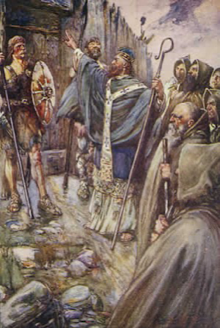
(Pictured: Columba banging on the gate of Bridei, son of Maelchon, King of Fortriu)

Leave a comment

St. Columba Arrives on the Isle of Iona

iona-abbey-isle-of-iona

St. Columba, an Irish monk, and twelve followers arrive on the tiny isle of Iona, barely three miles long by one mile wide, on May 12, 563, establishing a monastic community and building his first Celtic church. Iona has an influence out of all proportion to its size on the establishment of Christianity in Scotland, England and throughout mainland Europe.

Once settled, Columba sets about converting most of pagan Scotland and northern England to the Christian faith. Iona’s fame as a missionary centre and outstanding place of learning eventually spreads throughout Europe, turning it into a place of pilgrimage for several centuries to come. Iona becomes a sacred isle where kings of Scotland, Ireland and Norway are buried.

Columba is born of royal blood in 521 AD in Ireland, or Scotia as it is then called. He is the grandson of the Irish King Niall. He leaves Ireland for Scotland not as a missionary but as an act of self-imposed penance for a bloody mess he had caused at home. He had upset the king of Ireland by refusing to hand over a copy of the Gospel he had illegally copied, leading to a pitched battle in which Columba’s warrior family prevailed. Full of remorse for his actions and the deaths he had ultimately caused, he flees, ultimately settling on Iona as it is the first place he finds from which he is unable to see his native Ireland. One of the features on the island is even called “The Hill with its back to Ireland.”

Columba, however, is not the shy retiring type and sets about building Iona’s original abbey from clay and wood. In this endeavour he displays some strange idiosyncrasies, including banishing women and cows from the island. The abbey builders have to leave their wives and daughters on the nearby Eilean nam Ban (Woman’s Island). Stranger still, he also banishes frogs and snakes from Iona, although how he accomplishes this feat is not well documented.

The strangest claim of all however is that Columba is prevented from completing the building of the original chapel until a living person has been buried in the foundations. His friend Oran volunteers for the job and is duly buried. It is said that Columba later requests that Oran’s face be uncovered so he can bid a final farewell to his friend. Oran’s face is uncovered and he is found to be still alive but utters such blasphemous descriptions of Heaven and Hell that Columba orders that he be covered up immediately.

Over the centuries the monks of Iona produce countless elaborate carvings, manuscripts and Celtic crosses. Perhaps their greatest work is the exquisite Book of Kells, which dates from 800 AD, currently on display in Trinity College, Dublin. Shortly after this, in 806 AD, come the first of the Viking raids and many of the monks are slaughtered and their work destroyed.

The Celtic Church, lacking central control and organisation, diminishes in size and stature over the years to be replaced by the much larger and stronger Roman Church. Even Iona is not exempt from these changes and in 1203 a nunnery for the Order of the Black Nuns is established and the present-day Benedictine abbey, Iona Abbey, is built. The abbey is a victim of the Reformation and lay in ruins until 1899 when restoration is started.

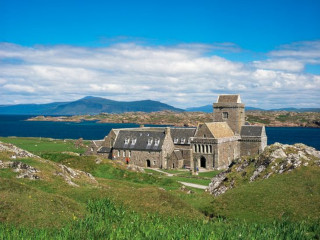
No part of Columba’s original buildings have survived, however on the left hand side of the abbey entrance can be seen a small roofed chamber which is claimed to mark the site of the Columba’s tomb.

(From: “St. Columba and the Isle of Iona” by Ben Johnson, historic-uk.com, pictured is the Iona Abbey and Nunnery)


Leave a comment

Death of Vergilius of Salzburg, Churchman & Astronomer

virgilius-of-salzburg

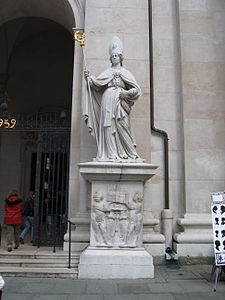
Vergilius of Salzburg, also known as Virgilius, Feirgil or Fergal, Irish churchman and early astronomer, dies on November 27, 784, in Salzburg, Austria. He serves as abbot of Aghaboe, bishop of Ossory and bishop of Salzburg. He is called “the Apostle of Carinthia” and “the geometer.”

He originates from a noble family of Ireland, where his name is Feirgil, and is said to have been a descendant of Niall of the Nine Hostages. Feirgil is likely educated at the Iona monastery.

In the Annals of the Four Masters and the Annals of Ulster he is mentioned as Abbot of Aghaboe, in County Laois, where he is known as “the Geometer” because of his knowledge of mathematics.

Around 745 Vergilius leaves Ireland, intending to visit the Holy land but, like many of his countrymen who seem to have adopted this practice as a work of piety, he settles down in France, where he is received with great favour by Pepin the Short, who is then Mayor of the Palace under Childeric III of Franconia. He serves as an adviser to Pepin. He probably uses a copy of the Collectio canonum Hibernensis, an Irish collection of canon law, to advise him to receive royal unction in 751, to assist his recognition as king Pippin III after the deposition of Childeric. After spending two years at Cressy, near Compiègne, he goes to Bavaria, at the invitation of Duke Odilo, where he founds the monastery of Chiemsee, and within a year or two is made Abbot of St. Peter’s at Salzburg. Among his notable accomplishments is the conversion of the Alpine Slavs and the dispatching of missionaries to Hungary.

While Abbot of St. Peter’s, Vergilius comes into collision with Saint Boniface. A priest, through ignorance, confers the Sacrament of Baptism using, in place of the correct formula, the words “Baptizo te in nomine patria et filia et spiritu sancta.” Vergilius holds that the sacrament has been validly conferred, but Boniface complains to Pope Zachary. The latter, however, decides in favour of Vergilius. Later on, Boniface accuses Vergilius of spreading discord between himself and Duke Odilo of Bavaria and of teaching a doctrine in regard to the rotundity of the earth, which is “contrary to the Scriptures.” Pope Zachary’s decision in this case is that “if it shall be clearly established that he professes belief in another world and other people existing beneath the earth, or in another sun and moon there, thou art to hold a council, and deprive him of his sacerdotal rank, and expel him from the church.”

Unfortunately, we no longer possess the treatise in which Vergilius expounds his doctrine. Two things, however, are certain: first, that there is involved the problem of original sin and the universality of redemption; secondly, that Vergilius succeeds in freeing himself from the charge of teaching a doctrine contrary to Scripture. It is likely that Boniface, already biased against Vergilius because of the preceding case, misunderstands him, taking it for granted, perhaps, that if there are antipodes, the “other race of men” are not descendants of Adam and are not redeemed by Christ.

After the martyrdom of Boniface, Vergilius is made Bishop of Salzburg in 766 or 767. Until his death in 784, he labours successfully for the upbuilding of his diocese as well as for the spread of Christianity in neighbouring heathen countries, especially in Carinthia.

Vergilius is venerated as a saint in the Orthodox Church and the Roman Catholic Church. In 1233 he is formally canonized by Pope Gregory IX. Aside from being personally associated with Abbey of Aghaboe and Salzburg Cathedral, a number of parishes around the world are dedicated to him, mostly being founded by small populations of far-flung Irish Catholics, like himself. There is a church still bearing his name dedicated to him in Broad Channel, Queens, New York. A parish in Morris Plains, New Jersey is also dedicated to him.