seamus dubhghaill

Promoting Irish Culture and History from Little Rock, Arkansas, USA


Leave a comment

Death of Columba, Founder of the Monastery of Iona

Columba (or Colum Cille), Irish abbot and missionary evangelist credited with spreading Christianity in what is today Scotland at the start of the Hiberno-Scottish mission., dies on June 9, 597.

He is born into the Cenél Conaill, a branch of the Northern Uí Néill, then Ireland’s most powerful dynasty. His place of birth is reputedly Gartan in modern day County Donegal, though there is no contemporary evidence for this.

His is the son of Fedlimid, who is said to be a great-grandson of Niall Nóigiallach, and his wife Eithne. The Irish form of his name, Colum Cille, has been taken to mean ‘Dove of the Church’. He is fostered and baptised by a priest named Cruithnechán, who lives near his birthplace. It is reputed that he undergoes schooling in bardic studies. His biographer, Adomnán (c. 624–704), states that he receives monastic training under a bishop whom he names variously as Findbarr or Finnio, who can most likely be identified as Finnian of Movilla. Otherwise little is known of his early life.

Adomnán states that Columba leaves Ireland in his forty-second year. Later tradition records that his departure is an act of penitence for instigating the battle of Cúl Dreimhne in 561, supposedly because he surreptitiously copies a Psalter lent to him by his former master, Finnian. Adomnán simply states, however, that he leaves Ireland to become a “pilgrim for Christ.” He probably also wishes to sever himself from the secular concerns arising from his family connections. Whatever the reason, he remains in Scotland for the rest of his life, returning to Ireland only on a few occasions.

His choice of Iona, an island off the Ross of Mull on the western coast of Scotland, as a monastic refuge is influenced by the contacts that his family has with the kingdom of Dál Riata and its rulers. Certainly it is under Dál Riata patronage that he subsequently founds the island monasteries of Campus Lunge (on Tiree) and Hinba, which more recent opinion takes to have been the island of Colonsay. He also founds churches in Inverness, probably following on his meeting with and likely conversion of Bridei I, king of the Picts. All of Iona’s foundations, on both sides of the Irish Sea, are under the headship of the abbot of the mother-house, and many of the abbots of the most important houses of the paruchia of Iona are of Columba’s kin-group. Although many foundations elsewhere in Scotland and in Northumbria are later attributed to him, it is doubtful whether Iona evangelises outside of Ireland, Dál Riata and Pictland. Yet there can be no doubt of his political influence. He “ordains” Áedán king of Dál Riata, and his influence and connections enable him to strengthen the alliance between the Uí Néill and Dál Riata.

One of the few, if not the only, times he leaves Scotland is toward the end of his life, when he returns to Ireland to found the monastery at Durrow.

According to traditional sources, Columba dies in Iona on Sunday, June 9, 597, and is buried by his monks in the abbey he created. However, Dr. Daniel P. McCarthy disputes this and assigns a date of 593 to Columba’s death. The Annals record the first raid made upon Iona in 795, with further raids occurring in 802, 806 and 825. Columba’s relics are finally removed in 849 and divided between Scotland and Ireland.

Colmcille is one of the three patron saints of Ireland, after Patrick and Brigid of Kildare. He is the patron saint of the city of Derry, where he founded a monastic settlement in c. 540. The Catholic Church of Saint Colmcille’s Long Tower, and the Church of Ireland St. Augustine’s Church both claim to stand at the spot of this original settlement. The Church of Ireland Cathedral, St. Columb’s Cathedral, and the largest park in the city, St. Columb’s Park, are named in his honour. The Catholic Boys’ Grammar School, St. Columb’s College, has him as Patron and namesake.

St. Columba’s National School in Drumcondra is a girls’ school named after the saint.

St. Colmcille’s Primary School and St. Colmcille’s Community School are two schools in Knocklyon, Dublin, named after him, with the former having an annual day dedicated to the saint on June 9.

The town of Swords, Dublin is reputedly founded by Colmcille in 560 AD. St. Colmcille’s Boys’ National School and St. Colmcille’s Girls’ National School, both located in the town of Swords, are also named after the Saint as is one of the local Gaelic teams, Naomh Colmcille.

The Columba Press, a religious and spiritual book company based in Dublin, is named after Colmcille.

Aer Lingus, Ireland’s national flag carrier has named one of its Airbus A330 aircraft in commemoration of the saint (reg: EI-DUO).

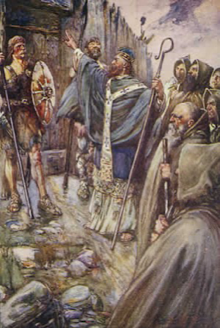
(Pictured: Columba banging on the gate of Bridei, son of Maelchon, King of Fortriu)


Leave a comment

Death of Sir Charles Algernon Parsons, Anglo-Irish Engineer & Scientist

Sir Charles Algernon Parsons, Anglo-Irish engineer and scientist best known for his invention of the compound steam turbine, dies on February 11, 1931, on board the steamship Duchess of Richmond while on a cruise with his wife.

Parsons is born in London on June 13, 1854, the youngest among eleven children of the famous astronomer William Parsons, 3rd Earl of Rosse, of Parsonstown (now Birr), King’s County (now County Offaly) and Mary Parsons (née Field), a Yorkshire heiress. Only four sons survive to adulthood. He is strongly influenced by his father, who encourages him to use the workshops at the Birr Castle observatory, and he is tutored at home by some of the assistant astronomers before entering Trinity College Dublin in 1871. He transfers to St. John’s College, Cambridge, and upon graduation in 1877 as eleventh wrangler in a class of thirty-six studying mathematics, he takes the unusual step for the son of an earl, of becoming a premium apprentice at the Elswick Engine and Ordnance Works of Sir William George Armstrong at Newcastle upon Tyne. In the period following this he develops a unique high-speed steam engine, and a torpedo which is powered by a gas turbine. He joins Clarke Chapman at Gateshead as a partner in 1884. In a matter of months he files patents for the world’s first effective steam turbine. These embody many novelties, but the key feature is an electricity generator rated at 6 kW and designed to run, directly coupled, at the astonishing speed of 18,000 rpm.

Parsons is not satisfied that his partners’ efforts to promote turbine development are sufficiently aggressive, and in 1889 he leaves to establish his own company, C. A. Parsons & Company, at Heaton near Newcastle upon Tyne. The price of this impetuous action is the loss of access to his original patents. He quickly establishes alternative designs and by 1892 he has built a turbo-alternator with an output of 100 kW for the Cambridge Electricity Company. Exhausting to a condenser, it has a steam consumption comparable with the best steam engines. Even his 1884 patents envisage applying turbines to marine propulsion, but it is 1893 before he can embark on the design of a suitable demonstration boat of 40 tons. By using careful tests on models, he perfects the hull shape and predicts the power requirements. At this time he recovers his 1884 patents and even wins the very rare prize of an extension for five years, which is a measure of the perceived national importance of his invention.

A syndicate is formed to raise the capital necessary to build Parsons’s turbine-powered vessel Turbinia. At the Spithead Fleet Review in 1897 she speeds among the ships of the world’s navies at 34.5 knots. In 1905 the Royal Navy decides to adopt turbines for its future warships. This example is followed by navies worldwide, from the United States to Japan. Builders of mercantile vessels follow quickly and the turbines of the Cunard liner RMS Mauretania (1906), each developing 26,000 kW, are the largest in existence at the time. The Mauretania holds the Blue Riband for the speediest Atlantic crossing until 1929, a fact that keeps Parsons’s name before the public.

The firm of C. A. Parsons (1889), which builds turbines for use on land, is privately owned, but the Parsons Marine Steam Turbine Company (1897) is a public company. Parsons also earns income from over 300 patents through the Parsons Foreign Patents Co. (1899). He readily licenses others to use his patents but he avoides costly litigation, the ruin of many inventors.

Parsons inherits an interest in optical instruments from his father. In 1890 he develops a cost-effective method for manufacturing searchlight mirrors, using sheets of plate glass and an iron mold heated in a gas furnace. During World War I he supplies most of the national requirements. In 1921 he acquires the optical instrument manufacturers Ross Ltd. and the Derby Crown Glass Company, makers of optical quality glass. In 1925 the firm of Howard Grubb, which makes large optical telescopes, is rescued from insolvency by Parsons. He believes that it is of national importance to maintain the industrial capacity to make optical equipment. Not all of his projects are commercially profitable, as for example his acoustic amplifier, dubbed the “Auxetophone,” or his attempts at synthesising diamonds, which absorbs much time and effort. In the development of his many inventions, he displays great tenacity in the face of reverses and always employs a meticulously scientific approach.

The supply of power on a large scale is revolutionised by the steam turbine. During the twenty years following the building of his first turbogenerator, Parsons remains at the forefront of promoting, building, and selling ever larger and more efficient turbines. He is not only a scientific engineer and inventor, but also a successful manufacturer and businessman. Modest and retiring in manner, his chief weakness lay in a lack of skill in managing interpersonal relationships, though this is compensated to a large extent by his integrity and loyalty. He seeks out the ablest men to run his businesses, among them several Fellows of the Royal Society (FRS). He is elected FRS himself in 1898 and is knighted in 1911. In 1927 he becomes the first engineer to be awarded the Order of Merit for his outstanding contributions to society. He is honoured by many universities and institutions in Europe and the United States.

Parsons marries Katharine Bethell, a Yorkshire woman, in 1883. They have one daughter and a son who dies on active service in 1918. He keeps a residence in London and in Northumbria.

Parsons dies on February 11, 1931, on board the steamship Duchess of Richmond while on a cruise with his wife. The cause of death is given as neuritis. A memorial service is held at Westminster Abbey on March 3, 1931. He is buried in the parish church of St. Bartholomew’s in Kirkwhelpington in Northumberland. His estate is valued at £1,214,355 gross.

A portrait of Parsons, painted by Maurice Codner, hangs in the Institution of Mechanical Engineers, London. There is also a portrait by Sir William Orpen in the Laing Art Gallery, Newcastle upon Tyne, and a portrait by Walter Stoneman in the National Portrait Gallery, London.

(From: “Parsons, Sir Charles Algernon” by W. Garrett Scaife, Dictionary of Irish Biography, http://www.dib.ie, October 2009)