seamus dubhghaill

Promoting Irish Culture and History from Little Rock, Arkansas, USA


Leave a comment

Commissioning of the USS Juneau

USS Juneau (CL-52), a United States Navy Atlanta-class light cruiser, is commissioned on February 14, 1942, with Captain Lyman Knute Swenson in command. The ship becomes horribly famous as the vessel which carries the five Irish American Sullivan brothers to their death on November 13, 1942, after it is hit by a Japanese torpedo at the Battle of Guadalcanal.

The USS Juneau is laid down by Federal Shipbuilding and Drydock Company, Kearny, New Jersey, on May 27, 1940, and launched on October 25, 1941, sponsored by Mrs. Harry I. Lucas, wife of the mayor of the city of Juneau, Alaska.

After a hurried shakedown cruise along the Atlantic Coast in the spring of 1942, USS Juneau assumes blockade patrol in early May off Martinique and the Guadeloupe archipelago to prevent the escape of Vichy French naval units. She returns to New York to complete alterations and operates in the North Atlantic and Caribbean from June 1 to August 12 on patrol and escort duties. The cruiser departs for the Pacific Theater on August 22.

On 8 November, USS Juneau departs Nouméa, New Caledonia, as a unit of Task Force 67 under the command of Rear Admiral Richmond K. Turner to escort reinforcements to Guadalcanal. The force arrives there on the morning of November 12, and USS Juneau takes up her station in the protective screen around the transports and cargo vessels. Unloading proceeds unmolested until 14:05, when 30 Japanese planes attack the alerted United States group. The anti-aircraft fire is effective, and the USS Juneau alone accounts for six enemy torpedo bombers shot down. The few remaining Japanese planes are, in turn, attacked by American fighters with only one bomber escaping. Later in the day, an American attack group of cruisers and destroyers clears Guadalcanal on reports that a large enemy surface force is headed for the island. At 01:48 on November 13, Rear Admiral Daniel J. Callaghan‘s relatively small landing support group engages the enemy. The Japanese force consists of two battleships, one light cruiser, and nine destroyers.

Because of bad weather and confused communications, the battle occurs in near-pitch darkness and at almost point-blank range, as the ships of the two sides become intermingled. During the melee, the USS Juneau is struck on the port side by a torpedo launched by Japanese destroyer Amatsukaze, causing a severe list, and necessitating withdrawal. Before noon on November 13, USS Juneau, along with two other cruisers damaged in the battle, USS Helena (CL-50) and USS San Francisco (CA-38), head toward Espiritu Santo for repairs. USS Juneau is steaming on one screw, keeping station 800 yards off the starboard quarter of the likewise severely damaged USS San Francisco. She is down 12 feet by the bow, but able to maintain 13 knots.

A few minutes after 11:00, two torpedoes are launched from Japanese submarine I-26. These are intended for USS San Francisco, but both pass ahead of her. One strikes USS Juneau in the same place that had been hit during the battle. There is a great explosion, and USS Juneau breaks in two and disappears in just 20 seconds. Fearing more attacks from I-26, and wrongly assuming from the massive explosion that there are no survivors, USS Helena and USS San Francisco depart without attempting to rescue any survivors. In fact, more than 100 sailors survive the sinking of USS Juneau. They are left to fend for themselves in the open ocean for eight days before rescue aircraft belatedly arrive. While awaiting rescue, all but ten die from the elements and shark attacks. Among those lost are the five Sullivan brothers. Two of the brothers apparently survive the sinking, only to die in the water. Two presumably go down with the ship. Some reports indicate the fifth brother also survives the sinking but disappears during the first night when he leaves a raft and gets into the water. On November 20, 1942, USS Ballard (DD-267) recovers two of the ten survivors. Five more in a raft are rescued by a PBY Seaplane five miles away. Three others, including a badly wounded officer, make it to San Cristobal (now Makira) Island, about 55 miles away from the sinking. One of the survivors recovered by USS Ballard says he had been with one of the Sullivan brothers for several days after the sinking.

As a direct result of the Sullivans’ deaths (and the deaths of four of the Borgstrom brothers within a few months of each other two years later), the United States Department of War adopts the Sole Survivor Policy, a set of regulations, partially stipulated by law, that are designed to protect members of a family from the draft during peacetime, or from hazardous duty or other circumstances, if they have already lost family members to military service.

To honor the five Sullivan brothers, who all died in the sinking, and the USS Juneau, the United States Navy later commissions two ships named USS The Sullivans, and two ships named USS Juneau. On March 17, 2018, the wreck of USS Juneau is located by Paul Allen‘s research crew on board RV Petrel at a depth of about 13,800 feet off the coast of the Solomon Islands in several large pieces.

Leave a comment

Death of Author Abraham “Bram” Stoker

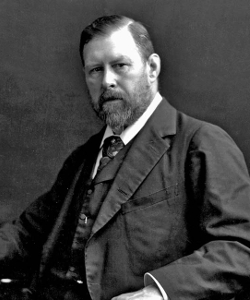
Abraham “Bram” Stoker, Irish author best known today for his 1897 Gothic fiction novel Dracula, dies in London on April 20, 1912.

Stoker is born on November 8, 1847, in Clontarf, Dublin. During his lifetime, he is better known as the personal assistant of actor Henry Irving and business manager of the Lyceum Theatre, London, which Irving owns.

Stoker’s father, Abraham Stoker, is a civil servant and his mother, Charlotte Mathilda Blake Thornley, is a charity worker and writer. Stoker is a sickly child and is bedridden with an unknown illness until he starts school at the age of seven, when he makes a complete recovery. Growing up his mother tells him a lot of horror stories which may have influence on his later writings.

In 1864 Stoker enters Trinity College, Dublin. While attending college he begins working as an Irish civil servant. He also works part time as a free lance journalist and drama critic. In 1876 he meets Henry Irving, a famous actor, and they soon become friends. Not long after that, Stoker meets and falls in love with an aspiring actress named Florence Balcombe whom he marries on December 4, 1878 at St. Anne’s Parish Church, Dublin. In 1878 he accepts a job working in London as Irving’s personal secretary.

On December 9, Stoker and his new wife move to England to join Irving. His first book The Duties of Clerks of Petty Sessions in Ireland, though written while he is still in Dublin, is published in 1879. On December 30, 1879 Stoker and his wife have their only child, a son Noel. While in England Stoker also writes several novels and short stories. His first book of fiction, Under the Sunset, is published in 1881.

Stoker visits the English coastal town of Whitby in 1890, a visit that is said to be part of the inspiration for Dracula. Before writing Dracula, he meets Ármin Vámbéry, a Hungarian writer and traveler. Dracula likely emerges from Vámbéry’s dark stories of the Carpathian Mountains. Stoker then spends several years researching European folklore and mythological stories of vampires.

Dracula is an epistolary novel, written as a collection of realistic but completely fictional diary entries, telegrams, letters, ship’s logs, and newspaper clippings, all of which add a level of detailed realism to the story, a skill which Stoker develops as a newspaper writer. At the time of its publication, Dracula is considered a “straightforward horror novel” based on imaginary creations of supernatural life.

The original 541-page typescript of Dracula is believed to have been lost until it is found in a barn in northwestern Pennsylvania in the early 1980s. It consists of typed sheets with many emendations, plus handwritten on the title page is “THE UN-DEAD.” The author’s name is shown at the bottom as Bram Stoker. The typescript is purchased by Microsoft co-founder Paul Allen.

After suffering a number of strokes, Abraham “Bram” Stoker dies at No. 26 St. George’s Square, London on April 20, 1912. Some biographers attribute the cause of death to tertiary syphilis, others to overwork. He is cremated and his ashes are placed in a display urn at Golders Green Crematorium in north London.


Leave a comment

Birth of Irish Author Abraham “Bram” Stoker

Abraham “Bram” Stoker, Irish author best known today for his 1897 Gothic fiction novel Dracula, is born on November 8, 1847 in Clontarf, Dublin. During his lifetime, he is better known as the personal assistant of actor Henry Irving and business manager of the Lyceum Theatre, London, which Irving owns.

Stoker’s father, Abraham Stoker, is a civil servant and his mother, Charlotte Mathilda Blake Thornley, is a charity worker and writer. Stoker is a sickly child and is bedridden with an unknown illness until he starts school at the age of seven, when he makes a complete recovery. Growing up his mother tells him a lot of horror stories which may have influence on his later writings.

In 1864 Stoker enters Trinity College, Dublin. While attending college he begins working as an Irish civil servant. He also works part time as a free lance journalist and drama critic. In 1876 he meets Henry Irving, a famous actor, and they soon become friends. Not long after that, Stoker meets and falls in love with an aspiring actress named Florence Balcombe whom he marries on December 4, 1878 at St. Anne’s Parish Church, Dublin. In 1878 he accepts a job working in London as Irving’s personal secretary.

On December 9, Stoker and his new wife move to England to join Irving. His first book The Duties of Clerks of Petty Sessions in Ireland though written while he is still in Dublin, is published in 1879. On December 30, 1879 Stoker and his wife have their only child, a son Noel. While in England Stoker also writes several novels and short stories. His first book of fiction, Under the Sunset, is published in 1881.

Stoker visits the English coastal town of Whitby in 1890, a visit that is said to be part of the inspiration for Dracula. Before writing Dracula, he meets Ármin Vámbéry, a Hungarian writer and traveller. Dracula likely emerges from Vámbéry’s dark stories of the Carpathian Mountains. Stoker then spends several years researching European folklore and mythological stories of vampires.

Dracula is an epistolary novel, written as a collection of realistic but completely fictional diary entries, telegrams, letters, ship’s logs, and newspaper clippings, all of which add a level of detailed realism to the story, a skill which Stoker develops as a newspaper writer. At the time of its publication, Dracula is considered a “straightforward horror novel” based on imaginary creations of supernatural life.

The original 541-page typescript of Dracula is believed to have been lost until it is found in a barn in northwestern Pennsylvania in the early 1980s. It consists of typed sheets with many emendations, plus handwritten on the title page is “THE UN-DEAD.” The author’s name is shown at the bottom as Bram Stoker. The typescript is purchased by Microsoft co-founder Paul Allen.

After suffering a number of strokes, Abraham “Bram” Stoker dies at No. 26 St. George’s Square, London on April 20, 1912. Some biographers attribute the cause of death to tertiary syphilis, others to overwork. He is cremated and his ashes are placed in a display urn at Golders Green Crematorium in north London.