seamus dubhghaill

Promoting Irish Culture and History from Little Rock, Arkansas, USA


1 Comment

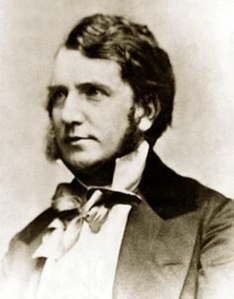
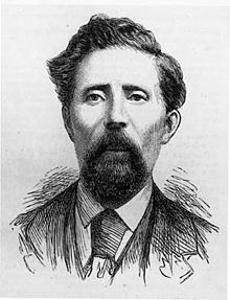
Fenian James Carey Killed by Patrick O’Donnell

james-carey

James Carey, a Fenian and informer most notable for his involvement in the Phoenix Park Murders, is shot and killed by Patrick O’Donnell aboard the Melrose on July 29, 1883.

Carey is born in James Street, Dublin, in 1845. He becomes a bricklayer and builder as well as the leading spokesman of his trade and obtains several large building contracts. During this period Carey is engaged in an Irish nationalist conspiracy, but to outward appearance he is one of the rising men of Dublin. He is involved in religious and other societies, and at one time is spoken of as a possible lord mayor. In 1882 he is elected a town councillor.

About 1861 Carey joins the Irish Republican Brotherhood, soon becoming treasurer. In 1881 he breaks with the IRB and forms a new group which assumes the title of the Irish National Invincibles and establishes their headquarters in Dublin. Carey takes an oath as one of the leaders. The object of the Invincibles is to remove all “tyrants” from the country.

The secret head of the Invincibles, known as No. 1, gives orders to kill Thomas Henry Burke, the under-secretary to the lord-lieutenant. On May 6, 1882, nine of the conspirators proceed to the Phoenix Park where Carey, while sitting on a jaunting-car, points out Burke to the others. At once they attack and kill him with knives and, at the same time, also kill Lord Frederick Cavendish, the newly appointed chief secretary, who happens to be walking with Burke.

For a long time no clue can be found to identify the perpetrators of the act. However, on January 13, 1883, Carey is arrested and, along with sixteen other people, charged with a conspiracy to murder public officials. On February 13, Carey turns queen’s evidence, betraying the complete details of the Invincibles and of the murders in the Phoenix Park. His evidence, along with that of getaway driver Michael Kavanagh, results in the execution of five of his associates by hanging.

His life being in great danger, he is secretly put onboard the Kinfauns Castle with his wife and family, which sails for the Cape on July 6. Carey travels under the name of Power. Aboard the same ship is Patrick O’Donnell, a bricklayer. Not knowing his true identity, O’Donnell becomes friendly with Carey. After stopping off in Cape Town, he is informed by chance of Carey’s real identity. He continues with Carey on board the Melrose for the voyage from Cape Town to Natal. On July 29, 1883, when the vessel is twelve miles off Cape Vaccas, O’Donnell uses a pistol he has in his luggage to shoot Carey dead.

O’Donnell is brought to England and is tried for murder. After being found guilty, he is executed on December 17 at Newgate.

Leave a comment

German Bombing of North Strand, Dublin

north-strand-bombing

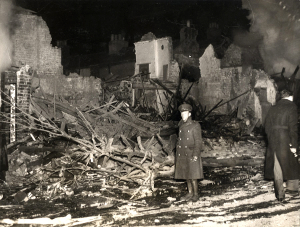
Four German bombs are dropped on north Dublin at approximately 2:00 AM on May 31, 1941. One bomb falls in the Ballybough area, demolishing the two houses at 43 and 44 Summerhill Park, injuring many but with no loss of life. A second bomb falls at the Dog Pond pumping works near the zoo in Phoenix Park, again with no casualties but damaging Áras an Uachtaráin, the official residence of the Irish President. A third bomb makes a large crater in the North Circular Road near Summerhill, again causing no injuries. A fourth bomb falls in North Strand destroying seventeen houses and severely damaging about fifty others, the worst damage occurring in the area between Seville Place and Newcomen Bridge. The raid claims the lives of 28 people, injures 90, destroys or damages approximately 300 houses, and leaves 400 people homeless.

The first bombing of Dublin during World War II occurs early on the morning of January 2, 1941, when German bombs are dropped on the Terenure area of south Dublin. This is followed, early on the following morning of January 3, 1941, by further German bombing of houses on Donore Terrace in the South Circular Road area of south Dublin. A number of people are injured, but no one is killed in these bombings.

After the war, what becomes West Germany accepts responsibility for the raid, and by 1958 it has paid compensation of £327,000. Over 2,000 claims for compensation are processed by the Irish government, eventually costing £344,000. East Germany and Austria, which are both part of Nazi Germany in 1941, make no contribution. The amounts are fixed after the 1953 London Agreement on German External Debts, allowing maximum compensation.

Several reasons for the raid have been asserted over time. German Radio, operated by the Ministry of Public Enlightenment and Propaganda, broadcasts that “it is impossible that the Germans bombed Dublin intentionally.” Irish airspace has been violated repeatedly, and both Allied and German airmen are being interned at the Curragh Camp. A possible cause is a navigational error or a mistaken target, as one of the pathfinders on the raid later recounts. Numerous large cities in the United Kingdom are targeted for bombing, including Belfast, which like Dublin, is across the Irish Sea from Great Britain. War-time Germany’s acceptance of responsibility and post-war Germany’s payment of compensation are cited as further indications that the causation is error on the part of the Luftwaffe pilots.

Another possible reason is that in April 1941, Germany has launched the Belfast blitz, which results in Belfast being heavily bombed. In response, Ireland sends rescue, fire, and emergency personnel to Belfast to assist the city. Éamon de Valera, the Taoiseach, formally protests the bombing to the German government, as well as making his famous “they are our people” speech. Some contend that the raid serves as a warning to Ireland to keep out of the war. This contention is given added credibility when Colonel Edward Flynn, second cousin of Ireland’s Minister for Coordination of Defensive Measures, recalls that Lord Haw Haw has warned Ireland that Dublin’s Amiens Street Railway Station, where a stream of refugees from Belfast is arriving, will be bombed. The station, now called Connolly Station, stands a few hundred metres from North Strand Road, where the bombing damage is heaviest. Flynn similarly contends that the German bombing of Dundalk on July 4 is also a pre-warning by Lord Haw Haw as a punishment for Dundalk being the point of shipment of Irish cattle sold to the United Kingdom.


Leave a comment

The Phoenix Park Murders

phoenix-park-murders

Lord Frederick Cavendish, newly appointed Chief Secretary for Ireland, and Thomas Henry Burke, the Permanent Undersecretary, are fatally stabbed in Phoenix Park, Dublin, on May 6, 1882 in what becomes known as the Phoenix Park Murders.

Cavendish, who is married to Lucy Cavendish, the niece of British Prime Minister William Ewart Gladstone, and has worked as Gladstone’s personal secretary, arrives in Ireland on the day he is murdered. Cavendish and Burke are attacked as they walk to the Viceregal Lodge, which is the out-of-season residence of the Lord Lieutenant of Ireland. Thomas Myles, resident surgeon at nearby Dr. Steevens’ Hospital, is summoned to render medical assistance to the victims. The then Lord Lieutenant, Lord Spencer, describes suddenly hearing screams, before witnessing a man running to the Lodge grounds shouting “Lord Frederick Cavendish and Mr. Burke are killed.” Responsibility for the assassinations is claimed by a small hitherto unheard-of Republican organisation called the Irish National Invincibles.

The hunt for the perpetrators is led by Superintendent John Mallon, a Catholic man from Armagh. Mallon has a pretty shrewd idea of who has committed the crime and suspects a number of former Fenian activists. A large number of suspects are arrested and kept in prison by claiming they are connected with other crimes. By playing one suspect against another, Mallon gets several of them to reveal what they know.

James Carey, leader of The Invincibles, Michael Kavanagh, and Joe Hanlon agree to testify against the others. Joe Brady, Michael Fagan, Thomas Caffrey, Dan Curley, and Tim Kelly are convicted of the murders and all are hanged by William Marwood in Kilmainham Gaol in Dublin between May 14 and June 9, 1883. Others, convicted as accessories to the crime, are sentenced to long prison terms. The getaway driver, James Fitzharris, is acquitted of murder but is retried as an accessory and convicted.

Only the case of Tim Kelly gives any real difficulty as he is only nineteen and generally said to look much younger. By referring to him as “a child” his defence counsel creates enough unease for two juries to disagree. He is found guilty only after an unprecedented third trial.

Charles Stewart Parnell makes a speech condemning the murders in 1882, which increases his already huge popularity in both Britain and Ireland. He has just enabled some reforms under the Kilmainham Treaty four days prior to the murders. Parnell’s reputation increases in Ireland, being seen as a more moderate reformer who would never excuse such tactics.

However, Parnell’s policy of allying his party to Gladstone’s Liberal Party in 1886 to enable Home Rule is also ultimately defeated by the murders. Gladstone’s Minister, Lord Hartington, is the elder brother of Lord Frederick Cavendish. Infuriated by the manner of his brother’s early death, Hartington splits with Gladstone on the Home Rule bills of 1886 and 1893 and leads the breakaway Liberal Unionist Association which allies itself to Lord Salisbury‘s conservative governments. In the ensuing 1886 general election, the Conservatives and Liberal Unionists sweep the board. This delays Home Rule by twenty-eight years, when the Third Irish Home Rule Bill is passed in 1914 but never effected.

In March 1887, The Times prints letters purportedly from Parnell claiming sympathy with the murderers and that his public denunciation of them was insincere. It emerges that the letters are forgeries written by journalist Richard Pigott. Parnell is personally vindicated by the Parnell Commission in 1888–89.


Leave a comment

An Garda Síochána na h-Eireann is Formed

An Garda Síochána na h-Eireann (Guardians of the Peace of Ireland), the police force of Ireland more commonly referred to as the Gardaí or “the guards,” is formed on February 21, 1922. The service, originally named the Civic Guard and headquartered in Dublin’s Phoenix Park, is headed by the Garda Commissioner who is appointed by the Irish government.

The Civic Guard is formed by the Provisional Government in February 1922 to take over the responsibility of policing the fledgling Irish Free State. It replaces the Royal Irish Constabulary (RIC) and the Irish Republican Police of 1919–22. In August 1922, the force accompanies Michael Collins when he meets the Lord Lieutenant in Dublin Castle.

The Garda Síochána (Temporary Provisions) Act 1923, enacted after the creation of the Irish Free State on August 8, 1923, provides for the creation of “a force of police to be called and known as ‘The Garda Síochána.'” Under section 22, the Civic Guard are deemed to have been established under and are to be governed by the Act. The law therefore effectively renames the existing force.

While most recruits to the Garda come from the ranks of the Irish Republican Army, which had fought against the RIC, about one hundred ex-RIC men become part of the new force. Problems become apparent when some recruits do not conceal their dislike of the ex-RIC instructors and refused to salute them. On May 15, 1922, over 1,200 recruits break ranks during Morning Parade, seize the armoury, and take over the Kildare Depot. Negotiations between the mutineers and the Provisional Government of Ireland over control of the force lasts seven weeks, during which time the Irish Civil War has begun. Commissioner Michael Staines resigns in September and is replaced by Eoin O’Duffy.

During the Irish Civil War, the new Free State sets up the Criminal Investigation Department as an armed, plain-clothed, counter-insurgency unit. It is disbanded after the end of the war in October 1923 and elements of it are absorbed into the Dublin Metropolitan Police, which was founded in 1836.

In Dublin, policing remains the responsibility of the Dublin Metropolitan Police until it merges with the Garda Síochána in 1925. Since then the Garda has been the only civil police force in the state now known as Ireland. Other police forces with limited powers are the Military Police within the Irish Defence Forces, the Airport Police Service, and Dublin Port and Dún Laoghaire Harbour police forces.

The Garda medal of honour, the Scott Medal, An Garda Síochána’s highest honour, is named after Colonel Walter Scott, the American philanthropist that endowed the fund for the original medals.


Leave a comment

Novelist Joseph Sheridan Le Fanu Dies In Dublin

joseph-sheridan-le-fanu

Joseph Thomas Sheridan Le Fanu, journalist, novelist, and short story writer, often called the father of the modern ghost story, dies in Dublin on February 7, 1873. He is the leading ghost-story writer of the nineteenth century and is central to the development of the genre in the Victorian era. His best-known works include Uncle Silas (1864), a suspense story, and The House by the Churchyard (1863), a murder mystery. His vampire story Carmilla, which influences Bram Stoker’s Dracula, has been filmed several times.

Le Fanu is born at 45 Lower Dominick Street in Dublin to Thomas Philip Le Fanu and Emma Lucretia Dobbin, a literary family of Huguenot, Irish, and English descent. Within a year of his birth the family moves to the Royal Hibernian Military School in Phoenix Park where his father, a Church of Ireland clergyman, is appointed to the chaplaincy of the establishment.

In 1826, the family moves to Abington, County Limerick, where Le Fanu’s father takes up his second rectorship. Le Fanu uses his father’s library to educate himself and by the age of fifteen he was writing poetry.

The disorders of the Tithe War (1831–1836) affect the region in 1832 and the following year the family temporarily moves back to Dublin, where Le Fanu works on a government commission. Although Thomas Le Fanu tries to live as though he is well-off, the family is in constant financial difficulty. At his death, Thomas has almost nothing to leave to his sons and the family has to sell his library to pay off some of his debts.

Le Fanu studies law at Trinity College, Dublin, where he is elected Auditor of the College Historical Society. He is called to the bar in 1839, but never practices and soon abandons law for journalism. In 1838 he begins contributing stories to the Dublin University Magazine, including his first ghost story, The Ghost and the Bone-Setter (1838). He becomes owner of several newspapers from 1840, including the Dublin Evening Mail and the Warder.

In 1847, Le Fanu supports John Mitchel and Thomas Francis Meagher in their campaign against the indifference of the government to the Irish Famine. Others involved in the campaign include Samuel Ferguson and Isaac Butt. Butt writes a forty-page analysis of the national disaster for the Dublin University Magazine in 1847. Le Fanu’s support costs him the nomination as Tory Member of Parliament (MP) for County Carlow in 1852.

In 1856 the family moves from Warrington Place to the house of his wife Susanna’s parents at 18 Merrion Square. His personal life becomes difficult at this time, as his wife suffers from increasing neurotic symptoms. She suffers from anxiety after the deaths of several close relatives, including her father two years previous. In April 1858, Susanna suffers a “hysterical attack” and dies the following day. She is buried in the Bennett family vault in Mount Jerome Cemetery beside her father and brothers. He does not write any fiction from this point until the death of his mother in 1861.

He becomes the editor and proprietor of the Dublin University Magazine in 1861 and begins to take advantage of double publication, first serializing in the Dublin University Magazine, then revising for the English market. He publishes both The House by the Churchyard and Wylder’s Hand in this manner. After lukewarm reviews of The House by the Churchyard, which is set in the Phoenix Park area of Dublin, Le Fanu signs a contract with Richard Bentley, his London publisher, which specifies that future novels be stories “of an English subject and of modern times,” a step Bentley thinks necessary for Le Fanu to satisfy the English audience. Le Fanu succeeds in this aim in 1864, with the publication of Uncle Silas, which is set in Derbyshire. In his very last short stories, however, Le Fanu returns to Irish folklore as an inspiration and encourages his friend Patrick Kennedy to contribute folklore to the Dublin University Magazine.

Le Fanu dies in his native Dublin on February 7, 1873, at the age of 58. Today there is a road and a park in Ballyfermot, near his childhood home in south-west Dublin, named after him.