seamus dubhghaill

Promoting Irish Culture and History from Little Rock, Arkansas, USA


Leave a comment

Death of George William Russell, Writer, Critic & Poet

George William Russell, Irish writer, editor, critic, poet, painter and Irish nationalist, dies of cancer in Bournemouth, England, on July 17, 1935.

Russell is born on April 10, 1867, in Lurgan, County Armagh, in what is now Northern Ireland. He writes with the pseudonym Æ (often written AE or A.E.). He is also a writer on mysticism, and a central figure in the group of devotees of theosophy which meets in Dublin for many years. He takes his pseudonym from a proofreader’s query about his earlier pseudonym, “AEon.”

Russell is the second son of Thomas Russell and Mary Armstrong. His father, the son of a small farmer, becomes an employee of Thomas Bell and Co., a prosperous firm of linen drapers. The family relocates to Dublin, where his father has a new offer of employment, when he is eleven years old.

Russell is educated at Rathmines School and the Metropolitan School of Art, where he begins a lifelong, if sometimes contentious, friendship with W. B. Yeats. In the 1880s, he lives at the Theosophical Society lodge at 3 Upper Ely Place, sharing rooms with Hamilton Malcolm Magee, the brother of William Kirkpatrick Magee.

Following his time at the Metropolitan School of Art, Russell becomes an accounts clerk in a drapery store but leaves in 1897 to organize agricultural cooperatives. Eventually he becomes editor of the periodicals Irish Homestead (1905–23) and The Irish Statesman (1923–30). In 1894 he publishes the first of many books of verse, Homeward: Songs by the Way, which establishes him in what is known as the Irish Literary Revival. His first volume of Collected Poems appears in 1913 and a second in 1926. He maintains a lifelong interest in theosophy, the origins of religion, and mystical experience. Candle of Vision: Autobiography of a Mystic (1918) is the best guide to his religious beliefs.

At the turn of the 20th century, Russell is considered by many to be the equal of Yeats, but he does not continue to grow and develop as Yeats does. He is prolific and versatile, but many critics find his poetry facile, vague, and monotonous, with “rather too much of the Celtic Twilight” in it.

Russell designs the famous Starry Plough flag for the Irish Citizen Army, which is unveiled on April 5, 1914, and flown during the Easter Rising in April 1916.

Russell, who had become increasingly unhappy in the Irish Free State which, according to Yeats, he called “a country given over to the Devil,” moves to England soon after his wife’s death in 1932. Despite his failing health he goes on a final lecture tour in the United States but returns home utterly exhausted. He dies of cancer in Bournemouth, England, on July 17, 1935. His body is brought back to Ireland, and he is interred in Mount Jerome Cemetery, Dublin.

Leave a comment

Birth of George William Russell, Writer, Poet & Nationalist

George William Russell, Irish writer, editor, critic, poet, painter and Irish nationalist, is born on April 10, 1867, in Lurgan, County Armagh, in what is now Northern Ireland. He writes with the pseudonym Æ (often written AE or A.E.). He is also a writer on mysticism, and a central figure in the group of devotees of theosophy which meets in Dublin for many years. He takes his pseudonym from a proofreader’s query about his earlier pseudonym, “AEon.”

Russell is the second son of Thomas Russell and Mary Armstrong. His father, the son of a small farmer, becomes an employee of Thomas Bell and Co., a prosperous firm of linen drapers. The family relocates to Dublin, where his father has a new offer of employment, when he is eleven years old.

Russell is educated at Rathmines School and the Metropolitan School of Art, where he begins a lifelong, if sometimes contentious, friendship with W. B. Yeats. In the 1880s, he lives at the Theosophical Society lodge at 3 Upper Ely Place, sharing rooms with Hamilton Malcolm Magee, the brother of William Kirkpatrick Magee.

Following his time at the Metropolitan School of Art, Russell becomes an accounts clerk in a drapery store but leaves in 1897 to organize agricultural cooperatives. Eventually he becomes editor of the periodicals Irish Homestead (1905–23) and The Irish Statesman (1923–30). In 1894 he publishes the first of many books of verse, Homeward: Songs by the Way, which establishes him in what is known as the Irish Literary Revival. His first volume of Collected Poems appears in 1913 and a second in 1926. He maintains a lifelong interest in theosophy, the origins of religion, and mystical experience. Candle of Vision: Autobiography of a Mystic (1918) is the best guide to his religious beliefs.

At the turn of the 20th century, Russell is considered by many to be the equal of Yeats, but he does not continue to grow and develop as Yeats does. He is prolific and versatile, but many critics find his poetry facile, vague, and monotonous, with “rather too much of the Celtic Twilight” in it.

Russell designs the famous Starry Plough flag for the Irish Citizen Army, which is unveiled on April 5, 1914, and flown during the Easter Rising in April 1916.

Russell, who had become increasingly unhappy in the Irish Free State which, according to Yeats, he called “a country given over to the Devil,” moves to England soon after his wife’s death in 1932. Despite his failing health he goes on a final lecture tour in the United States but returns home utterly exhausted. He dies of cancer in Bournemouth, England, on July 17, 1935. His body is brought back to Ireland, and he is interred in Mount Jerome Cemetery, Dublin.


Leave a comment

Birth of Henry Dixon, Biologist & Professor

Generated by IIPImage

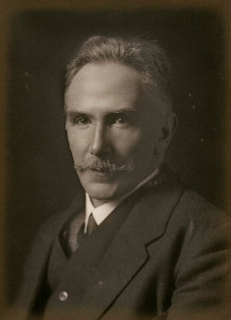
Henry Horatio Dixon, plant biologist and professor at Trinity College, Dublin, is born in Dublin on May 19, 1869. Along with John Joly, he puts forward the cohesion-tension theory of water and mineral movement in plants.

Dixon is the youngest of the seven sons of George Dixon, a soap manufacturer, and Rebecca (née Yeates) Dixon. He is educated at Rathmines School and Trinity College, Dublin. In 1894, after studying in Bonn, Germany, he is appointed assistant and later full Professor of Botany at Trinity. In 1906 he becomes Director of the Botanic Gardens and in 1910 of the Herbarium also. He has a close working relationship with physicist John Joly and together they develop the cohesion theory of the ascent of sap.

Dixon’s early research includes work on the cytology of chromosomes and first mitosis in certain plants. Familiarity with work on transpiration and on the tensile strength of columns of sulfuric acid and water leads Dixon and Joly to experiment on transpiration. “On the Ascent of Sap” (1894) presents the hypothesis that the sap or water in the vessels of a woody plant ascends by virtue of its power of resisting tensile stress and its capacity to remain cohesive under the stress of great differences of pressure. Dixon and Joly further demonstrate that water is transported through passive vessels and not living cells.

Dixon writes Transpiration and the Ascent of Sap in Plants (1914), which brings various theories and experimental works together in a coherent argument. He also writes a textbook, Practical Plant Biology (1922).

In 1907 Dixon marries Dorothea Mary, daughter of Sir John H. Franks, with whom he raises three sons. He is the father of biochemist Hal Dixon and grandfather of Adrian Dixon and Joly Dixon.

In 1908 Dixon is elected a Fellow of the Royal Society. In 1916 he is awarded the Boyle Medal of the Royal Dublin Society. He delivers the society’s Croonian Lecture in 1937.

Henry Dixon dies in Dublin on December 20, 1953.

(Pictured: Henry Horatio Dixon, bromide print by Walter Stoneman, 1922, National Portrait Gallery, London)