seamus dubhghaill

Promoting Irish Culture and History from Little Rock, Arkansas, USA


Leave a comment

Irish Brigade of France Takes Part in the Siege of Savannah

On October 9, 1779, members of Arthur Dillon‘s regiment of the Irish Brigade of France take part in the Franco-American siege of Savannah, or the Second Battle of Savannah, during the final stages of the siege during the American Revolutionary War. The year before, the city of Savannah, Georgia, had been captured by a British expeditionary corps under Lieutenant Colonel Archibald Campbell. The siege itself consists of a joint Franco-American attempt to retake Savannah, from September 16 to October 18, 1779.

Charles Henri Hector, Count of Estaing, begins landing troops below the city on September 12, and begins moving in by September 16. Confident of victory and believing that British Lieutenant Colonel John Maitland‘s reinforcements will be prevented from reaching Savannah by Major General Benjamin Lincoln, he offers Major General Augustine Prévost the opportunity to surrender. Prevost delays, asking for a 24-hour truce. Owing to miscommunication about who is responsible for preventing Maitland’s movements, the waterways separating South Carolina‘s Hilton Head Island from the mainland are left unguarded, and Maitland is able to reach Savannah hours before the truce ends. Prevost’s response to d’Estaing’s offer is a polite refusal, despite the arrival.

On September 19, as Charles-Marie de Trolong du Rumain moves his squadron up the river, he exchanges fire with Comet, Thunder, Savannah, and Venus. The next day the British scuttle Rose, which is leaking badly, just below the town to impede the French vessels from progressing further. They also burn Savannah and Venus. By scuttling Rose in a narrow part of the channel, the British effectively block it. Consequently, the French fleet is unable to assist the American assault.

Germaine takes up a position to protect the north side of Savannah’s defenses. Comet and Thunder have the mission of opposing any attempt by the South Carolinian galleys to bombard the town. Over the next few days, British shore batteries assist Comet and Thunder in engagements with the two South Carolinian galleys. During one of these, they severely damage Revenge.

The French commander, rejecting the idea of assaulting the British defenses, unloads cannons from his ships and begins a bombardment of the city. The city, rather than the entrenched defenses, bear the brunt of this bombardment, which lasts from October 3 to 8. “The appearance of the town afforded a melancholy prospect, for there was hardly a house that had not been shot through,” writes one British observer.

When the bombardment fails to have the desired effect, d’Estaing changes his mind and decides it is time to try an assault. He is motivated in part by the desire to finish the operation quickly, as scurvy and dysentery are becoming problems on his ships, and some of his supplies are running low. While a traditional siege operation would likely have succeeded eventually, it would take longer than d’Estaing is prepared to stay.

Against the advice of many of his officers, d’Estaing launches the assault against the British position on the morning of October 9. The success depends in part on the secrecy of some of its aspects, which are betrayed to Prévost well before the operations are supposed to begin around 4:00 a.m. Dillon’s regiment is sent to the right of the main assault, but their guides prove to be unreliable, and the column goes down the wrong path into a swamp. The British have already learned of the assault and the bagpipes of a Highland regiment begin playing at daybreak, unnerving the allies since it signals that surprise is lost. It is nearly daylight when the attack finally gets underway.

The redoubt on the right side of the British works had been chosen by the French admiral in part because he believed it to be defended only by militia. In fact, it is defended by a combination of militia and Scotsmen from John Maitland’s 71st Regiment of Foot, Fraser’s Highlanders, who had distinguished themselves at Stono Ferry. The militia includes riflemen, who easily pick off the white-clad French troops when the assault is underway. Admiral d’Estaing is twice wounded, and Polish cavalry officer Casimir Pulaski, fighting with the Americans, is mortally wounded. By the time the second wave arrives near the redoubt, the first wave is in complete disarray, and the trenches below the redoubt are filled with bodies. Attacks intended as feints against other redoubts of the British position are easily taken.

The second assault column is commanded by the Swedish Count Curt von Stedingk, who manages to reach the last trench. He later writes in his journal, “I had the pleasure of planting the American flag on the last trench, but the enemy renewed its attack, and our people were annihilated by crossfire.” He is forced back by overwhelming numbers of British troops, left with some 20 men, all being wounded, including von Stedingk. He later writes, “The moment of retreat with the cries of our dying comrades piercing my heart was the bitterest of my life,”

After an hour of carnage, d’Estaing orders a retreat. On October 17, Lincoln and d’Estaing abandon the siege.

The Irish Brigade of France suffers more than 40 killed and close to 150 wounded. Among the dead is Captain Bernard O’Neill, a 5th generation officer in Dillon’s regiment. Dillon’s regiment is the only one of the Brigade units to remain in command of one family for its entire service. Count Arthur Dillon, commander at Savannah, is the grandson of Colonel Arthur Dillon, who brought the regiment into French service in 1690. The Count later becomes a victim of the French Revolution. He is condemned for alleged participation in a prison conspiracy and executed by guillotine on April 13, 1794.

Leave a comment

Birth of Josephine Bracken, Common-law wife of José Rizal

Marie Josephine Leopoldine Bracken, the common-law wife of Philippine national hero José Rizal, is born in Victoria Barracks in Victoria, British Hong Kong, on August 9, 1876.

Bracken is born to Irish parents James Bracken, a corporal in the British Army, and Elizabeth Jane McBride, of Belfast. After her mother dies shortly after childbirth, her father gives her up for adoption. She is taken in by her godfather, the American George Taufer, a blind, and fairly well-to-do engineer of the pumping plant of the Hong Kong Fire Department, and his late Portuguese wife. He later remarries another Portuguese woman from Macau, Francesca Spencer, with whom he has another daughter.

After the second Mrs. Taufer dies in 1891, Taufer decides to remarry again but the new wife turns out to be difficult to deal with for Bracken. She spends two months in the Convent of the Canossian Sisters, where she previously attended early years of school. She decides to go back only after Taufer calls at the convent’s door pleading with her to come back home as his third wife turned out to be a bad housekeeper. A few months later she has trouble again with the third Mrs. Taufer and haunts her out of the house.

Bracken later recommends that her blind adoptive father see José Rizal, who is a respected ophthalmologist who had practiced at Rednaxela Terrace in Hong Kong. By this time, he is a political exile in Dapitan, Zamboanga del Norte in southern Philippines. The family sails to the Philippines and arrives in Manila on February 5, 1895, and later that month Bracken and Taufer sail to Dapitan.

Taufer’s double cataract is beyond Rizal’s help, but he falls in love with Bracken. Taufer vehemently opposes the union but finally listens to reason. She accompanies Taufer to Manila on his way back to Hong Kong, together with Rizal’s sister, Narcisa, on March 14, 1895. Rizal applies for marriage but because of his writings and political stance, the local priest Father Obach, will only agree to the ceremony if Rizal obtains permission from the Bishop of Cebu. Either the Bishop does not write him back or Rizal is not able to mail the letter because of Taufer’s sudden departure.

Before heading back to Dapitan to live with Rizal, Bracken introduces herself to members of his family in Manila. His mother suggests a civil marriage, which she believes to be a lesser “sacrament” but free from hypocrisy — and thus less a burden to Rizal’s conscience — than making any sort of political retraction. Nevertheless, Bracken and Rizal live together as husband and wife in Barangay Talisay, Dapitan, beginning in July 1895. The couple has a son, Francísco Rizal y Bracken, who is born prematurely and dies within a few hours of birth.

On the evening before his execution on December 30, 1896, on charges of treason, rebellion and sedition by the Spanish colonial government, the Catholic Church claims that Rizal returned to the faith and is married to Bracken in a religious ceremony officiated by Father Vicente Balaguer, S.J. sometime between 5:00 AM and 6:00 AM, an hour before his scheduled execution at 7:00 AM. Despite claims by Father Balaguer and Bracken herself, some sectors, including members of Rizal’s family, dispute that the wedding had occurred because no records are found attesting to the union.

Following Rizal’s death, Bracken joins revolutionary forces in Cavite province, where she takes care of sick and wounded soldiers, boosting their morale, and helping operate reloading jigs for Mauser cartridges at the Imus Arsenal under revolutionary general Pantaleón García. Imus is under threat of recapture, so Bracken, making her way through the thicket and mud, moves with the operation to the Cavite mountain redoubt of Maragondon. She witnesses the Tejeros Convention on March 22, 1897, before returning to Manila, and is later summoned by the Spanish Governor-General, who threatens her with torture and imprisonment if she does not leave the colony. Owing however to her adoptive father’s American citizenship, she cannot be forcibly deported, but she voluntarily returns to Hong Kong upon the advice of the American consul in Manila.

Upon returning to Hong Kong, Bracken once more lives in her father’s house. After his death, she marries Vicente Abad, a Cebuano mestizo, who represents his father’s tabacalera company in the British territory. A daughter, Dolores Abad y Braken, is born to the couple on April 17, 1900. A later testimony of Abad affirms that her mother “was already suffering from tuberculosis of the larynx” at the time of the wedding.

Bracken dies of tuberculosis on March 15, 1902, in Hong Kong and is interred at the Happy Valley Cemetery.


Leave a comment

The Battle of Cassano

battle-of-cassano

Units of the Irish Brigade of France fight at the Battle of Cassano on August 16, 1705, during the War of the Spanish Succession. The battle is fought at the town of Cassano d’Adda, in Lombardy, Italy, between a French army commanded by Louis Joseph, Duke of Vendôme and an Imperial army under Prince Eugene of Savoy.

By August 1705, the French occupy most of Savoy, with the exception of Turin. In order to relieve the pressure, Prince Eugene tries to cross the river Adda at Cassano and threaten Milan. Although the French are taken by surprise, they manage to hold the bridge after six hours of intense conflict, both sides suffering heavy casualties.

The deep and fast-flowing river Adda has limited crossing points, especially for large bodies of men. The town of Cassano is on the right bank, with a stone bridge protected by a small fortification or redoubt. The area is also divided by numerous small streams and irrigation channels, the most significant being the Retorto, an irrigation canal running parallel to the Adda. This is connected to the left bank by another bridge, protected by another strongpoint.

Assuming Prince Eugene is still heading for Mantua, Vendôme orders his brother Philippe to leave his positions around Cassano and intercept him. In fact, the Imperial troops had marched overnight from Romanengo and are approaching the town when spotted by one of Vendôme’s cavalry patrols early the next morning. Realising their intentions, Vendôme heads to Cassano, along with approximately 2,000 reinforcements.

On arrival, he finds Philippe’s troops unprepared and in an extremely dangerous position, the bulk of their force caught between the Retorto canal and the Adda, and the main bridge blocked by their transport. Vendôme orders the baggage thrown into the river and forms a line running from the Retorto on the left, his centre around the main bridge, and his extreme right resting on the road leading to the nearby village of Rivolta d’Adda. Armand St. Hilaire, the French artillery commander, positions his guns inside the town, allowing him to fire directly on the bridge.

Around 2:00 in the afternoon, Austrian grenadiers attack the French positions around the Retorto. They initially succeed in capturing the bridge before being repulsed by St. Hilaire’s guns and a counterattack. Vendôme sends four regiments of the French Irish Brigade to reinforce his left, but after a fierce struggle, the Imperialists capture the canal’s sluice gates. After these are closed, the water level in the canal is lowered enough for men to wade across it.

Prince Eugene orders Leopold I, Prince of Anhalt-Dessau, and his Prussians into the canal to assault the French left. They manage to seize the further bank but suffer heavily in doing so. The battle surges back and forth across the river for several hours, in the course of which Vendôme has his horse killed under him, while Prince Eugene is wounded twice and has to leave the field. The fighting lasts another four to five hours, until ended by sheer exhaustion, with the opposing forces back at their starting positions.

The battle is inconclusive. While the French prevent the Imperialists crossing the Adda, Prince Eugene succeeds in delaying an assault on Turin until June 1706. Combined with having to transfer forces to Northern France following their defeat at Ramillies in May 1706, the French siege is broken in September, and fighting in Northern Italy ends in March 1707.

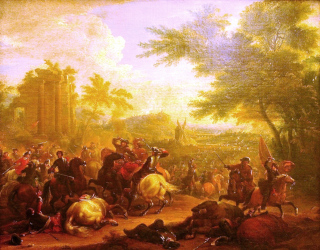
(Pictured: The battle of Cassano 1705 (War of the Spanish Succession), painted by Jean Baptiste Martin (1659-1735). Oil on canvas, Heeresgeschichtliches Museum, Vienna, Austria)