
As part of the larger Congo Crisis (1960–1964), the siege of Jadotville begins on September 13, 1961, lasting for five days. While serving under the United Nations Operation in the Congo (Opération des Nations Unies au Congo, ONUC), a small contingent of the Irish Army‘s 35th Battalion, designated “A” Company, are besieged at the UN base near the mining town of Jadotville (modern-day Likasi) by Katangese forces loyal to the secessionist State of Katanga. The siege takes place during the seven-day escalation of hostilities between ONUC and Katangese forces during Operation Morthor. Although the contingent of 156 Irish soldiers repels attacks by a 3,000-strong Katangese force, they are eventually forced to surrender after running out of ammunition and water. “A” Company is subsequently held as prisoners of war for approximately one month, before being released on October 15 as part of a prisoner exchange. The Irish forces inflict approximately 1,300 casualties (including up to 300 killed) on the Katangan force, with no deaths amongst “A” Company.
On the morning of Wednesday, September 13, 1961, the soldiers stationed at Jadotville are informed of Operation Morthor by UN Headquarters at Elisabethville. At 07:40 twenty Katangese troops attack while many of the UN Irish troops of A Company are attending an open-air Mass. Expecting to take the men off-guard, the first attackers move in rapidly. However, they are spotted by an Irish sentry, and a warning shot by Private Billy Ready alerts the company to the threat. Ready is wounded in a later exchange of fire.
The paramilitary Katangese Gendarmerie, which is a combined force of mercenaries, Belgian settlers and local tribesmen, attack the Irish company. The attackers have a strength of 3,000–5,000 men – consisting of mostly Katangese and settlers, but with many Belgian, French and Rhodesian mercenaries armed with a mix of weapons. Additionally, these forces have limited air support from a Fouga CM.170 Magister trainer-light ground attack jet fitted with a pair of underwing bombs and twin 7.5 mm machine guns, which repeatedly attacks the UN position. The Irish soldiers are armed with personal weapons, several water-cooled Vickers machine guns, 60 mm mortars and two Irish-built Ford Mark VI armoured cars under the command of Lieutenant Kevin Knightly.
The Katangese attack in waves of 600 or so, preceded by bombardment from 81 mm mortars and a French 75mm field gun. The Irish Support Platoon of “A” Company knocks out most of the Katangese mortar and artillery positions, including the 75mm gun, with counter-battery fire from 60mm mortars. The fire from the UN Irish positions proves accurate and effective. Mercenary officers are reportedly observed shooting native gendarmes to stem the rout caused in Katangese lines.
The 500 Irish and Swedish UN troops based in Kamina, and Indian army Gurkhas make several attempts to relieve the besieged Irish soldiers. The supporting force of mercenaries beat back these efforts. They have been brought in by Moïse Tshombe, Katanga’s premier, whose secessionist government has been supported by Belgium.
Attempting to reach the besieged “A” Company, the relief column, named “Force Kane” after its commander Commandant John Kane, is stymied in a series of battles at a pinch point called the Lufira Bridge. It carries the Jadotville-to-Elisabethville Highway across the Lufira River. The Katangese forces dig in here and bring heavy and sustained ground and air fire onto the relief column, killing three Indian UN troops, injuring a number of Irish UN troops and ultimately forcing the column off the bridge. Additionally, during the effort to reach the trapped company, the Katanga forces set off charges on the railway bridge to impede potential relief efforts.
On September 14, the Katangan Fouga jet flies passes over the battlefield, dropping bombs that rendered the Company’s vehicles inert and cause injuries to Privates Tahaney and Gormley.
During the siege, the Irish radio to their headquarters: “We will hold out until our last bullet is spent. Could do with some whiskey.”
On September 16, a second attempt to reach the Irish Company is made but fails with another three Indian troops being killed and a further eight soldiers suffering injuries. The Katangese ask Commandant Pat Quinlan for a ceasefire, as their own forces have been seriously diminished. By this time their effective strength may have been reduced to 2,000 men. Later that same day, a ceasefire agreement is reached between Commandant Quinlan and the Burgomaster of the Katangan forces, enabling the Irish troops to re-supply with water. The Gendarmerie retreat from their positions surrounding the UN.
Quinlan lacks any clear direction or communication from his superiors, and the Katangese gradually infringe on the ceasefire agreement to undermine “A” Company’s position. With his position untenable, without any clear orders or promise of assistance, having run out of ammunition and food and being low on water, Quinlan accepts their second offer to surrender. On September 17, Quinlan meets with Katanga Minister Munongo, in which a formal written ceasefire and surrender agreement is made, which contains the proviso that the Irish Company will keep their weapons and be unharmed.
“A” Company, 35th Battalion, suffers five wounded in action during the siege. The Katangese suffered up to 300 killed, including 30 mercenaries and an indeterminate number of wounded, with figures ranging from 300 to 1,000.
The Irish soldiers are held as hostages for approximately one month, in an effort to extort terms of ceasefire that are embarrassing to the United Nations.
After being released, the troops are returned to their base in Elisabethville. Some weeks later, however, “A” Company finds itself in active combat again, this time with the support of Swedish UN troops. Eventually, they are reinforced with fresh troops from Ireland, their replacement being the 36th Battalion. After weeks of fighting and their six-month tour of duty now complete, “A” Company is rotated out of the battle zone and are home in Ireland that December.
In 2016, the Irish government awards a Presidential Unit Citation to “A” Company, the first in the State’s history. In October 2017, a plaque commemorating Quinlan is unveiled in his native County Kerry, by former Taoiseach Enda Kenny. The decision of the State to honour individually the soldiers of Jadotville or their next of kin is one of the last decisions taken by Kenny before he retires as Taoiseach in June 2017. They are presented with newly designed Siege of Jadotville Medals in Athlone on December 2, 2017.
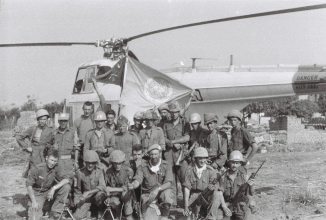
(Pictured: No.3 Platoon, A Company, 35th Battalion, pose in front of a UN relief helicopter, September 17, 1961)

 seamus dubhghaill