seamus dubhghaill

Promoting Irish Culture and History from Little Rock, Arkansas, USA


Leave a comment

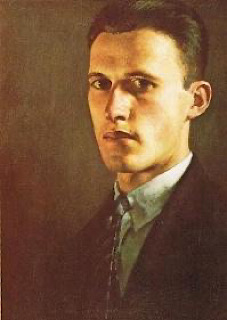
Death of John Luke, Northern Irish Artist

Northern Irish artist John Luke dies in Belfast on February 4, 1975.

Luke is born at 4 Lewis Street in Belfast on January 19, 1906, the fifth of seven sons and one daughter of James Luke and his wife Sarah, originally from Ahoghill, County Antrim. He attends the Hillman Street National School and in 1920 goes to work at the York Street Flax Spinning Company. He goes on soon after to become a riveter at the Workman, Clark shipyard. While working there he enrolls in evening classes at the Belfast School of Art.

Luke excells at the college under the tutelage of Seamus Stoupe and Newton Penpraze. His contemporaries include Romeo Toogood, Harry Cooke Knox, George MacCann and Colin Middleton. In 1927 he wins the coveted Dunville Scholarship which enables him to attend the Slade School of Fine Art in London, where he studies painting and sculpture under the celebrated Henry Tonks, who greatly influences his development as a draughtsman.

Luke remains at the Slade School of Fine Art until 1930, in which year he wins the Robert Ross Scholarship. On leaving the Slade School he stays in London, intent on establishing himself in the art world. For a time he shares a flat with fellow Ulsterman F. E. McWilliam, and enrolls as a part-time student of Walter Bayes at the Westminster School of Art to study wood engraving. He begins to exhibit his work and in October 1930 shows two paintings, Entombment and Carnival, in an exhibition of contemporary art held at Leger Galleries. The latter composition, depicting a group of masked merry-makers, is singled out by the influential critic, Paul George Konody of the Daily Mail (October 3, 1930), as “one of the most attractive features of the exhibition.” But the economic climate is deteriorating and a year later, at the end of 1933, he is driven back to Belfast by the recession. He remains in Belfast, apart from a time during World War II when he goes to KillyleaCounty Armagh.

Luke paints in the style known as Regionalism, whose main proponents are Thomas Hart BentonGrant WoodJohn Steuart Curry and Harry Epworth Allen. His painting technique is painstakingly slow, his manner precise. “I’m afraid I’m very much a one job man,” he once writes to John Hewitt, continuing, “my strength lies in making the most of one job at a time, in sustained thought and effort, to bring it to the highest level of organisation and completeness I desire: the other way I lead to disintegrate in looseness and frustration with its inevitable weakness.” The precision characteristic of his work is manifested, too, in his appearance and personal manner. Dark haired, in stature he is erect and spare of build. Always tidy, his clothes brushed, his hair short, he is, in Hewitt’s words, “not at all close to the romantic stereotype of the artist.”

Apart from Luke’s work as a practising artist, he teaches from time to time in the Belfast School of Art, where he influences a generation of students “especially in the matter of drawing,” as he once puts it. Although principally a painter, throughout his career he occasionally makes sculptures, such as the Stone HeadSeraph of c. 1940 (Ulster Museum). Indeed it is for sculpture that he wins the Robert Ross Prize at the Slade School of Fine Art. He is also much interested in philosophical theories of art. In the 1930s, for example, as John Hewitt records, topical books such as Roger Fry’s Vision and DesignClive Bell’s Art and R. H. Wilenski‘s Modern Movement in Art direct his thinking.

From the late 1930s until 1943, when Luke produces Pax, there is a gap in his output, occasioned, no doubt, by his move to County Armagh in order to escape Belfast after the Blitz. In 1946, he holds his first one-man exhibition at the Belfast Museum and Art Gallery, and this is followed two years later by a similar show, held under the aegis of CEMA, nearby at number 55A Donegal Place. In 1950, to celebrate the Festival of Britain the following year, he is commissioned to paint in Belfast City Hall, a mural representing the history of the city, a work which brings his name to the attention of a wider audience. In later years, other commissions follow for murals in the Masonic Hall, Rosemary Street, in 1956, and the College of Technology at Millfield in the 1960s. He also carves in relief coats of arms for the two Governors of Northern Ireland, John Loder, 2nd Baron Wakehurst (1959) and John Erskine, 1st Baron Erskine of Rerrick (1965). He is also a member of the Royal Ulster Academy.

Having been in declining health for some years, Luke dies, unmarried, at the Mater Infirmorum Hospital in Belfast on February 4, 1975, just a month into his sixty-ninth year. A retrospective exhibition of his work is held, in association with the Arts Councils of Ireland, in the Ulster Museum in 1978, and is accompanied by a short monograph on his life and career written by John Hewitt. Since that time his reputation has grown enormously, his loss rekindling memories in many of his former students of a fastidiously arranged life-room in the College of Art, his coat folded to perfection and his soft, gentle manner of instruction.


2 Comments

The Sinking of the RMS Lusitania

The Cunard ocean liner RMS Lusitania is sunk by German U-boatU-20 eleven miles off the Old Head of Kinsale on May 7, 1915 during World War I.

On the morning of May 6, RMS Lusitania is 750 miles west of southern Ireland. By 5:00 AM on May 7 she reaches a point 120 miles west southwest of Fastnet Rock off the southern tip of Ireland, where she meets the patrolling boarding vesselPartridge. By 6:00 AM, heavy fog has arrived and extra lookouts are posted. As the ship comes closer to Ireland, Captain William Thomas Turner orders depth soundings to be made and at 8:00 AM for speed to be reduced to eighteen knots, then to 15 knots and for the foghorn to be sounded. Some of the passengers are disturbed that the ship appears to be advertising her presence. By 10:00 AM the fog begins to lift and by noon it has been replaced by bright sunshine over a clear smooth sea. The RMS Lusitania increases speed to 18 knots.

U-20 surfaces at 12:45 PM as visibility is now excellent. At 1:20 PM something is sighted and Kapitänleutnant  Walther Schwieger is summoned to the conning tower. At first it appears to be several ships because of the number of funnels and masts, but this resolves into one large steamer appearing over the horizon. At 1:25 PM the submarine submerges to periscope depth of 11 metres and sets a course to intercept the liner at her maximum submerged speed of 9 knots. When the ships have closed to 2 miles RMS Lusitania turns away. Schwieger fears he has lost his target, but she turns again, this time onto a near ideal course to bring her into position for an attack. At 2:10 PM with the target at 700m range he orders one gyroscopic torpedo to be fired, set to run at a depth of three metres.

The U-20‘s torpedo officer, Raimund Weisbach, views the destruction through the vessel’s periscope and feels the explosion is unusually severe. Within six minutes, RMS Lusitania‘s forecastle begins to submerge.

On board the RMS Lusitania, Leslie Morton, an eighteen-year-old lookout at the bow, spots thin lines of foam racing toward the ship. He shouts, “Torpedoes coming on the starboard side!” through a megaphone, thinking the bubbles come from two projectiles. The torpedo strikes RMS Lusitania under the bridge, sending a plume of debris, steel plating and water upward and knocking lifeboat number five off its davits. A second, more powerful explosion follows, sending a geyser of water, coal, dust, and debris high above the deck. Schwieger’s log entries attest that he had only launched one torpedo. Some doubt the validity of this claim, contending that the German government subsequently alters the published fair copy of Schwieger’s log, but accounts from other U-20 crew members corroborate it. The entries are also consistent with intercepted radio reports sent to Germany by U-20 once she has returned to the North Sea, before any possibility of an official coverup.

At 2:12 PM Captain Turner orders Quartermaster Johnston stationed at the ship’s wheel to steer “hard-a-starboard” towards the Irish coast, which Johnston confirms, but the ship can not be steadied on the course and rapidly ceases to respond to the wheel. Turner signals for the engines to be reversed to halt the ship, but although the signal is received in the engine room, nothing can be done. Steam pressure collapses from 195 PSI before the explosion, to 50 PSI and falling afterwards. RMS Lusitania‘s wireless operator sends out an immediate SOS, which is acknowledged by a coastal wireless station. Shortly afterward he transmits the ship’s position, 10 miles (16 km) south of the Old Head of Kinsale. At 2:14 PM electrical power fails, plunging the cavernous interior of the ship into darkness. Radio signals continue on emergency batteries, but electric lifts fail, trapping passengers and crew. Bulkhead doors closed as a precaution before the attack can not be reopened to release trapped men.

About one minute after the electrical power fails, Captain Turner gives the order to abandon ship. Water has flooded the ship’s starboard longitudinal compartments, causing a 15-degree list to starboard.

RMS Lusitania‘s severe starboard list complicates the launch of her lifeboats. Ten minutes after the torpedoing, when she has slowed enough to start putting boats in the water, the lifeboats on the starboard side swing out too far to step aboard safely. While it is still possible to board the lifeboats on the port side, lowering them presents a different problem. As is typical for the period, the hull plates of RMS Lusitania are riveted, and as the lifeboats are lowered they drag on the inch high rivets, which threatens to seriously damage the boats before they land in the water.

Many lifeboats overturn while loading or lowering, spilling passengers into the sea. Others are overturned by the ship’s motion when they hit the water. RMS Lusitania has 48 lifeboats, more than enough for all the crew and passengers, but only six are successfully lowered, all from the starboard side. A few of her collapsible lifeboats wash off her decks as she sinks and provides floatation for some survivors.

There is panic and disorder on the decks. Schwieger has been observing this through U-20‘s periscope, and by 2:25 PM, he drops the periscope and heads out to sea.

Captain Turner is on the deck near the bridge clutching the ship’s logbook and charts when a wave sweeps upward towards the bridge and the rest of the ship’s forward superstructure, knocking him overboard into the sea. He manages to swim and find a chair floating in the water which he clings to. He survives, having been pulled unconscious from the water after spending three hours there. RMS Lusitania‘s bow slams into the bottom about 330 feet below at a shallow angle because of her forward momentum as she sinks. Along the way, some boilers explode, including one that causes the third funnel to collapse. The remaining funnels collapse soon after. The ship travels about two miles from the time of the torpedoing to her final resting place, leaving a trail of debris and people behind. After her bow sinks completely, RMS Lusitania‘s stern rises out of the water, enough for her propellers to be visible, and then goes under.

RMS Lusitania sinks in only 18 minutes. It takes several hours for help to arrive from the Irish coast and by that time many in the 52° F water have succumbed to the cold. By the days’ end, 764 passengers and crew from the RMS Lusitania are rescued and land at Queenstown. Eventually, the final death toll for the disaster comes to a catastrophic number. Of the 1,959 passengers and crew aboard RMS Lusitania at the time of her sinking, 1,195 have been lost.

In the days following the disaster, the Cunard line offers local fishermen and sea merchants a cash reward for the bodies floating all throughout the Irish Sea, some floating as far away as the Welsh coast. In all, only 289 bodies are recovered, 65 of which are never identified. The bodies of many of the victims are buried at either Queenstown, where 148 bodies are interred in the Old Church Cemetery, or the Church of St. Multose in Kinsale. The bodies of the remaining 885 victims are never recovered.