seamus dubhghaill

Promoting Irish Culture and History from Little Rock, Arkansas, USA


Leave a comment

Birth of Lionel Cranfield Sackville, Lord Lieutenant of Ireland

lionel-cranfield-sackville

Lionel Cranfield Sackville, 1st Duke of Dorset, English political leader and Lord Lieutenant of Ireland, is born in Dorset, United Kingdom on January 18, 1688.

Sackville is the son of Charles Sackville, 6th Earl of Dorset and 1st Earl of Middlesex, and the former Lady Mary Compton, younger daughter of James Compton, 3rd Earl of Northampton. Styled Lord Buckhurst from birth, he succeeds his father as 7th Earl of Dorset and 2nd Earl of Middlesex in 1706 and is created Duke of Dorset in 1720.

Perhaps because he had been on a previous diplomatic mission to Hanover, Sackville is chosen to inform George I of his accession to the Crown in August 1714. George I initially favours him and numerous offices and honours are given to him: Privy Councillor, Knight of the Garter, Groom of the Stool, Lord Steward, Governor of Dover Castle and Lord Warden of the Cinque Ports. At George I’s coronation he carries the sceptre. At the coronation of George II, he is Lord High Steward and carries St. Edward’s Crown. He quarrels with the King in 1717 and is told his services are no longer required, but he is made a Duke three years later.

Sackville serves twice as Lord Lieutenant of Ireland, from 1731 to 1737 and again from 1751 to 1755. In 1739, at the foundation of the Foundling Hospital, he is one of that charity’s original governors. His first term as Lord Lieutenant is uneventful. His second takes place at a time of acute political tension between the two main factions in the Irish Government, one led by Henry Boyle, the Speaker of the Irish House of Commons, the other by George Stone, the Anglican Archbishop of Armagh. Sackville, now heavily influenced by his son George Sackville, makes the mistake of openly backing the archbishop. He is unable to oust Boyle from power and is accused of being the archbishop’s tool. He becomes extremely unpopular, leading to his eventual recall.

Sackville’s last years are uneventful, apart from a riot in 1757 caused by the passage of the Militia Act to raise an army for the Seven Years’ War, in which he narrowly escapes injury. He dies at Knole, a country house in west Kent, on October 9, 1765, and is buried at Withyham in East Sussex.

(Pictured: Oil on canvas Portrait of Lionel Sackville, 1st Duke of Dorset (1688-1765) by Godfrey Kneller (1646-1723), 1719, currently displayed at Commonwealth Secretariat, Marlborough House, London)

Leave a comment

St. Columba Encounters Monster in Loch Ness

columba-and-loch-ness-monster

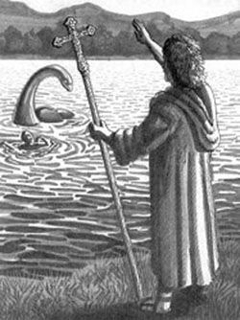
St. Columba is said to have encountered the Loch Ness Monster on August 22, 565.

Columba is trained by Irish monks. However, his youthful Christianity is skin-deep while his passions are strong. He is partly responsible for the battle of Cul-drebene in which many men lose their lives. Repentant, he sails to Britain as “a pilgrim for Christ” and founds the monastery of Iona, from which Christianity spreads across North Britain. He himself travels and preaches, establishing several churches and monasteries.

Revered as a saint, his life is written by Adomnán. In reporting Columba’s life, Adomnán gives what appears to be the first written account of the Loch Ness Monster.

Traveling in Scotland, Columba has to cross the Loch Ness. On its banks, he sees some of the Picts burying a man who had been bitten by a water monster while swimming. The body had been pulled from the loch with the aid of a hook by rescuers who had come to his assistance in a boat.

Despite the danger, Columba orders one of his followers to swim across the loch and bring back a boat that is moored on the other side. This man’s name was Lugne Mocumin. Without hesitation, Lugne strips for the swim and plunges in.

The monster, robbed of its earlier feast, surfaces and darts at Lugne with a roar, its jaws open. Everyone on the bank is stupefied with terror, everyone except Columba, that is. A firm believer in the authority of the crucified Christ, he raises his hand, making the sign of the cross. Invoking the name of God, he commands the beast, saying, “You will go no further, and won’t touch the man; go back at once.”

At the voice of the saint, the monster flees as if terrified, “more quickly than if it had been pulled back with ropes,” says Adomnán. The heathens are amazed. Everyone who witnesses the sight gives glory to the God of the Christians.

The authenticity of this event remains in doubt. To begin with, Adomnán’s account is written over a hundred years after the alleged events. Furthermore, different versions of the story disagree with one another. One has Columba raising the monster’s first victim from the dead by laying his staff across his chest.

This is only one of many extraordinary events in Adomnán’s account. According to him, Columba drips with prophecies and predictions that come true. He makes water into wine like Jesus, draws water from a rock like Moses, calms a storm at sea, provides a miraculous draught of fishes, multiplies a herd of cattle, drives a demon out of a milk pail, and cures the sick. A book owned by Columba could not be destroyed by water. Through his prayers he kills a wild boar, stops serpents from harming the inhabitants of a certain island. Angels and manifestations of divine light attend him throughout his life. Adomnán’s account has so many incredible tales that it is unbelievable.

(From “Columba Encountered Loch Ness Monster” by Dan Graves, MSL published on Christianity.com)