seamus dubhghaill

Promoting Irish Culture and History from Little Rock, Arkansas, USA


Leave a comment

The Bombing of Air India Flight 182

air-india-182

Air India Flight 182, an Air India flight operating on the Montreal, CanadaLondon, U.K.Delhi, India route, is destroyed by a bomb on June 23, 1985, at an altitude of 31,000 feet and crashes into the Atlantic Ocean while in Irish airspace.

It is the first bombing of a 747 jumbo jetliner. A total of 329 people are killed, including 268 Canadian citizens, 27 Britons, and 24 Indians. The majority of the victims were Canadian citizens of Indian ancestry. The incident is the largest mass murder in Canadian history. It is the deadliest terrorist attack involving an airplane until the September 11, 2001, attacks in the United States in 2001. The bombing of Air India 182 occurs at the same time as the Narita Airport bombing in Japan. Investigators believe that the two plots are linked, and that those responsible are aiming for a double bombing. However, the bomb at Narita explodes before it can be loaded onto a plane.

At 07:14:01 GMT, the crew of Air India 182 “squawked 2005,” a routine activation of its aviation transponder, as requested by Shannon International Airport Air Traffic Control (ATC). The plane then disappears from radar. A bomb in a Sanyo tuner in a suitcase in the forward cargo hold explodes while the plane is at 31,000 feet at 51°3.6′N 12°49′W. It causes rapid decompression and the break-up of the aircraft in mid-air. The wreckage settles in 6,700-feet deep water off the southwest coast of Ireland, 120 miles offshore of County Cork. No “mayday” call is received by Shannon ATC. ATC asks aircraft in the area to try to contact Air India, to no avail. By 07:30:00 GMT, ATC has declared an emergency and requests nearby cargo ships and the Irish Naval Service vessel Aisling to begin searching for the aircraft.

The bomb kills all 22 crew and 307 passengers. One hundred thirty-two bodies are recovered. The remaining 197 are lost at sea. Eight bodies exhibit “flail pattern” injuries, indicating that they had exited the aircraft before it hit the water. This is a sign that the aircraft had broken up in mid-air. Twenty-six bodies show signs of hypoxia (lack of oxygen). Twenty-five, mostly victims who were seated near windows, show signs of explosive decompression. Twenty-three have signs of “injuries from a vertical force.” Twenty-one passengers are found with little or no clothing.

Canadian law enforcement determines that the main suspects in the bombing are members of the Sikh militant group Babbar Khalsa. The attack is thought to be a retaliation against India for the operation carried out by the Indian Army Operation Blue Star to flush out several hundred Sikh militants who were within the premises of the Golden temple and the surrounding structures ordered by the Indian government, headed by Prime Minister Indira Gandhi. Though a handful of members are arrested and tried, Inderjit Singh Reyat, a Canadian national, remains the only person convicted of involvement in the bombing. Singh pleads guilty in 2003 to manslaughter. He is sentenced to 15 years in prison for building the bombs that exploded aboard Flight 182 and at Narita.

The subsequent investigation and prosecution lasts almost twenty years and is the most expensive trial in Canadian history, costing nearly CAD 130 million. The Governor General-in-Council in 2006 appoints the former Supreme Court Justice John C. Major to conduct a commission of inquiry. His report is completed and released on June 17, 2010. It concludes that a “cascading series of errors” by the government of Canada, the Royal Canadian Mounted Police (RCMP), and the Canadian Security Intelligence Service (CSIS) had allowed the terrorist attack to take place.

Leave a comment

First Aircraft Lands at Rineanna Airfield (Shannon Airport)

rineanna-airport

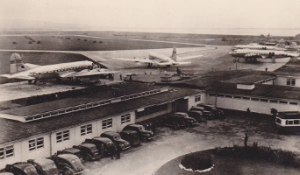
The first aircraft, an Irish Air Corps Aero Anson A43, lands at the newly opened Rineanna Airfield, which is later to become known as Shannon International Airport, on May 18, 1939.

Transatlantic aviation in the Shannon Estuary first commences with a seaplane base at Foynes. In October 1935, the Irish Government makes a decision to initiate a survey to find suitable bases for the operation of seaplanes and land planes on a transatlantic service. The Department of Defence, which provides technical advice on aviation to the Civil Aviation Section of the Department of Industry, is given the task.

On November 21, 1935, a survey party sets out and surveys sites as far north as Athlone and south to Askeaton. Among the sites for a seaplane base to be considered are the Shannon just below Limerick, Lough Derg, Lough Corrib, Tralee Bay, Kenmare Bay, Lough Ree, and Valentia. Foynes, near the mouth of the Fergus River, is finally selected due to its sheltered anchorage and its proximity to long open stretches of water.

The first priority is drainage to remove surface water from the site and to construct embankments to prevent flooding of the airfield due to its proximity to the tidal River Shannon. Several hundred men are employed to dig narrow lateral drains for the approximately 135 miles of pipes which are laid in parallel lines 50 feet apart over almost the entire area of the airfield site. They also excavate catchment drains to collect water from the surface of the site.

At this time all indications are that regular aerial travel between Europe and the United States will be initially by flying boat and accordingly, the base at Rineanna is designed to cater to both land planes and flying boats.  Construction work commences to build embankments and a breakwater to provide for a seaplane base and to protect the airfield site from flooding from the River Shannon.

Developments in aviation during World War I ensure land planes and not flying boats are to be the future of aviation, therefore the mooring basin and the east breakwater which are being constructed for flying boats at Rineanna are never quite finished.  Construction of the embankments continue to protect the site from the River Shannon and to form a drainage lagoon for surface water from the western headland of the airport site.

When World War II ends, the airport is ready to be used by the many new post-war commercial airlines of Europe and North America. On September 16, 1945, the first transatlantic proving flight, a Pan Am DC-4, lands at Shannon from New York City. On October 24, the first scheduled commercial flight, an American Overseas Airlines DC-4, passes through Shannon Airport. An accident involving President Airlines on September 10, 1961 results in the loss of 83 lives. The Douglas DC-6 aircraft crashes into the River Shannon while leaving Shannon Airport for Chicago.

The number of international carriers rises sharply in succeeding years as Shannon becomes well known as the gateway between Europe and the Americas as limited aircraft range necessitates refueling stops on many journeys. Shannon becomes the most convenient stopping point before and after a trip across the Atlantic. Additionally, during the Cold War, many transatlantic flights from the Soviet Union stop here for refueling, because Shannon is the westernmost non-NATO airport.

Shannon Airport is one of Ireland’s three primary airports, along with Dublin Airport and Cork Airport, and includes the longest runway in Ireland at 10,495 feet. It is a designated emergency landing site for the Space Shuttle during the U.S. shuttle program. In 2015, 1.715 million passengers pass through the airport, making it the third busiest airport in the country after Dublin and Cork. Shannon Airport is in Shannon, County Clare, and mainly serves Limerick, Ennis, Galway, and the south-west of Ireland.