seamus dubhghaill

Promoting Irish Culture and History from Little Rock, Arkansas, USA


Leave a comment

Birth of Reg Ryan, Irish Footballer

Reginald Alphonso Ryan, Irish footballer also referred to as Paddy Ryan, is born in Dublin, County Dublin, on October 30, 1925. He plays for West Bromwich Albion F.C., Derby County F.C. and Coventry City F.C. He is also a dual international, playing for both Ireland teams – the FAI XI and the IFA XI. He is the last player to represent both teams. He is considered more of a goal creator then a goalscorer.

Ryan initially plays Gaelic football for the Marino School in Dublin while growing up, but then switches to soccer after moving to Blackpool, Lancashire, England, during the early years of World War II. He then plays with Claremount School, Blackpool Boys, various factory teams and has trials with both Sheffield United F.C. and Nottingham Forest F.C. before joining Nuneaton Borough F.C.

Ryan has two spells with Coventry City. In April 1943, he signs for the club as an amateur and during the 1942–43 season he plays two games in wartime regional leagues. He then turns professional in August 1944 and makes a further four appearances for the club during the 1944–45 wartime season. After playing for West Bromwich Albion and Derby County, he returns to City in September 1958. He then helps the club win promotion from the newly formed Football League Fourth Division, after they finish as runners-up in 1959. During his second spell with City he plays 70 times in all competitions.

In April 1945, Ryan signs for West Bromwich Albion and, during the 1945–46 season, makes 17 appearances in the Football League South. He makes his debut for the club against Millwall F.C. in November 1945. Together with Davy Walsh and Jackie Vernon, he helps West Brom gain promotion to the Football League First Division in 1949. In 1954, together with Ronnie Allen and Frank Griffin, he is also a member of the West Brom team that finishes as First Division runners-up and FA Cup winners. He also helps West Brom gain a share of the FA Charity Shield when he scores in a 4–4 draw against Wolverhampton Wanderers F.C.

Ryan signs for Derby County in June 1955 for a fee of £3,000. He is appointed team captain by manager Harry Storer, Jr., and during his three seasons with the club misses only three matches – two because of injury and one because of international duty. He is a member of the side promoted as champions of the Third Division North to the Football League Second Division in 1956–57. In 1955 he also plays for an English Division Three North XI against an English Division Three South XI. He plays 133 league games for County, scoring 30 goals. He also plays a further six games for the club in the FA Cup, scoring a further goal.

When Ryan begins his international career in 1949 there are, in effect, two Ireland teams, chosen by two rival associations. Both associations, the Northern Ireland–based Irish Football Association (IFA) and the Republic of Ireland–based Football Association of Ireland (FAI) claim jurisdiction over the whole of Ireland and select players from the whole island. As a result, several notable Irish players from this era, including Ryan, play for both teams.

Between 1949 and 1955 Ryan makes 16 appearances and scores 3 goals for the FAI XI. He makes his debut in a 3–1 defeat to Sweden on November 13, 1949, in a qualifier for the 1950 FIFA World Cup. He scores his first two goals for the FAI XI in October 1953 during the qualifiers for the 1954 FIFA World Cup, one against France in a 5–3 defeat and the second, a penalty, against Luxembourg in 4–0 win. On November 7, 1954, in a friendly against Norway, he scores his third goal, again from the penalty spot, and earns the FAI XI a 2–1 victory. He makes his last appearance for the FAI XI on November 27, 1955, in a 2–2 draw with Spain.

Ryan makes his one and only appearance for the IFA XI in a 0–0 draw with Wales on March 8, 1950. As well as being part of the 1950 British Home Championship, the game also doubles up as a qualifier for the 1950 FIFA World Cup. Ryan, together with Con Martin, Davy Walsh and Tom Aherne, is one of four players born in the Irish Free State, included in the IFA XI that day. He earlier plays for the FAI XI in the same competition, and as a result, plays for two different teams in the same FIFA World Cup tournament. This situation eventually leads to intervention by FIFA and, as a result, Ryan becomes one of the last four Irish Free State–born players to play for the IFA XI.

After retiring as a player in November 1960, Ryan works as a pools supervisor for both Coventry City (1960–1961) and West Bromwich Albion (1961–1962). Between September 1962 and October 1976, he is chief scout for West Brom. He later works as a scout for various clubs including Aston Villa F.C., Derby County F.C., Hereford United F.C. and Leeds United F.C. before retiring in 1994.

Ryan dies at the age of 71 on February 13, 1997, at Sheldon, West Midlands, England.

Leave a comment

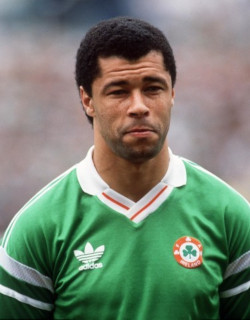
Birth of Professional Footballer Paul McGrath

Paul McGrath, former professional footballer for St. Patrick’s Athletic F.C., Manchester United F.C., Aston Villa F.C., Derby County F.C., and the Republic of Ireland national football team, is born in Greenford, Middlesex on December 4, 1959.

McGrath is born to an Irish mother and a Nigerian father. His father disappears soon after his conception. His mother, Betty McGrath, is terrified that her father will find out she had become pregnant outside marriage and in an interracial relationship. She travels in secret to London to have her child, who is considered illegitimate, and gives him up for fostering when he is four weeks old. When he is five years old, the family he had been fostered by comes to Betty saying they cannot control him. Betty places him into an orphanage.

McGrath begins as a schoolboy with Pearse Rovers and plays junior football for Dalkey United. While at the latter, he attracts the attention of Manchester United scout Billy Behan. Before becoming a full-time professional with League of Ireland club St. Patrick’s Athletic in 1981, he briefly works as an apprentice metal worker and a security guard in Dublin.

McGrath makes his debut in a League of Ireland Cup clash with the Shamrock Rovers F.C. in August at Richmond Park. He ultimately excels at St. Patrick’s, earning the nickname “The Black Pearl of Inchicore” and receiving the PFAI Players’ Player of the Year Award in his first and only season, scoring four goals in 31 total appearances.

In 1982, McGrath moves to Manchester United, then managed by Ron Atkinson. He misses out on a place in the FA Cup victory over Brighton & Hove Albion F.C. the following year. He is named man of the match for the 1985 FA Cup Final, which United wins 1–0 against Everton F.C. In his early years at Manchester United, he is frequently used as a midfielder, changing to defender while still at Old Trafford.

In 1985–86, it appears that McGrath is on course to pick up a league title medal after United wins their first 10 league games of the season, but injuries to key players including Bryan Robson soon take their toll on the side and they eventually finish fourth in the table, 12 points behind champions Liverpool F.C. Despite a dismal start to the 1986–87 season and a managerial change, McGrath remains a regular member of the first team. United finishes second behind Liverpool in the league a year later.

By the 1988–89 season, McGrath is struggling with knee injuries and is becoming a less regular member of the first team. His relationship with manager Alex Ferguson is becoming strained, as McGrath’s alcohol addiction and physical problems lead to United offering him a retirement package of £100,000. He refuses and Ferguson begins to inform clubs of his availability. Aston Villa’s offer is accepted and McGrath signs on August 3, 1989 for a fee of £400,000.

While at Aston Villa, McGrath plays some of the best football of his career, despite recurrent knee problems. Villa comes close to winning the title in his first season, finishing second to Liverpool. In the inaugural season of the Premier League (1992-93), Aston Villa again finishes as runners-up, behind Manchester United. As a sign of the regard he is now held in by his fellow professionals, McGrath wins the PFA Players’ Player of the Year award at the end of the season. He wins his first trophy with Villa, defeating Manchester United in the 1993–94 Football League Cup. In 1996 he wins a second League Cup for Villa. By the end of his Villa career he has chalked up 323 appearances for the club.

McGrath departs Aston Villa in the autumn of 1996, leaving a legacy as one of the greatest players in the club’s history. He is sold to Derby County for £200,000 and helps the newly promoted Rams finish 12th in its first Premier League season. He then drops down a division to sign for Sheffield United F.C. in the summer of 1997. He plays his final game as a professional for Sheffield United against Ipswich Town F.C. on November 9, 1997. He officially retires at the end of the season.

In McGrath’s international career he wins his first full cap against Italy in 1985, last playing 12 years later, against Wales. During that time, he is often regarded as the single most influential player Ireland has in the national team’s glory days.

In McGrath’s international career he is a major part of the breakthrough of Ireland’s national team of the late 1980s and early 1990s. During the early part of Jack Charlton‘s era, he plays as a defensive midfielder, due to the wealth of talent Ireland has in defence. In UEFA Euro 1988, as the national side first qualifies for an international tournament, he is present in the 1–0 group stage win against England.

In 1990, Ireland qualifies for its first FIFA World Cup, eventually reaching the quarter-finals, where they lose to Italy 1-0, with McGrath ever present in the lineups. He captains the team four times in 1992 after the retirement of Mick McCarthy, and ignores a painful shoulder virus to play in the 1994 FIFA World Cup.

In Ireland’s opening game of the 1994 World Cup, a 1–0 win against favourites Italy, in a perfect example of his commitment to the game, McGrath puts up an astonishing defensive performance in spite of excruciating knee problems. Even after his retirement from international football in 1997, he is still regarded today as one of the greatest players ever to put on Ireland’s green shirt.

Upon retiring, McGrath settles in Monageer, County Wexford. In 2004, one year after being taken to court, charged with a breach of the peace, he returns to the football world after five years, moving to Waterford F.C. in Ireland as director of football.

In 2011, McGrath launches a singing career with a cover version of the Gerry Goffin and Carole King song “Goin’ Back.” The recording is followed by the planning of an album of covers by the footballer, with a percentage of the album’s proceeds going to the Acquired Brain Injury Foundation and the Cystic Fibrosis Foundation of Ireland.


Leave a comment

Birth of Irish Footballer Jimmy Dunne

James “Jimmy” Dunne, Irish footballer who played for, among others, Shamrock Rovers F.C., Sheffield United F.C., Arsenal F.C. and Southampton F.C., is born on September 3, 1905, in Ringsend, Dublin. Dunne is also a dual internationalist and plays for both Ireland teams: the FAI XI and the IFA XI. Dunne holds the all-time record of consecutive goals scored at the elite level of English football.

Dunne is the first Irishman to figure prominently in the English Football League scoring records. In the 1930–1931 season he scores 41 league goals for Sheffield United. This becomes a club record and remains the most league goals scored by an Irishman during a single English League season.

In the 1931–1932 season, he scores in twelve consecutive matches. This is the all-time record of consecutive goals scored at the elite level of English football. Dunne also scores 30 or more First Division goals in three consecutive seasons between 1930 and 1933. He excels at either centre forward or inside forward and is outstanding with his head. On September 27, 1930, he scores a hat-trick of headers against Portsmouth F.C. He is a fringe member of the great Arsenal F.C. side of the 1930s before finishing his career at Shamrock Rovers F.C.

Dunne dies suddenly from a heart attack in Dublin, at the age of 44, on November 14, 1949. His two sons, Tommy and Jimmy, also play in the League of Ireland for St. Patrick’s Athletic F.C. Tommy also plays for Shamrock Rovers F.C. His nephew, another Tommy Dunne, also plays for Rovers and another nephew Christy Doyle, plays for Shelbourne F.C. and the Republic of Ireland.