seamus dubhghaill

Promoting Irish Culture and History from Little Rock, Arkansas, USA


Leave a comment

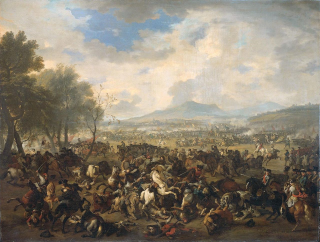
The Battle of Ramillies

The Irish Brigade of France fights at the Battle of Ramillies in the War of the Spanish Succession on May 23, 1706. For one hundred years Irishmen are smuggled from Ireland to France, where their rights are stripped by foreign invaders to fill the ranks of the famous Irish Brigade. During those one hundred years they fight all over Europe, in North America, the Caribbean, and even India. They shed their blood freely on several hundred fields “from Dunkirk to Belgrade,” in the words of Thomas Davis.

For the Grand AllianceAustria, England, and the Dutch Republic – the Battle of Ramillies follows an indecisive campaign against the Bourbon armies of King Louis XIV of France in 1705. Although the Allies capture Barcelona that year, they are forced to abandon their campaign on the Moselle, stall in the Spanish Netherlands and suffer defeat in northern Italy. Yet despite his opponents’ setbacks Louis XIV wants peace, but on reasonable terms. Because of this, as well as to maintain their momentum, the French and their allies take the offensive in 1706.

The campaign begins well for Louis XIV’s generals. In Italy, Marshal of France Louis Joseph, Duke of Vendôme, defeats the Austrians at the Battle of Calcinato in April, while in Alsace Marshal Claude Louis Hector de Villars forces Louis William, Margrave of Baden-Baden, back across the Rhine. Encouraged by these early gains Louis XIV urges Marshal François de Neufville, Duke of Villeroy, to go over to the offensive in the Spanish Netherlands and, with victory, gain a ‘fair’ peace. Accordingly, the French Marshal sets off from Leuven at the head of 60,000 men and marches toward Tienen, as if to threaten Zoutleeuw. Also determined to fight a major engagement, John Churchill, 1st Duke of Marlborough, commander-in-chief of Anglo-Dutch forces, assembles his army of some 62,000 men near Maastricht, and marches past Zoutleeuw. With both sides seeking battle, they soon encounter each other on the dry ground between the rivers Mehaigne and Gete, close to the small village of Ramillies, Belgium.

In less than four hours Marlborough’s Dutch, English, and Danish forces overwhelm Villeroi’s and Maximilian II Emanuel‘s Franco-Spanish-Bavarian army. The Duke’s subtle moves and changes in emphasis during the battle, something his opponents fail to realise until it is too late, catches the French in a tactical vice. With their foe broken and routed, the Allies are able to fully exploit their victory. Town after town falls, including Brussels, Bruges and Antwerp. By the end of the campaign Villeroi’s army has been driven from most of the Spanish Netherlands. With Prince Eugene of Savoy‘s subsequent success at the Siege of Turin in northern Italy, the Allies impose the greatest loss of territory and resources that Louis XIV would suffer during the war. Thus, the year 1706 proves, for the Allies, to be an annus mirabilis.

(Pictured: “The Battle of Ramillies between the French and the English, 23 May 1706” by Jan van Huchtenburgh, oil on canvas painted between 1706 and 1710)

Leave a comment

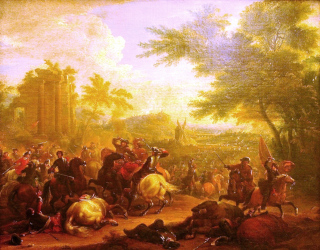
The Battle of Cassano

battle-of-cassano

Units of the Irish Brigade of France fight at the Battle of Cassano on August 16, 1705, during the War of the Spanish Succession. The battle is fought at the town of Cassano d’Adda, in Lombardy, Italy, between a French army commanded by Louis Joseph, Duke of Vendôme and an Imperial army under Prince Eugene of Savoy.

By August 1705, the French occupy most of Savoy, with the exception of Turin. In order to relieve the pressure, Prince Eugene tries to cross the river Adda at Cassano and threaten Milan. Although the French are taken by surprise, they manage to hold the bridge after six hours of intense conflict, both sides suffering heavy casualties.

The deep and fast-flowing river Adda has limited crossing points, especially for large bodies of men. The town of Cassano is on the right bank, with a stone bridge protected by a small fortification or redoubt. The area is also divided by numerous small streams and irrigation channels, the most significant being the Retorto, an irrigation canal running parallel to the Adda. This is connected to the left bank by another bridge, protected by another strongpoint.

Assuming Prince Eugene is still heading for Mantua, Vendôme orders his brother Philippe to leave his positions around Cassano and intercept him. In fact, the Imperial troops had marched overnight from Romanengo and are approaching the town when spotted by one of Vendôme’s cavalry patrols early the next morning. Realising their intentions, Vendôme heads to Cassano, along with approximately 2,000 reinforcements.

On arrival, he finds Philippe’s troops unprepared and in an extremely dangerous position, the bulk of their force caught between the Retorto canal and the Adda, and the main bridge blocked by their transport. Vendôme orders the baggage thrown into the river and forms a line running from the Retorto on the left, his centre around the main bridge, and his extreme right resting on the road leading to the nearby village of Rivolta d’Adda. Armand St. Hilaire, the French artillery commander, positions his guns inside the town, allowing him to fire directly on the bridge.

Around 2:00 in the afternoon, Austrian grenadiers attack the French positions around the Retorto. They initially succeed in capturing the bridge before being repulsed by St. Hilaire’s guns and a counterattack. Vendôme sends four regiments of the French Irish Brigade to reinforce his left, but after a fierce struggle, the Imperialists capture the canal’s sluice gates. After these are closed, the water level in the canal is lowered enough for men to wade across it.

Prince Eugene orders Leopold I, Prince of Anhalt-Dessau, and his Prussians into the canal to assault the French left. They manage to seize the further bank but suffer heavily in doing so. The battle surges back and forth across the river for several hours, in the course of which Vendôme has his horse killed under him, while Prince Eugene is wounded twice and has to leave the field. The fighting lasts another four to five hours, until ended by sheer exhaustion, with the opposing forces back at their starting positions.

The battle is inconclusive. While the French prevent the Imperialists crossing the Adda, Prince Eugene succeeds in delaying an assault on Turin until June 1706. Combined with having to transfer forces to Northern France following their defeat at Ramillies in May 1706, the French siege is broken in September, and fighting in Northern Italy ends in March 1707.

(Pictured: The battle of Cassano 1705 (War of the Spanish Succession), painted by Jean Baptiste Martin (1659-1735). Oil on canvas, Heeresgeschichtliches Museum, Vienna, Austria)