seamus dubhghaill

Promoting Irish Culture and History from Little Rock, Arkansas, USA


Leave a comment

Pope Gregory XIII Commissions the Gregorian Calendar

pope-gregory-xiii

Pope Gregory XIII commissions the new Gregorian calendar on February 24, 1582, replacing the Julian calendar introduced by Julius Caesar in 45BCE.

The reason for the reform is that the average length of the year in the Julian calendar is too long. It treats each year as 365 days, 6 hours in length, whereas calculations show that the actual mean length of a year is 365 days, 5 hours, and 49 minutes. As a result, the date of the actual vernal equinox, over the course of 13 centuries, has slowly slipped to March 10, while the calculation of the date of Easter still follows the traditional date of March 21.

These calculations are verified by the observations of mathematician and astronomer Christopher Clavius, and the new calendar is instituted when Gregory decrees on February 24, 1582, that the day after Thursday, October 4, 1582 will not be Friday, October 5, but rather Friday, October 15, 1582. The new calendar duly replaces the Julian calendar and has since come into universal use. Because of Gregory’s involvement, the reformed Julian calendar comes to be known as the Gregorian calendar.

The switchover is bitterly opposed by much of the populace, who fear it is an attempt by landlords to cheat them out of a week and a half of rent. However, the Catholic countries of Spain, Portugal, Poland, and Italy comply almost immediately. France, some states of the Dutch Republic, and various Catholic states in Germany and Switzerland follow suit within a year or two, and Hungary follows in 1587.

More than a century passes before Protestant Europe accepts the new calendar. Denmark, the remaining states of the Dutch Republic, and the Protestant states of the Holy Roman Empire and Switzerland adopt the Gregorian calendar in 1700–1701. Ireland and Great Britain, along with its American colonies, reform in 1752, where Wednesday, September 2, 1752 is immediately followed by Thursday, September 14, 1752. They are joined by the last Protestant holdout, Sweden, on March 1, 1753.

The Gregorian calendar is not accepted in eastern Christendom for several hundred years, and then only as the civil calendar. The Gregorian Calendar is instituted in Russia by the Bolsheviks in 1917. Romania accepts it in 1919 and is followed by Turkey in 1923. The last Orthodox country to accept the calendar is Greece, also in 1923.


Leave a comment

The Whiddy Island Disaster

betelgeuse

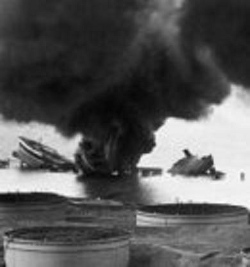
The Whiddy Island disaster, also known as the Betelgeuse incident, occurs on January 8, 1979, at around 1:00 AM, when the oil tanker Betelgeuse explodes in Bantry Bay in County Cork, at the offshore jetty for the oil terminal at Whiddy Island, while discharging its cargo of oil.

The explosion and resulting fire claim the lives of 50 people including 42 French nationals, 7 Irish nationals, and 1 United Kingdom national. Only 27 bodies are recovered. A further fatality occurs during the salvage operation with the loss of a Dutch diver.

On November 24, 1978, the Betelgeuse leaves Ras Tanura in the Persian Gulf bound for Leixões, Portugal, with a full cargo of crude oil. Originally the Betelgeuse is to call at Sines, Portugal, to lighten the load of the ship but poor weather conditions prevent the vessel from entering the harbour. Plans are further frustrated at Leixões as a ship has run aground across the harbour entrance preventing the Betelgeuse from berthing there to discharge her cargo. The Betelgeuse is then instructed to sail for Whiddy Island, Ireland.

The Betelgeuse first puts in at Vigo, Spain, to change some of her crew and then sails for Whiddy Island on December 30, 1978. During the passage the vessel encounters heavy weather in the Bay of Biscay and, after reporting a leakage of oil, is instructed to head towards Brest, France, at reduced speed. However, the origin of the leak is discovered and stopped. The vessel proceeds on its original planned course, arriving in Bantry Bay on January 4, 1979.

On the evening of January 6, 1979, the Betelgeuse has completed berthing at the offshore jetty in around 98 feet of water. At 11:30 PM the vessel commences discharging its 114,000 tonnes of mixed Arabian crude oil. This process is expected to take about 36 hours.

betelgeuse-memorial

At about 1:00 AM on Monday, January 8, a rumbling noise is heard from the vessel followed shortly by a huge explosion within its hull. The force of the explosion blows men from the jetty into the sea. Local residents report seeing the Betelgeuse engulfed in a ball of fire a few moments later. A series of further explosions follow, breaking the vessel in half. Much of the oil cargo still on board ignites. The concrete unloading jetty crumbles and firefighters, arriving on the scene from several neighbouring towns, are unable to get near the vessel. The firefighters concentrate their efforts on preventing the fire from spreading to the tanks of the storage farm and on containing the oil spillage.

About 12 hours after the explosion the Betelgeuse sinks at her moorings in 130 feet of water, which largely extinguishes the main body of the fire. In spite of this, rescue workers are not able to approach the wreck for two weeks due to clouds of toxic and inflammable gas surrounding it. After two weeks, it is possible to start recovering bodies from the wreck and pumping off the remainder of the oil cargo that is still on board.

A number of memorial services have been held to commemorate anniversaries of the incident. A memorial sculpture, incorporating the ship’s bell which was recovered from the wreck, has been erected in the hillside graveyard overlooking the harbor. The bodies of two unidentified casualties from the incident are interred nearby.