seamus dubhghaill

Promoting Irish Culture and History from Little Rock, Arkansas, USA


Leave a comment

Death of Sir Thomas de Rokeby, Justiciar of Ireland

Sir Thomas de Rokeby, a soldier and senior Crown official in fourteenth-century England and Ireland, who serves as Justiciar of Ireland, dies on April 23, 1357. He is appointed to that office to restore law and order to Ireland, and has considerable early success in this task, but he is recalled to England after the military situation deteriorates. He is later re-appointed Justiciar, and returns to Ireland to take up office, but dies soon afterwards.

The Rokebys are a prominent landowning family from Mortham in North Yorkshire. He is probably the son of Thomas de Rokeby, who dies in 1318. His nephew, also named Thomas, the son of his brother Robert, is closely associated with him in his later years and the elder Thomas is often called “l’oncle” to distinguish him from his nephew.

Rokeby first comes to public attention in 1327 when, after his return from prison in Scotland, he receives the thanks of the new King Edward III for being the squire who had first pointed out the approach of the Scots army during the invasion of the previous July. As a reward he is knighted and given lands worth £100 a year. He sees action against the Scots regularly between 1336 and 1342 and has charge of Stirling Castle and Edinburgh Castle while they are held by the English. He is High Sheriff of Yorkshire from 1342 to 1349. He is one of the English commanders at the Battle of Neville’s Cross in 1346, and it is said, “gave the Scots such a draught as they did not care to taste again.” He is then entrusted with bringing King David II of Scotland as a captive to London, and he receives further grants of land as a reward for his good services.

In 1349 Rokeby is appointed Justiciar of Ireland, and given a large armed retinue to accompany him, as it is recognised by the English Crown that “Ireland is not in good plight or good peace.” While there is some surprise at the appointment of an old soldier to such a sensitive political position, the more informed view is that Rokeby is well suited to the task of enforcing justice by military force. He arrives in December and makes a quick circuit of the south of Ireland, mainly to keep watch on the powerful but troublesome magnate Maurice FitzGerald, 1st Earl of Desmond.

Rokeby is praised by his contemporaries for his regard for justice and his zeal in checking extortion by Crown officials. He undertakes a general overhaul of the Irish administration, aimed particularly at the detection and prevention of corruption and the removal of incompetent officials. Arguably he shows excessive zeal in arresting and imprisoning the Lord High Treasurer of Ireland, Robert de Emeldon, a man who enjoys the King’s personal regard. Admittedly the charges against Emeldon are very serious, including rape, robbery and manslaughter, but the King, out of regard for their long friendship and Emeldon’s record of good service to the Crown in Ireland, had already pardoned Emeldon for killing one Ralph de Byrton, a knight, in 1336. Emeldon is once more pardoned and quickly released.

In November 1351 Rokeby holds a Great Council at Kilkenny. It deals partly with the problem of official corruption already mentioned, partly with the problem of defence of the Pale, and partly with the question of intermarriage and other close contacts between the Anglo-Irish and the Old Irish. Otway-Ruthven notes that little of the legislation is new, apart from the application to Ireland of the English Statute of Labourers of 1351, and that much of it is repeated in the better-known Statutes of Kilkenny of 1366.

In 1353 the Clan MacCarthy of Muskerry, the dominant clan in central County Cork, who had until then been loyal to the English Crown, rebels. Rokeby shows considerable skill in crushing the uprising and succeeds in replacing the rebellious head of the clan, Dermot MacCarthy, with his more compliant cousin Cormac. Cormac’s descendants gain great wealth, extensive lands and the title Earl of Clancarty.

This promising state of good order does not last long. A rebellion by the O’Byrne Clan of Wicklow in 1354 is followed by a general uprising headed by the MacMurrough-Kavanagh dynasty. Although Muirchearteach MacMurrough-Kavanagh, the self-styled King of Leinster, is captured and executed, Rokeby suffers several military defeats. He is unable to suppress the O’Byrnes’ rebellion, and other risings take place in Tipperary, Kildare and Ulster.

Rokeby, now an ageing and discouraged man, is recalled in 1355. His replacement, rather surprisingly, is that Earl of Desmond whom it had been one of his main tasks to keep in check. Desmond dies a year later on July 26, 1356. Rokeby is reappointed Justiciar, and returns to Ireland, only to die soon afterwards on April 23, 1357 at Kilkea Castle.

Rokeby is married and his wife is named Juliana, but little else is known of her. They have no children, and his estates pass to his nephew, the younger Thomas.

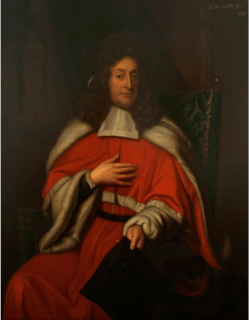
(Pictured: Portrait of Sir Thomas de Rokeby, painting by Godfried Schalcken)


1 Comment

Edward the Bruce Appointed High King of Ireland

grave-of-king-edward-de-bruce

Edward Bruce of Scotland is crowned High King of Ireland at Dundalk on May 2, 1316. He is the younger brother of Robert the Bruce, King of Scotland. He is also sometimes known as Edward de Brus or Edward the Bruce.

Edward is the second of five sons of Robert de Brus, 6th Lord of Annandale and Marjorie, Countess of Carrick. His date of birth, believed to be around 1280, is unknown but King Robert is obviously the firstborn. He has eleven siblings, of whom nine survive childhood. One of his older sisters, Lady Christina Bruce, also plays an active role in the wars of independence against England.

By 1307 Edward fights alongside Robert throughout his struggle for the Scottish throne and accompanies him during his flight from Scotland and subsequent guerilla campaign against the English. The three younger Bruce brothers Nigel, Thomas, and Alexander are all captured and executed by the English during this period. Some time between 1309 and 1313, Edward is created Earl of Carrick, a title previously held by his maternal grandfather Niall of Carrick, his mother and his elder brother.

As the Scots become more dominant, Edward commands a number of successful sieges of English-held castles across the country. By November 1313 he commands the siege of the last remaining English outpost in Scotland, Stirling Castle. Without Robert’s knowledge, he makes a deal with the English Constable of the castle that should an English army not arrive to relieve it by June 24, 1314, the castle will surrender, so making an aggressive siege unnecessary. Robert is deeply unhappy, but has little choice but to confront the English army sent by Edward II to relieve Stirling in June 1314. The armies meet at the Battle of Bannockburn, and the result is a decisive victory for the Scots which leaves Robert in fairly unopposed control of Scotland.

Robert decides to open a second front against the English and dispatches an army of 6,000 men under the command of Edward to Ireland. The aim is to challenge English dominance of the British Isles by drawing together Scottish and Irish interests. Scottish and Irish forces are initially successful in defeating the English and on May 2, 1316 Edward is appointed High King of Ireland.

A famine in 1317 proves a setback to Edward and greatly reduces his popularity. This allowed time for an English army under John de Bermingham to be assembled. The English army meets the Scots-Irish army under King Edward Bruce at the Battle of Faughart on October 14, 1318. The Scots-Irish army is badly defeated by de Bermingham’s forces. Edward is killed, his body being quartered and sent to various towns in Ireland, and his head being delivered to King Edward II.

Edward Bruce is the last High King of Ireland.

(Pictured: Grave of King Edward De Bruce, located in Faughart Cemetery)


Leave a comment

James I Ascends to King of England and Ireland

king-james-i

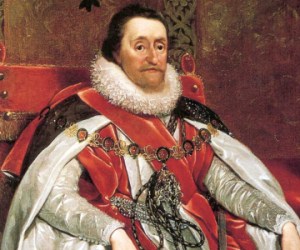
James VI of Scotland ascends to King of England and Ireland as James I on March 24, 1603. The kingdoms of Scotland and England are individual sovereign states, with their own parliaments, judiciary, and laws, though both are ruled by James in personal union.

James is born on June 19, 1566, at Edinburgh Castle, the son of Mary, Queen of Scots, and a great-great-grandson of Henry VII, King of England and Lord of Ireland, uniquely positioning him to eventually accede to all three thrones. He is baptised “Charles James” on December 17, 1566, in a Catholic ceremony held at Stirling Castle.

James succeeds to the Scottish throne at the age of thirteen months, after his mother is compelled to abdicate in his favour. Four different regents govern during his minority though he does not gain full control of his government until 1583. On March 24, 1603, he succeeds his cousin, Elizabeth I, upon her death, uniting the crowns of Scotland and England, while also gaining possession of the Kingdom of Ireland, then an English possession.

James continues to reign in all three kingdoms for 22 years, a period known as the Jacobean era, until his death in 1625 at 58 years of age. After the Union of the Crowns in 1603, he bases himself in England, which is the largest of the three realms, and styles himself “King of Great Britain and Ireland.” He returns to Scotland only once in 1617. He is a major advocate of a single parliament for England and Scotland. During his reign, the Plantation of Ulster and British colonisation of the Americas begins.

At 57 years and 246 days, James’s reign in Scotland is longer than those of any of his predecessors. He achieves most of his aims in Scotland but faces great difficulties in England, including the Gunpowder Plot in 1605 and repeated conflicts with the English Parliament. Under James, the “Golden Age” of Elizabethan literature and drama continues, with writers such as William Shakespeare, John Donne, Ben Jonson, and Sir Francis Bacon contributing to a flourishing literary culture. James himself is a talented scholar, the author of works such as Daemonologie (1597), True Law of Free Monarchies (1598), and Basilikon Doron (1599). He sponsors the translation of the Bible that is named after him – the Authorised King James Version.

In early 1625, James is plagued by severe attacks of arthritis, gout, and fainting fits. In March, he falls seriously ill with tertian ague followed by a stroke. He dies at Theobalds House on March 27 during a violent attack of dysentery. James is buried in Westminster Abbey, but the position of the tomb is lost for many years. In the 19th century, following an excavation of many of the vaults beneath the floor, the lead coffin is found in the Henry VII vault.