
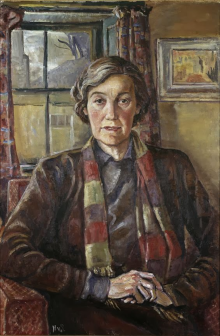
Eva Sydney Hone RHA, Irish painter and stained glass artist usually known as Evie, is born at Roebuck Grove, County Dublin, on April 22, 1894. She is considered to be an early pioneer of cubism, although her best known works are stained glass. Her most notable pieces are the East Window in the Chapel at Eton College, which depicts the Crucifixion, and My Four Green Fields, which is now in the Government Buildings in Dublin.
Hone is the youngest daughter of Joseph Hone, of the Hone family, and Eva Eleanor (née Robinson), daughter of Sir Henry Robinson and granddaughter of Arthur Annesley, 10th Viscount Valentia. Her mother dies two days after her birth. She is related to artists Nathaniel Hone and Nathaniel Hone the Younger.
Shortly before her twelfth birthday, Hone suffers from polio (infant paralysis), suffering a fall while helping to decorate the Taney parish church for Easter. Her resulting ill health leads to her seeking treatment in Harley Street, Marylebone, Central London. She is educated by a governess, continuing her education in Switzerland, and goes on tours to Spain and Italy before moving to London in 1913. Her three sisters all marry British Army officers, and all are widowed in World War I.
Hone studies at the Byam Shaw School of Art in London and then under Bernard Meninsky at the Central School of Arts and Crafts. She meets Mainie Jellett when both are studying under Walter Sickert at the Westminster Technical Institute. She works under André Lhote and Albert Gleizes in Paris before returning to become influential in the modern movement in Ireland and becoming one of the founders of the Irish Exhibition of Living Art. She is considered an early pioneer of Cubism but in the 1930s turns to stained glass, which she studies with Wilhelmina Geddes.
Hone is extremely devout. She spends time in an Anglican Convent in 1925 at Truro in Cornwall and converts to Catholicism in 1937. This possibly influences her decision to begin working in stained glass. Initially, she works as a member of the An Túr Gloine stained glass co-operative before setting up a studio of her own in Rathfarnham.
Hone’s most important works are probably the East Window, depicting the Crucifixion, for the Chapel at Eton College, Windsor (1949–1952) and My Four Green Fields, now located in Government Buildings, Dublin. This latter work, commissioned for the Irish Government’s Pavilion, wins first prize for stained glass in the 1939 New York World’s Fair. It graces CIÉ‘s Head Office in O’Connell Street from 1960 to about 1983. The East Window of Eton College is commissioned following the destruction of the building after a bomb is dropped in 1940 on the school during World War II. She is commissioned to design the East Window in 1949, and the new window is inserted in 1952. This work is featured on an Irish postage stamp in 1969. From December 2005 to June 2006, an exhibition of her work is on display at the National Gallery of Ireland. Saint Mary’s church in Clonsilla also features her stained glass windows.
Despite ill health, Hone continues to produce a huge number of small stained glass panels as well as oils, watercolours, and gouache landscapes. In 1953, she is represented at the Contemporary Irish Art exhibition at Aberystwyth, Wales, and at the Tate gallery in London, receiving as well an honorary LLD from Trinity College Dublin (TCD). In 1954, she is elected an honorary member of the Royal Hibernian Academy (RHA).
Unmarried, Hone dies on March 13, 1955, while entering her parish church at Rathfarnham. She is survived by two of her sisters. Over 20,000 people visit a memorial exhibition of her work at University College Dublin (UCD), Earlsfort Terrace, Dublin, in 1958.
(Pictured: Portrait of Evie Hone by Hilda van Stockum)
 seamus dubhghaill