Doire Leathan is on the eastern shores of Teelin Bay, being just across from the village of Teelin. The battle is part of the ongoing succession dispute for the leadership of the Gaelic lordship of O’Donnell. A combined force of Irish clans and ScottishRedshankmercenaries hired by Iníon Dubh (pronounced “In-neen Doo”) defeat and kill Sir Domhnall Ó Domhnaill (Sir Donnell O’Donnell). The Tanist of Tír Conaill, Sir Domhnall’s younger half-brother and Iníon Dubh’s son, Red Hugh O’Donnell, is still imprisoned in Dublin Castle, but later rises following a subsequent escape to lead Clan O’Donnell and is a prominent figure during the Nine Years’ War.
According to the Annals of the Four Masters, “The son of O’Donnell, i.e. Donnell, the son of Hugh, son of Manus, son of Hugh Duv, son of Hugh Roe, son of Niall Garv, son of Turlough of the Wine, attempt to depose his father, after he had grown weak and feeble from age, and after his other son had been imprisoned in Dublin; so that Donnell brought under his power and jurisdiction that part of Tirconnell from the mountain westwards, i.e. from Bearnas to the River Drowes; and also the people of Boylagh and Tir-Boghaine. It was a cause of great anguish and sickness of mind to Ineenduv, the daughter of James Mac Donnell, that Donnell should make such an attempt, lest he might attain the chieftainship of Tirconnell in preference to her son, Hugh Roe, who was confined in Dublin, and who she hoped would become chief, whatever time God might permit him to return from his captivity; and she, therefore, assembled all the Kinel-Connell who were obedient to her husband, namely, O’Doherty, with his forces; Mac Sweeny-na dTuath (Owen Oge), with his forces; and Mac Sweeny Fanad, with his forces; with a great number of Scots along with them. After Donnell O’Donnell had received intelligence that this muster had been made to oppose him, he assembled his forces to meet them. These were they who rose up to assist him on this occasion: Mac SweenyBanagh (Donough, the son of Mulmurry); a party of the Clan Sweeney of Munster, under the conduct of the three sons of Owen, the son of Mulmurry, son of Donough, son of Turlough, and their forces; and O’Boyle (Teige Oge, the son of Teige, son of Turlough), with all his forces, assembled. The place where the son of O’Donnell happened to be stationed along with these chieftains was Doire-leathan at the extremity of Tir-Boghaine, to the west of Gleann Choluim Cille. The other party did not halt until they came to them to that place; and a battle ensued between them, which was fiercely fought on both sides. The Scots discharged a shower of arrows from their elastic bows, by which they pierced and wounded great numbers, and, among the rest, the son of O’Donnell himself, who, being unable to display prowess or defend himself, was slain at Doire-leathan, on one side of the harbour of Telinn, on the 14th of September. Seldom before that time had his enemies triumphed over him; and the party by whom he was slain had not been by any means his enemies until they encountered on this occasion; and although this Donnell was not the rightful heir of his father, it would have been no disgrace to Tirconnell to have elected him as its chief, had he been permitted to attain to that dignity. In this conflict were slain along with Donnell the three sons of Owen, son of Mulmurry, son of Donough above mentioned, together with two hundred others, around Donnell.”
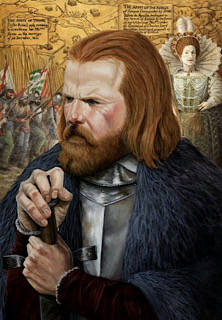
(Pictured: Hugh Roe O’Donnell, otherwise known in history and lore as Red Hugh O’Donnell)
Brian O’Neill (Irish: Brian Chatha an Dúna Ó Néill), the High King of Ireland from 1258 to 1260, is defeated and killed by the forces of Roger des Auters at the Battle of Down on May 14, 1260.
O’Neill is the son of Niall Roe O’Neill, and grandson of Áed in Macáem Tóinlesc. His wife is Nuala O’Connor (Ní Conchobair), a daughter of Rory O’Connor (Irish: Ruaidrí Ua Conchobair), the last High King of Ireland before the Norman invasion. Therefore, through his mother, he is descended from Brian Boru (Irish: Brian Bóramha).
In 1230, Hugh O’Neill (Irish: Aedh Ó Néill), king of Tyrone, dies and is succeeded by Donnell MacLaughlin. MacLaughlin, however, is removed in 1238 by the Justiciar of Ireland, Maurice FitzGerald, 2nd Lord of Offaly, and Hugh de Lacy, 1st Earl of Ulster, who install “the son of O’Neill”, presumed to have been Brian, and take the hostages of the Cenel Owen and Cenel Connell. However, it may have been Brian’s cousin Donnell, who afterwards is killed by MacLaughlin. After this, O’Neill claims the kingship of the O’Neill dynasty as well as Tyrone, possibly with the aid of Hugh de Lacy, 1st Earl of Ulster.
In revenge, O’Neill with the aid of Melaghlin O’Donnell, king of Tyrconnell, defeat MacLoughlin and ten of his closest kinsmen at the Battle of Camergi, somewhere within Tyrone north of Omagh, in 1241. This ends the long rivalry between the MacLoughlin’s and O’Neill’s, with the MacLoughlin’s afterwards excluded from the kingship of Tyrone and Ailech.
In 1244, Henry III of England sends letters to various Gaelic Irish lords, including O’Neill, requesting their aid in a military campaign against the Kingdom of Scotland. In the end the issue is sorted out diplomatically. Copies of the letter are also distributed to O’Neill’s sub-chiefs including his tánaiste, Hugh Boy O’Neill.
A consequence of this infighting between the rival factions of the Cenél Eoghain allows the Normans to advance deeper into Gaelic Ulster, however, in 1243 de Lacy dies. Thus the Earldom of Ulster reverts to the English Crown and is taken over by royal administrators. John FitzGeoffrey, the king’s chief governor in Ireland, erects a bridge across the River Bann and builds castles at Coleraine and Ballyroney in Iveagh. From here FitzGeoffrey is able to penetrate deeper into Tyrone.
Despite ending MacLoughlin aspirations to the kingship, O’Neill forms a marriage alliance with them, however, this results in a war with the O’Donnells of Tyrconnell. Subsequently in 1248 O’Neill backs the king of Tyrconnell, Rory O’Cannon (Irish: Ruaidri Ua Canannáin), against the claims of O’Donnell. O’Cannon had been set up in the kingship by FitzGerald, however, rather than backing him, enters Tyrconnell and removes him in favour of Gofraid O’Donnell.
O’Cannon, who had been expelled to Tyrone, and O’Neill once again lead their forces into Tyrconnell to confront O’Donnell, however they are defeated and O’Cannon is killed.
That same year, John FitzGeoffrey, who replaced FitzGerald as Justiciar in 1246, enters Tyrone and takes the submission and hostages of O’Neill. A resolution had been adopted at a meeting of the Cenel Owen that “since the power of the Foreigners was over the Gaeidhel of Erinn, to give hostages to the Foreigners, and to make peace with them, for the sake of their country.”
In 1249, the king of Connacht, Felim O’Connor, is given refuge from the Normans by O’Neill. In 1252, O’Neill and his brother give their submissions to the Justiciar of Ireland, who had marched to Armagh with a large force. A Rory O’Neill is given as hostage.
In 1253, as a sign of defiance against his vassal status with the Earldom of Ulster, O’Neill withholds his tribute to it and raids Iveagh, destroying the castle at Ballyroney. He also launches an offensive against the Normans in Leinster. That same year, the son of Maurice FitzGerald leads his forces into Tyrone to attack O’Neill, however he fails to take his submission or hostages and after battle suffers a heavy defeat at the hands of O’Neill.
In 1255, O’Neill makes a pact with Felim O’Connor’s son Hugh, whereby allowing Hugh free rein in the Kingdom of Breifne, he would aid O’Neill against the Normans of the earldom who are eroding his territory.
In 1257, the king of Tyrconnell, Gofraid O’Donnell, is mortally wounded in battle against the FitzGeralds and O’Neill uses this opportunity to try to exact Tyrconnell’s submission. As the Cenel Connell discuss what to do, Gofraid’s youngest brother, Donnell Óg, returns from fosterage and is conferred the chieftainship of Tyrconnell. He refuses to submit O’Neill stating the Scottish proverb “Every man should have his own world.”
FitzGerald in 1252 had built a castle at Caoluisce, on the banks of Lough Erne, near modern day Belleek, County Fermanagh, Northern Ireland, however, in 1258 it is the site where O’Neill, in the presence of his ally O’Connor, is inaugurated as “King of the Gael of Erin.” While he receives hostages from O’Connor and from O’Brien of Thomond, along with several other minor Kings from Meath and Munster, his claim is not recognised by those of the Irish closest to him including the other O’Neill factions, the O’Donnell’s of Tyrconnell, the MacMahon’s of Airgíalla, and the O’Rourkes of Breifne. The following year O’Donnell leads an attack into Tyrone.
In 1260, O’Neill, along with his O’Connor allies, launch an attack on the Normans of the Earldom of Ulster at Drumderg, near its capital at Downpatrick in modern County Down, Northern Ireland. The Normans levy the town, and with the aid of forces brought by Sir Roger des Auters, O’Neill and his allies are decisively defeated at the subsequent Battle of Down. The Annals of Inisfallen state that the forces recruited by the Normans consist mostly of native Irish and that the Normans play only a minor role.
In the battle, O’Neill is killed along with many other Irish nobles including over a dozen members of the O’Cahans. O’Neill’s head is cut off by the Normans and sent to King Henry III of England, a sign of how dangerous his coalition is believed to be.
After this battle, O’Neill becomes known in Irish as Brian Chatha an Dúna, meaning “Brian of the Battle of Down.”
After O’Neill’s death, the kingship of the Cenel Owen, and with it Tyrone, is taken by his cousin’s son, Hugh Boy O’Neill, ancestor of the Clandeboye O’Neill’s, who also has the support of the earldom of Ulster. Upon Hugh’s death in 1283 O’Neill’s son Donnell seizes the kingship, which until 1295 is highly contested between him and his second-cousin Niall Culanach O’Neill and Hugh Boy’s son Brian, until he wins outright control by killing his opponents.


 seamus dubhghaill