After moving to Houston in 1994, Devlin tends bar in Irish pubs and music venues for a number of years before starting his first band. From his perspective behind the bar, he realizes there is a local demand for Irish rock music that nobody is fulfilling. In 1996, to this end he forms a band called On the Dole. Although the band does well for several years, opening for legendary Irish touring acts like The Wolfe Tones and The Saw Doctors, eventually he decides it is time to clear the decks and start again.
In 2003, while hosting a weekly open mic at an Irish pub, Devlin meets bassist and singer Chad Smalley, son of Nobel laureateRichard Smalley and a veteran of the Houston music scene who had recently returned from New York and is looking for a new project. The two of them soon begin singing and performing together every week, developing a tight vocal harmony style.
In July 2004, Devlin and Smalley form Blaggards, along with violinist Turi Hoiseth and drummer Brian Vogel. Hoiseth and Vogel have since left the band, leaving Devlin and Smalley as the only original members.
The song “Big Strong Man” from Blaggards’ first album Standards (2005) appears in the 2010 British film The Kid, directed by Nick Moran.
“Big Strong Man” and “Drunken Sailor” (also from Standards) are both featured in episode 86 of the CBS series The Good Wife, aired on March 24, 2013.
Blaggards’ second album, Live in Texas, is released in 2010. It is a recording of a live performance at Houston’s Continental Club on June 13, 2009. The band’s latest album, Blagmatic, is released on July 14, 2021.
Blaggards, with Arizona-based fiddle player Heide Riggs and drummer Kevin “Turbo” Newton in the current lineup, continue to maintain a rigorous schedule, playing constantly throughout Texas and touring nationally several times a year. Beginning in 2010 (excluding the COVID years), the band does a 10-day Ireland tour every year in the early fall.
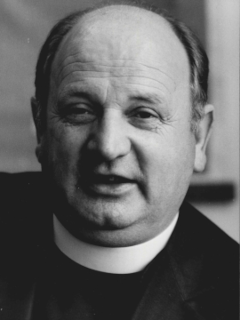
Eamonn Casey, Irish Catholicprelate who serves as bishop of Galway and Kilmacduagh from 1976 until his resignation 1992, returns to Ireland on February 5, 2006, following fourteen years in exile. He fled Ireland after he admitted to fathering his son, Peter.
Casey holds this position until 1976, when he is appointed Bishop of Galway and Kilmacduagh and apostolic administrator of Kilfenora. While in Galway, he is seen as a progressive. It is a significant change in a diocese that had been led for nearly forty years by the very conservative Michael Browne, bishop from 1937 to 1976. He is highly influential in the Irish Catholic hierarchy and a friend and colleague of another highly prominent Irish priest, Father Michael Cleary.
In 1992 it is reported that, despite the vow of chastity undertaken by Catholic clergy, Casey has a sexual relationship in the early 1970s with American woman Annie Murphy. When Murphy becomes pregnant, he is determined that the child should be given up for adoption in order to avoid any scandal for himself or the Catholic church. By contrast, Murphy is determined to accept responsibility for her child, and she returns to the United States with their son, Peter, who is born in 1974 in Dublin. He makes covert payments for the boy’s maintenance, fraudulently made from diocesan funds and channeled through intermediaries. In order to continue the cover up of his affair with Murphy and his fraudulent activities, he refuses to develop a relationship with his son, or acknowledge him. Murphy is very disappointed by this, and in the early 1990s contacts The Irish Times to tell the truth about Casey’s hypocrisy and deception. Having been exposed, he reluctantly admits that he had “sinned” and wronged the boy, his mother and “God, his church and the clergy and people of the dioceses of Galway and Kerry,” and his embezzlement of church funds. He is forced to resign as bishop and flees the country under a cloud of scandal. He is succeeded by his secretary, James McLoughlin, who serves in the post until his own retirement on July 3, 2005.
Murphy publishes a book, Forbidden Fruit, in 1993 revealing the truth of their relationship and the son she bore by Casey, exposing the institutional level of hypocrisy, moral corruption and misogyny within the Irish Catholic Church.
Casey is ordered by the Vatican to leave Ireland and become a missionary alongside members of the Missionary Society of St. James in a rural parish in Ecuador, whose language, Spanish, he does not speak. During this time, he travels long distances to reach the widely scattered members of his parish but does not travel to meet his own son. After his missionary position is completed, he takes a position in the parish of St. Pauls, Haywards Heath, West Sussex, England.
In 2005, Casey is investigated in conjunction with the sexual abuse scandal in Galway, Kilmacduagh and Kilfenora diocese, and cleared of any wrongdoing. In 2019, it emerges that he had faced at least three accusations of sexual abuse before his death, with two High Court cases being settled. The Kerry diocese confirms that it had received allegations against him, that Gardaí and health authorities had been informed and that the person concerned was offered support by the diocese.
Casey returns to Ireland on February 5, 2006, with his reputation in tatters, and is not permitted to say Mass in public.
In August 2011, Casey, in poor health, is admitted to a nursing home in County Clare. He dies on March 13, 2017, a month before his 90th birthday. He is interred in Galway cathedral’s crypt.
Casey is the subject of Martin Egan’s song “Casey,” sung by Christy Moore. He is also the subject of The Saw Doctors‘ song “Howya Julia.”
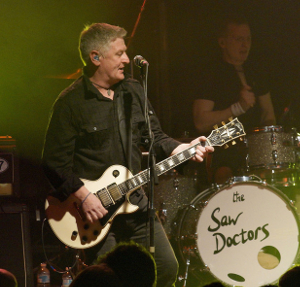
Davy Carton, singer, songwriter, and rhythm guitarist, is born in Islington, London, on April 10, 1959. He is best known as a core member of The Saw Doctors, the folk-rock band he co-founds with Leo Moran and others in 1987.
Carton moves permanently to Tuam, County Galway, with his family in 1966. As a teenager he attends Tuam’s Christian Brothers school, where he forms the punk band Blaze X with fellow students Paul Cunniffe, Paul Ralph, and Ja Keating. He works in a local textile factory after leaving school but continues to play with Blaze X until the band dissolves in 1981, the year Carton marries his girlfriend, Trisha.
Working full-time in the textile factory throughout Ireland’s economically bleak 1980s, Carton largely puts his musical career on hold to support his wife and three young sons.
In the late 1980s, Carton gets together for a pint with Leo Moran, formerly of Irish reggae band Too Much for the White Man. Carton and Moran begin gigging around Galway with a handful of their own rootsy-rock compositions.
The duo adopts the name Saw Doctors — travelers who earn money by sharpening saws in old Ireland — until they can think of something better. As the band grows, the opportunity to find a better name never arises.
Carton finally gives up his day job in 1989, when the Saw Doctors rise to prominence and begin touring with bands including The Waterboys, Hothouse Flowers, and The Stunning.
Carton’s achievements with the Saw Doctors include six studio albums, two live albums, a concert DVD, several compilation albums, and extensive tours throughout Europe and the United States. Noted for his witty, rapacious lyrics, Carton has co-written almost all of the band’s songs, including “I Useta Lover,” one of the all-time best-selling singles in Ireland.
The Saw Doctors’ lyrics tend to stay out of political issues. “I’m not a politician, and I never will be a politician,” Carton tells the website PopMatters in 2003. “What I like to do is go into a room of people and make them sing along and whatever. I’m not going to tell them how to vote – there’s enough people doing that already. I’d rather talk about girlfriends and football. We don’t like to write about things we don’t really know about. We know about rejection from girls and all that, so we can write about that.”


 seamus dubhghaill