seamus dubhghaill

Promoting Irish Culture and History from Little Rock, Arkansas, USA


Leave a comment

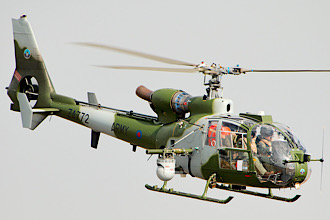
1978 British Army Gazelle Helicopter Downing

On February 17, 1978, a British Army Aérospatiale Gazelle helicopter, serial number XX404, goes down near Jonesborough, County ArmaghNorthern Ireland, after being fired at by a Provisional Irish Republican Army unit from the South Armagh Brigade. The IRA unit is involved at the time in a gun battle with a Royal Green Jackets observation post deployed in the area, and the helicopter is sent in to support the ground troops. The helicopter crashes after the pilot loses control of the aircraft while evading ground fire.

Lieutenant Colonel Ian Douglas Corden-Lloyd, 2nd Battalion Green Jackets commanding officer, dies in the crash. The incident is overshadowed in the press by the La Mon restaurant bombing, which takes place just hours later near Belfast.

By early 1978, the British Army forces involved in Operation Banner have recently replaced their aging Bell H-13 Sioux helicopters for the more versatile Aérospatiale Gazelles. The introduction of the new machines increases the area covered on a reconnaissance sortie as well as the improved time spent in airborne missions. In the same period, the Provisional IRA receives its first consignment of M60 machine guns from the Middle East, which are displayed by masked volunteers during a Bloody Sunday commemoration in Derry. Airborne operations are crucial for the British presence along the border, especially in south County Armagh, where the level of IRA activity means that every supply and soldier has to be ferried in and out of their bases by helicopter since 1975.

The Royal Green Jackets have been in South Armagh since December 1977, and have already seen some action. Just a few days after arrival, two mortar rounds hit the C Company base at Forkhill, injuring a number of soldiers. In the aftermath of the attack, two Royal Ulster Constabulary (RUC) officers are wounded by a booby trap while recovering the lorry where the mortar tubes are mounted. Two days later, a patrol near the border suffers a bomb and gun attack, leaving the commanding sergeant with severe head wounds. The sergeant is picked up from the scene by helicopter. He is later invalided from the British Army as a result of his injuries.

On January 17, 1978, a Royal Green Jackets observation post deployed around the village of Jonesborough begins to take heavy fire from the “March Wall,” which draws parallel with the Irish border to the east, along the Dromad woods. The soldiers return fire, but the short distance to the border and the open ground prevents them from advancing.

The Commanding Officer, Lieutenant Colonel Ian Corden-Lloyd, along with Captain Philip Schofield and Sergeant Ives fly from the battalion base at Bessbrook Mill to assess the situation and provide information to the troops. They are escorted by a Scout helicopter with an Airborne Reaction Force (ARF), comprising a medic and three soldiers from the 2nd Battalion Light Infantry. While hovering over the scene of the engagement, the Aérospatiale Gazelle receives a barrage of 7.62 mm tracer rounds. The pilot loses control of the aircraft during a turn at high speed to avoid the stream of fire. The Aérospatiale Gazelle hits a wall and crashes in a field, some 2 km from Jonesborough. According to the crew and passengers of the Scout, the Aérospatiale Gazelle hits the ground twice after losing power, with its rotor blades trashing into the soil following the second impact, and then cartwheels across the field. The Scout lands the ARF while still under IRA fire. The soldiers rush to the wrecked helicopter, some 100 metres away from the site of the initial crash.

Corden-Lloyd is killed and the other two passengers are wounded. The machine comes to rest on its right side. The pilot remains trapped inside the wreckage, but he survives thanks to his helmet. The IRA later claim they had shot at the helicopter with an M60 machine gun. The IRA unit vanishes into the Dromad woods to the Republic of Ireland. Some Gardaí witness the attack from the other side of the border.

The gun battle and Aérospatiale Gazelle shootdown is displaced from the headlines by the deaths of twelve civilians in the La Mon restaurant bombing on the same day, some of whom are burned to death. Initially the British Army downplays the IRA’s claim as published by An Phoblacht, that the helicopter was shot down, on the basis that no hits were found on the wreckage, but finally they acknowledged that the IRA action had caused the crash.

The death of Corden-Lloyd, a former Special Air Service officer, is deeply regretted by the British Army, who regarded him as promising. He is awarded a posthumous mentioned in despatches “in recognition of gallant and distinguished service in Northern Ireland.” In 1973, Irish republicans had accused Corden-Lloyd and his subordinates of brutality against Belfast Catholics during an earlier tour of the Royal Green Jackets in 1971, at the time of Operation Demetrius.


Leave a comment

The Clonoe Ambush

The Clonoe Ambush, a military action between the British Army and the Provisional Irish Republican Army (IRA), occurs on February 16, 1992, during the Troubles in Northern Ireland. An IRA unit attacks the Royal Ulster Constabulary (RUC) security base in the village of Coalisland in County Tyrone and is ambushed shortly afterwards by the Special Air Service (SAS) in the grounds of a church in the village of Clonoe while attempting to make its escape, resulting in several IRA fatalities.

From 1985 onwards, the IRA in East Tyrone had been at the forefront of a campaign against British state police and army facilities and their personnel. In 1987, an East Tyrone IRA unit was ambushed with eight of its members being killed by the SAS while they were making an attack on a police station in Loughgall, County Armagh. This was the IRA’s greatest loss of life in a single incident during The Troubles. Despite these losses, the IRA’s campaign continued, with it attacking nearly 100 police and military facilities over the next five years, wrecking thirty-three and damaging the remainder to varying degrees. The SAS ambush has no noticeable long-term effect on the level of IRA activity in East Tyrone. In the two years before the Loughgall ambush, the IRA killed seven people in East Tyrone and North Armagh, and eleven in the two years following the ambush.

Three other IRA members – Gerard Harte, Martin Harte and Brian Mullin – had been ambushed and killed by the SAS as they tried to kill an off-duty Ulster Defence Regiment (UDR) soldier near Carrickmore, County Tyrone. British intelligence identified them as the perpetrators of the Ballygawley bus bombing, which killed eight British soldiers. After that bombing, all troops going on leave or returning from leave were ferried in and out of East Tyrone by helicopter. Another high-profile attack of the East Tyrone Brigade was carried out on January 11, 1990, near Augher, where a Gazelle helicopter was shot down.

On June 3, 1991, three IRA men, Lawrence McNally, Michael “Pete” Ryan and Tony Doris, were killed at the town of Coagh, when a stolen car they were driving in on their way to kill an off-duty Ulster Defence Regiment soldier was ambushed by the Special Air Service. Ryan was the same man who, according to Irish journalist and author Ed Moloney, had led an attack on Derryard checkpoint on the orders of IRA Army Council member Thomas “Slab” Murphy two years earlier.

The IRA’s East Tyrone Brigade lost 53 members killed by the British Forces during the Troubles – the highest of any “Brigade areas.” Of these, 28 were killed between 1987 and 1992.

At 10.30 p.m. on the night of February 16, 1992, a stolen car and lorry carrying multiple IRA attackers drives into the centre of the village of Coalisland and, pulling up at its fortified Royal Ulster Constabulary security base, fires 30 rounds of armour-piercing tracer ammunition into it at close range from a Soviet Union made DShK heavy machine-gun that they had mounted on the back of the lorry. The heavy machine gun is fired by IRA member Kevin O’Donnell, the rest of the unit being armed with Soviet-made AKM assault rifles. The IRA attackers then drive off at speed up Annagher hill, without any apparent pursuit from the security forces. While making their escape they drive past the home of Tony Doris, an IRA man who had been killed by the British Army the previous year, where they stop to fire into the air, shouting, “Up the ‘RA, that’s for Tony Doris!” Witnesses also report the IRA men waving Irish Tricolours from the back of the lorry. After this they drive on at speed to the car park of St. Patrick’s Roman Catholic Church in the village of Clonoe, two miles away from Coalisland police station, arriving at 10.45 p.m., where getaway cars are waiting.

Immediately on arrival, the IRA attackers are in the process of preparing to abandon the attack vehicles and dismounting the DShK to take with them when they are assailed by a British Army detachment that had been lying in wait for them in the car park’s perimeter, primarily composed of soldiers from the Special Air Service, who engage them with sustained automatic fire. Patrick Vincent, age 20, the driver of the stolen lorry, is shot dead with five bullets while still in its cab. Peter Clancy, age 19, and Kevin O’Donnell, age 21) are killed while dismounting the DShK on the back of the lorry. Sean O’Farrell, age 23, is pursued on foot across the church grounds over a distance of 100 yards before being shot dead with five bullets while trying to climb over a fence. Two other IRA men, one of them being Aidan McKeever, who are found sitting in a car in the car park with the intention of acting as getaway drivers, surrender after being wounded and are taken prisoner. The roof of the church is accidentally set on fire after a stray round hit a fuel storage tank. One British soldier is wounded during the confrontation. An IRA statement reports that another active service unit made up of at least four volunteers taking part in the operation at Coalisland “escaped unharmed” under heavy fire in other vehicles after splitting up into two teams.

Several witnesses to the ambush later claim that some of the IRA men tried to surrender to the British Army engaging unit during the ambush but were summarily executed. Justice Seamus Treacy of Northern Ireland’s High Court awards McKeever, the IRA getaway driver, £75,000 in damages in 2011. It is unclear whether or not this decision is appealed, or whether the damages are ever paid.

A local IRA source points out areas of incompetence in the attack by the IRA unit involved that leads to its destruction:

  • The use of a long-range weapon for a short-range shooting. The DShK can be used up to 2,000 metres from the target, and its armour-piercing capabilities at 1,500 metres are still considerable.
  • The use of tracer rounds is ill-judged as they easily reveal the firing location of the gun if it is not being fired from a well-hidden position.
  • The escape route is chosen at random, with the machine-gun in full sight and the support vehicle flashing its hazard lights.
  • The gathering of so many men at the same place after such an attack is another factor in the failure to escape for most of the attacking force.

During the funeral services for O’Donnell and O’Farrell in Coalisland, the parish priest criticises the security forces for what happened at Clonoe church, which had resulted in the deaths of the four IRA men. The priest, Fr. MacLarnon, then appeals to the IRA and Sinn Féin to replace “the politics of confrontation with the politics of cooperation.” While Francie Molloy, a local Sinn Féin councillor, walks out of the church in protest, leading Sinn Féin politicians Gerry Adams and Martin McGuinness remain in their seats. There are hundreds of Royal Ulster Constabulary police officers outside the church during the funeral, the RUC having changed its policy after the Milltown Cemetery attack. This show of force is criticised by Sinn Féin.

This is the last occasion that IRA members are killed in a series of ambushes by the British Army, spearheaded by the Special Air Service, in Northern Ireland. Growing tension between locals and the British military foot-patrols lead to street confrontations with soldiers from the Parachute Regiment three months later.

(Pictured: The ambush scene at Clonoe, County Tyrone, where four IRA men were shot dead by the British army in February 1992)