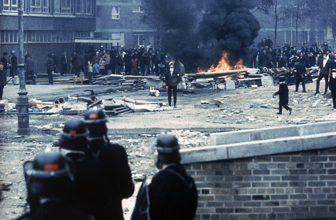
The unrest begins on August 12 with the Battle of the Bogside in Derry’s predominantly CatholicBogside district. Tensions have been building for over a year due to long-standing nationalist grievances, including political discrimination and gerrymandering that has kept the city under Unionist control since 1925. The violence erupts during the annual Apprentice Boys’ march, when Protestant marchers pass through the Catholic area, provoking clashes with residents.
On August 13, nationalist protests spread to other towns, including Belfast, Armagh, Dungannon, and Newry. In Belfast, seven people are killed and hundreds wounded, with many Catholic civilians shot by police. Loyalists attack Catholic homes, and both republican and loyalist paramilitaries are involved. Over 150 homes are destroyed, and 1,800 families are displaced.
By August 14, the British government deploys 300 troops from the 1st Battalion, Prince of Wales’s Own Regiment of Yorkshire to County Londonderry, replacing the exhausted RUC. The move is initially welcomed by some residents, but it remains clear that the violence has not been contained. The deployment marks the start of Operation Banner, the British Army’s long-term presence in Northern Ireland.
The riots and protests are widely regarded as the beginning of the Troubles, a 30-year conflict. The British Army’s presence, the establishment of peace lines to separate Catholic and Protestant areas, and the Republic of Ireland’s call for a United Nations peacekeeping force reflect the deepening crisis.
In short, August 14, 1969, is the day British troops enter Northern Ireland to restore order after days of nationalist-led protests and riots, events that define the region’s political landscape for decades.
The Battle of St. Matthew’s, also known as the Battle of Short Strand, is a gun battle that takes place on the night of June 27-28, 1970, in Belfast, Northern Ireland. It is fought between the Provisional Irish Republican Army (IRA), and Ulster loyalists in the area around St. Matthew’s Roman Catholic church. This lies at the edge of the Short Strand, a Catholic enclave in a mainly-Protestant part of the city. Violence erupts there, and in other parts of Belfast, following marches by the Orange Order. The battle lasts about five hours and ends at dawn when loyalists withdraw. The British Army and police are deployed nearby but do not intervene. Three people are killed and at least 26 wounded in the fighting, while another three are killed in north Belfast.
The battle is the Provisional IRA’s first major action during the Troubles, and a propaganda victory for the Irish nationalist organization. It presents itself as successfully defending a vulnerable Catholic enclave from armed loyalist mobs. Loyalists, however, argue that the IRA lured them into a carefully prepared trap.
During the Northern Ireland riots of August 1969 in Belfast, Catholic Irish republicans clash with Protestant Ulster loyalists and the mainly-Protestant Royal Ulster Constabulary (RUC), Northern Ireland’s police force. Catholics believe that they are about to become “victims of a Protestant pogrom” and Protestants believe they are on the “eve of an IRA insurrection.” Hundreds of Catholic homes and businesses are burned out and more than 1,000 families, mostly Catholic, are forced to flee. The Irish Republican Army (IRA) has few weapons or members and is unable to adequately defend the Catholic areas. The rioting ends with the deployment of British troops. In December 1969, the IRA splits into the Official Irish Republican Army and the Provisional Irish Republican Army—with the Provisionals vowing to defend Catholic areas in future.
The Short Strand is a Catholic/nationalist enclave in East Belfast, a mainly Protestant/Ulster unionist part of the city. In the early years of the Troubles, Catholics in Short Strand number about 6,000, while their Protestant neighbours total about 60,000.
On Saturday, June 27, 1970, a large march by the Orange Order takes place in west Belfast, which is joined by loyalist bands from other parts of the city. Violence breaks out as the march enters the Catholic Springfield Road area on its way to Whiterock Orange Hall. Missiles are thrown by both sides, a bakery is set ablaze, and the British Army fires CS gas to disperse crowds. The riot sparks violence in other parts of Belfast.
In north Belfast, another Orange march proceeds along the Crumlin Road, the boundary between the Catholic Ardoyne and the Protestant Shankill areas. According to Crown prosecutors, a crowd emerges from Ardoyne throwing bottles and stones. As the riot descends into a gun battle, the IRA—who according to Gerry Adams were “ready and waiting”—kill three Protestants: William Kincaid (28), Daniel Loughins (32) and Alexander Gould (18). Others are wounded, including a Royal Navypetty officer who is shot in the jaw while driving a field ambulance. Earlier in the month, British troops divert an Orange march away from Ardoyne, leading to serious rioting by Protestants in the Shankill.
In the predominantly Protestant east of the city, an Orange parade also takes place along the Newtownards Road. At the bottom of the road is the Catholic enclave of the Short Strand, and here a gun battle breaks out between the IRA and Protestants, though the cause of it is disputed by both sides.
Violence erupts at St. Matthew’s Catholic church on the evening of June 27. It begins after a loyalist band and supporters march through the area on their return from the main parade. Rival groups gather, taunting leads to stone-throwing, and eventually, shots are fired.
As the situation worsens, Catholic residents fear that the gathering crowds of loyalists will attempt to invade the Short Strand and burn them from their homes. Local IRA members retrieve weapons from arms dumps. A young resident, Jim Gibney, recalls, “I saw neighbours, people I knew, coming down the street carrying rifles. I was just dumbstruck by this experience. I’d never seen such a thing before.”
The battle begins at about 10:00 p.m. and continues for the next five hours. Loyalists begin attacking the church and surrounding property with petrol bombs. A small house on the church grounds, where the sexton lives with his family, is set ablaze. A nearby Catholic pub is also looted and burned.
A small group of IRA members and members of the Citizens’ Defence Committee take up positions in the church grounds and in adjoining streets. The IRA members are armed with M1 carbines and are led by Billy McKee, commander of the IRA’s Belfast Brigade. Also present is Billy Kelly, commander of the Belfast Brigade’s 3rd Battalion. The IRA members fire at the loyalists, some of whom are positioned on the roofs opposite. Jim Magee, a local loyalist, sees wounded people lying on the road and asks the police (RUC) for help. According to Magee, “[they] said ‘if you have anything, get it out and protect your people.’ So we got an old rifle and went into Frazer Street and started firing back.”
The security forces are deployed in the area at the time but do not intervene to end the fighting. Shortly after the shooting begins, StormontMPPaddy Kennedy goes with Short Strand residents to the local RUC base and demands protection for their homes. Across the River Lagan, in the Markets area, other IRA members assemble and prepare to reinforce the Short Strand should it be invaded. British soldiers eventually arrive in armoured vehicles and cordon off the roads around the Short Strand, which denies the IRA “any hope of reinforcement.” At the time, the British Army says that its soldiers fired no shots because “owing to the confused situation, it was impossible to identify targets.” British Army Colonel Mike Dewar later says, “The whole incident had taken its course because the Army was so chronically overstretched that night in Belfast. The one spare platoon in the whole of west Belfast was not able to get through rioting Protestants to the Short Strand.” JournalistTony Geraghty writes that sometimes “The gunfire eased long enough to allow an occasional British Army personnel carrier (a ‘Pig‘) to whine past, illuminated by the flames in a token gesture of law-and-order.”
Another journalist who witnesses the battle, Peter Taylor, later says, “The shooting intensified but the soldiers still declined to intervene and separate the two sides – either because they felt they were not numerically strong enough or because they did not wish to get caught up in the middle of a sectarian fight, in the darkness, with shots being fired by both sides.”
Liz Maskey, who is a volunteer nurse that night, says that the Short Strand is surrounded by loyalists and claim they attacked her ambulance as it tried to leave the area.
The loyalists withdraw after about five hours, as dawn breaks. IRA leader Billy McKee claims that his unit had fired 800 rounds during the battle.
Three people are killed in the fighting. At least 26 are wounded, including Billy McKee, who is shot five times.
Robert Neill, a 38-year-old Protestant, died instantly when a shot fired from the church bounced off the pavement and hit him in the spine.
James McCurrie, a 34-year-old Protestant, is shot dead on Beechfield Street.
Henry McIlhone, a 33-year-old Catholic, is helping to defend Short Strand when he is accidentally shot from the republican side. He dies on June 29. However, McKee maintains that McIlhone is shot by loyalists. Tírghrá, the IRA’s official list of its fallen, lists McIlhone as a “volunteer” but adds “although not a member of the IRA, Henry McIlhone was included in the republican roll of honour as a mark of respect for this great Irishman by republican comrades he fought alongside.”
Republicans and loyalists disagree over who started the violence and fired the first shots. Republicans claim that the violence was started by a mob of loyalists returning from an Orange march. They say that the loyalists tried to set the church alight and invade Short Strand, with the intention of burning the residents from their homes. Hence, republicans argue that they were defending the Short Strand from a loyalist attack. Loyalists claim the violence was begun by republicans, allegedly when the returning Orangemen and supporters were attacked on Newtownards Road. They argue that republicans attacked Protestants to lure them into “a carefully prepared trap.”
The following day, loyalists expel 500 Catholic workers from the nearby Harland & Wolff shipyard. Shortly after, the British government’s representative at Stormont says that the decision to allow Orange marches to go ahead on that day was “the greatest single miscalculation I have ever seen made in the course of my life.”
Many Catholics and nationalists believe that the IRA had been unable to defend them during the August 1969 riots. However, it is argued that the IRA’s defence of Short Strand redeemed it in the eyes of many Catholics and nationalists. Prior to the gun battle, the IRA had been waiting for an opportunity to portray themselves as defenders of the Catholic community. Among republicans, the battle is seen as a key event in the growth of the Provisional IRA.
Less than a week later, the British Army seizes a large haul of Official IRA weapons during a three-day operation in west Belfast. Nationalists see this as a confiscation of their defences.
From the late 1960s until the late 1990s, Northern Ireland undergoes a conflict known as the Troubles, in which more than 3,500 people are killed. More than 700 of those killed are British military personnel, deployed as part of Operation Banner. The vast majority of these British military personnel are killed by the Provisional Irish Republican Army (IRA), which wages an armed campaign to force the British to negotiate a withdrawal from Northern Ireland. In 1997, the IRA calls a final ceasefire and in 1998 the Good Friday Agreement is signed. This is widely seen as marking the end of the conflict.
However, breakaway groups of dissident Irish republicans oppose the ceasefire and continue a low-level armed campaign against the British security forces in Northern Ireland. The main group involved is an IRA splinter group known as the Real IRA. In 2007, the British Army formally ends Operation Banner and greatly reduces its presence in Northern Ireland.
The low-level dissident republican campaign continues. In January 2009, security forces have to defuse a bomb in Castlewellan, County Down, and in 2008 three separate incidents see dissident republicans attempt to kill PSNI officers in Derry, Castlederg and Dungannon. In all three cases, PSNI officers are seriously wounded. Two of the attacks involve firearms while the other involves an under-car booby-trap bomb.
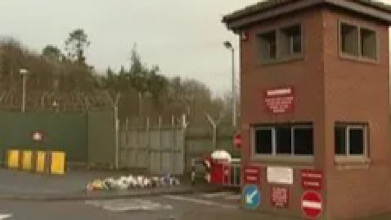
At about 9:40 p.m. on the evening of Saturday, March 7, four off-duty British soldiers of the Royal Engineers walk outside the barracks to receive a pizza delivery from two delivery men. As the exchange is taking place, two masked gunmen in a nearby car open fire with PM md. 63assault rifles. The firing lasts for more than 30 seconds with more than 60 shots being fired. After the initial burst of gunfire, the gunmen walk over to the wounded soldiers lying on the ground and fire again at close range, killing two of them. Those killed are Sappers Mark Quinsey from Birmingham and Patrick Azimkar from London. The other two soldiers and two deliverymen are wounded. The soldiers are wearing desert fatigues and were to be deployed to Afghanistan the following day. A few hours later, the stolen car involved is found abandoned near Randalstown, eight miles (13 km) from the barracks.
A Dublin-based newspaper, the Sunday Tribune, receives a phone call from a caller using a recognised Real IRA codeword. The caller claims responsibility for the attack on behalf of the Real IRA, adding that the civilian pizza deliverymen were legitimate targets as they were “collaborating with the British by servicing them.”
The shootings are the first British military fatalities in Northern Ireland since Lance Bombardier Stephen Restorick was shot dead by the Provisional IRA in February 1997, during the Troubles. The attack comes days after a suggestion by Northern Ireland’s police chief, Sir Hugh Orde, that the likelihood of a “terrorist” attack in Northern Ireland is at its highest level in several years.
Civilian security officers belonging to the Northern Ireland Security Guard Service are criticised for not opening fire during the incident, as a result of which plans are made to retrain and rearm them.
The morning after the attack, worshippers come out of St. Comgall’s Church after mass and keep vigil near the barracks. They are joined by their priest and clerics from the town’s other churches. On March 11, 2009, thousands of people attend silent protests against the killings at several venues in Northern Ireland.
The killings are condemned by all mainstream political parties in Northern Ireland, as well as the Irish government, the United States government and Pope Benedict XVI. Sinn Féin condemns the killings, but is criticised for being less vehement than others in its condemnation.
On March 14, 2009, the PSNI arrests three men in connection with the killings, one of whom is former IRA prisoner Colin Duffy. He had broken away from mainstream republicanism and criticised Sinn Féin’s decision to back the new PSNI. On March 25, 2009, after a judicial review of their detention, all the men are ordered to be released by the Belfast High Court. Duffy is immediately re-arrested on suspicion of murder. On March 26, 2009, Duffy is charged with the murder of the two soldiers and the attempted murder of five other people. The following day he appears in court for indictment and is remanded in custody to await trial after it is alleged that his full DNA profile had been found on a latex glove inside the vehicle used by the gunmen. There is also soil found in the car they drove that matches the soil on the ground in front of the barracks.
Brian Shivers, a cystic fibrosis sufferer, is charged with the soldiers’ murders and the attempted murder of six other people. He is also charged with possession of firearms and ammunition with intent to endanger life. He is arrested in Magherafelt, County Londonderry, in July 2009.
In January 2012, Shivers is convicted of the soldiers’ murders, but Duffy is acquitted. In January 2013, Shivers’s conviction is overturned by Northern Ireland’s highest appeals court. A May 2013 retrial finds Shivers not guilty. He is cleared of all charges and immediately released from jail. The judge questions why the Real IRA would choose Shivers as the gunman, with his cystic fibrosis and his engagement to a Protestant woman.
The barracks are shut down in 2010 as part of the reduction of the British Army presence in Northern Ireland.
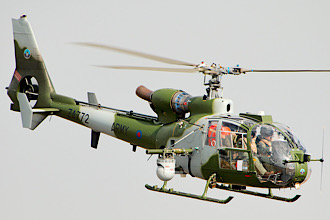
By early 1978, the British Army forces involved in Operation Banner have recently replaced their aging Bell H-13 Sioux helicopters for the more versatile Aérospatiale Gazelles. The introduction of the new machines increases the area covered on a reconnaissancesortie as well as the improved time spent in airborne missions. In the same period, the Provisional IRA receives its first consignment of M60 machine guns from the Middle East, which are displayed by masked volunteers during a Bloody Sunday commemoration in Derry. Airborne operations are crucial for the British presence along the border, especially in south County Armagh, where the level of IRA activity means that every supply and soldier has to be ferried in and out of their bases by helicopter since 1975.
The Royal Green Jackets have been in South Armagh since December 1977, and have already seen some action. Just a few days after arrival, two mortar rounds hit the C Company base at Forkhill, injuring a number of soldiers. In the aftermath of the attack, two Royal Ulster Constabulary (RUC) officers are wounded by a booby trap while recovering the lorry where the mortar tubes are mounted. Two days later, a patrol near the border suffers a bomb and gun attack, leaving the commanding sergeant with severe head wounds. The sergeant is picked up from the scene by helicopter. He is later invalided from the British Army as a result of his injuries.
On January 17, 1978, a Royal Green Jackets observation post deployed around the village of Jonesborough begins to take heavy fire from the “March Wall,” which draws parallel with the Irish border to the east, along the Dromad woods. The soldiers return fire, but the short distance to the border and the open ground prevents them from advancing.
The Commanding Officer, Lieutenant Colonel Ian Corden-Lloyd, along with Captain Philip Schofield and Sergeant Ives fly from the battalion base at Bessbrook Mill to assess the situation and provide information to the troops. They are escorted by a Scout helicopter with an Airborne Reaction Force (ARF), comprising a medic and three soldiers from the 2nd Battalion Light Infantry. While hovering over the scene of the engagement, the Aérospatiale Gazelle receives a barrage of 7.62 mm tracer rounds. The pilot loses control of the aircraft during a turn at high speed to avoid the stream of fire. The Aérospatiale Gazelle hits a wall and crashes in a field, some 2 km from Jonesborough. According to the crew and passengers of the Scout, the Aérospatiale Gazelle hits the ground twice after losing power, with its rotor blades trashing into the soil following the second impact, and then cartwheels across the field. The Scout lands the ARF while still under IRA fire. The soldiers rush to the wrecked helicopter, some 100 metres away from the site of the initial crash.
Corden-Lloyd is killed and the other two passengers are wounded. The machine comes to rest on its right side. The pilot remains trapped inside the wreckage, but he survives thanks to his helmet. The IRA later claim they had shot at the helicopter with an M60 machine gun. The IRA unit vanishes into the Dromad woods to the Republic of Ireland. Some Gardaí witness the attack from the other side of the border.
The gun battle and Aérospatiale Gazelle shootdown is displaced from the headlines by the deaths of twelve civilians in the La Mon restaurant bombing on the same day, some of whom are burned to death. Initially the British Army downplays the IRA’s claim as published by An Phoblacht, that the helicopter was shot down, on the basis that no hits were found on the wreckage, but finally they acknowledged that the IRA action had caused the crash.
The death of Corden-Lloyd, a former Special Air Service officer, is deeply regretted by the British Army, who regarded him as promising. He is awarded a posthumous mentioned in despatches “in recognition of gallant and distinguished service in Northern Ireland.” In 1973, Irish republicans had accused Corden-Lloyd and his subordinates of brutality against Belfast Catholics during an earlier tour of the Royal Green Jackets in 1971, at the time of Operation Demetrius.
The Provisional IRA, officially known as the Irish Republican Army (Irish: Óglaigh na hÉireann) and informally as the Provos, is an Irish republicanparamilitary force that seeks to end British rule in Northern Ireland, facilitate Irish reunification and bring about an independent republic encompassing all of Ireland. It is the most active republican paramilitary group during the Troubles. It argues that the all-island Irish Republic continues to exist, and it sees itself as that state’s army, the sole legitimate successor to the original IRA from the Irish War of Independence (1919-21). It is designated a terrorist organisation in the United Kingdom and an unlawful organisation in the Republic of Ireland, both of whose authority it rejects.
The Provisional IRA emerges in December 1969, due to a split within the previous incarnation of the IRA and the broader Irish republican movement. It is initially the minority faction in the split compared to the Official IRA but becomes the dominant faction by 1972. The Troubles begin shortly before when a largely Catholic, nonviolent civil rights campaign is met with violence from both Ulster loyalists and the Royal Ulster Constabulary (RUC), culminating in the August 1969 riots and deployment of British soldiers. The IRA initially focuses on defence of Catholic areas, but it begins an offensive campaign in 1970 that is aided by external sources, including Irish diaspora communities within the Anglosphere, and the Palestine Liberation Organization (PLO) and Libyan leader Muammar Gaddafi. It uses guerrilla tactics against the British Army and RUC in both rural and urban areas and carries out a bombing campaign in Northern Ireland and England against military, political and economic targets, and British military targets in mainland Europe. They also target civilian contractors to the British security forces. The IRA’s armed campaign, primarily in Northern Ireland but also in England and mainland Europe, kills over 1,700 people, including roughly 1,000 members of the British security forces and 500–644 civilians.
The Provisional IRA issues the following statement to news media on the morning of July 19, 1997:
“On August 31, 1994, the leadership of Oglaigh na hEireann (Gaelic for Irish Republican Army) announced a complete cessation of military operations as our contribution to the search for a lasting peace.
After 17 months of cessation, in which the British government and the (pro-British Protestant) unionists blocked any possibility of real or inclusive negotiations, we reluctantly abandoned the cessation.
It is the root cause of division and conflict in our country. We want a permanent peace and therefore we are prepared to enhance the search for a democratic peace settlement through real and inclusive negotiations.
So, having assessed the current political situation, the leadership of Oglaigh na hEireann are announcing a complete cessation of military operations from 12 o’clock midday on Sunday the 20th, July 1997.
We have ordered the unequivocal restoration of the ceasefire of August 1994. All IRA units have been instructed accordingly.”
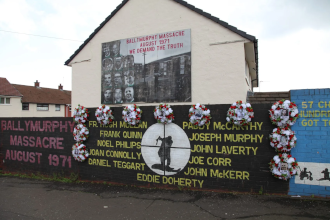
On the morning of Monday, August 9, 1971, the security forces launch Operation Demetrius, the main focus of which is to arrest and intern suspected members of the Provisional Irish Republican Army (IRA). The Parachute Regiment is selected to carry out the operation. The operation is chaotic and informed by poor intelligence, resulting in a number of innocent people being interned. By focusing solely on republicans, it excludes violence carried out by loyalistparamilitaries. Some nationalist neighbourhoods attempt to disrupt the army with barricades, petrol bombs and gunfire. In the Catholic district of Ballymurphy, ten civilians are shot and killed between the evening of August 9 and the morning of August 11, while another dies of heart failure.
Members of the Parachute Regiment state that they were shot at by republicans as they entered the Ballymurphy area and returned fire. The press officer for the British Army stationed in Belfast, Mike Jackson, later to become head of the British Army, includes a disputed account of the shootings in his autobiography, stating that those killed in the shootings were republican gunmen. This claim is strongly denied by the families of those killed in the shootings, including in interviews conducted during the documentary film The Ballymurphy Precedent. The claim is found to be without basis by a later coroner’s inquest, which establishes that those killed were “entirely innocent.”
The six civilians killed on August 9 are Francis Quinn (19), shot while going to the aid of a wounded man, Father Hugh Mullan (38), a Catholic priest, shot while going to the aid of a wounded man, reputedly while waving a white cloth to indicate his intentions, Joan Connolly (44), shot by three soldiers as she stands opposite the army base, Daniel Teggart (44), shot fourteen times mostly in the back as he lay injured on the ground, Noel Phillips (20) and Joseph Murphy (41), shot as they stand opposite the army base. Murphy is subsequently taken into army custody and after his release, as he is dying in hospital, he claims that he had been beaten and shot again while in custody. When his body is exhumed in October 2015, a second bullet is discovered in his body, which activists say corroborates his claim.
Edward Doherty (28), is shot and killed on August 10 while walking along Whiterock Road.
Another three civilians are shot on 11 August: John Laverty (20) and Joseph Corr (43) are shot at separate points at the top of the Whiterock Road. Laverty is shot twice, once in the back and once in the back of the leg. Corr is shot several times and dies of his injuries on August 27. John McKerr (49), is shot in the head by an unknown sniper while standing outside a Catholic church and dies of his injuries on August 20. While a number of eyewitnesses state that soldiers were seen shooting toward the area, the 2021 inquest cannot establish who had killed him. The coroner notes that a more specific finding is not possible, in large part, due to an “abject failing by the authorities to properly inquire into the death of [McKerr at the time].”
Paddy McCarthy (44), an eleventh civilian, dies on August 11 following an altercation with a group of soldiers. His family allege that an empty gun is put in his mouth and the trigger pulled, he suffers a heart attack and dies shortly after the alleged confrontation.
In February 2015, the conviction of Terry Laverty, younger brother of John Laverty, one of those killed, is quashed by the Criminal Cases Review Commission. He had been convicted of riotous behaviour and sentenced to six months on the eyewitness evidence of a private in the Parachute Regiment. The case is referred to court because the sole witness retracts his evidence.
In 2016, Sir Declan Morgan, the Lord Chief Justice of Northern Ireland, recommends an inquest into the killings as one of a series of “legacy inquests” covering 56 cases related to the Troubles. These inquests are delayed, as funding has not been approved by the Northern Ireland Executive. The Stormont first minister, Arlene Foster of the Democratic Unionist Party (DUP), defers a bid for extra funding for inquests into historic killings in Northern Ireland, a decision condemned by the human rights group Amnesty International. Foster confirms she has used her influence in the devolved power-sharing executive to hold back finance for a backlog of inquests connected to the conflict. The High Court says her decision to refuse to put a funding paper on the Executive basis is “unlawful and procedurally flawed.”
In January 2018, the coroner’s office announces that the inquest will begin in September 2018. On May 11, 2021, this coroner’s inquest finds that the ten civilians killed were innocent and that the use of lethal force by the British Army was “not justified.” The circumstances of the 11th death are not part of the inquest since Paddy McCarthy died from a heart attack, allegedly after being threatened by a soldier. Following the inquest verdict, Boris Johnson, the British prime minister, apologises for the deaths at Ballymurphy in a phone call to Foster and deputy First MinisterMichelle O’Neill. The lack of public apology is criticised by some relatives of the victims and Northern Irish politicians.
In May 2021, families of those shot dead by British soldiers in Ballymurphy urge the Irish government to oppose any attempt to prevent the prosecution of British soldiers alleged to have committed crimes during the Troubles.
The killings are the subject of the August 2018 documentaryThe Ballymurphy Precedent, directed by Callum Macrae and made in association with Channel 4.
In August 2005, it is announced that in response to the Provisional IRA declaration that its campaign is over, and in accordance with the Good Friday Agreement provisions, Operation Banner would end by August 1, 2007. This involves troops based in Northern Ireland being reduced to 5,000, and only for training purposes. Security is entirely transferred to the police. The Northern Ireland Resident battalions of the Royal Irish Regiment, which had grown out of the Ulster Defence Regiment, stand down on September 1, 2006. The operation officially ends at midnight on July 31, 2007, making it the longest continuous deployment in the British Army’s history, lasting over 38 years.
While the withdrawal of troops is welcomed by the nationalist parties Social Democratic and Labour Party and Sinn Féin, the unionist Democratic Unionist Party and Ulster Unionist Party oppose the decision, which they regard as premature. The main reasons behind their resistance are the continuing activity of republican dissident groups, the loss of security-related jobs for the protestant community and the perception of the British Army presence as an affirmation of the political union with Great Britain.
According to the Ministry of Defence, 1,441 serving British military personnel die in Operation Banner, 722 of whom are killed in paramilitary attacks and 719 of whom die as a result of other causes. The British military kills 307 people during the operation, about 51% of whom are civilians and 42% of whom are members of republican paramilitaries.
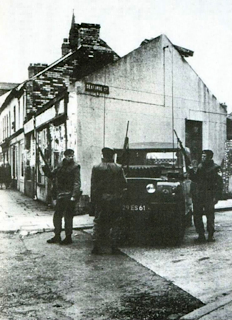
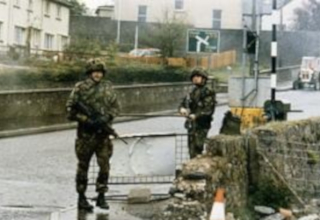
(Pictured: Two British soldiers on duty at a vehicle checkpoint near the A5 Omagh/Armagh road junction)
A week before the Falls Curfew, on Saturday, June 27, 1970, there is severe rioting in Belfast following marches by the Protestant/unionist Orange Order. At the Short Strand, a Catholic enclave in a Protestant part of the city, the Provisional Irish Republican Army (IRA) fights a five-hour gun battle with loyalists. Three people are killed, and the loyalists withdraw. The Provisional IRA presents itself as having successfully defended a vulnerable Catholic enclave from armed loyalist mobs.
Meanwhile, the Official IRA arranges for a large number of weapons to be brought into the mainly nationalist and Catholic Lower Falls area for distribution. The area is a stronghold of the Official IRA.
The operation begins at about 4:30 PM on Friday, July 3, as a search for weapons in the staunchly Irish nationalist district. As the search ends, local youths attack the British soldiers with stones and petrol bombs and the soldiers respond with CS gas. This quickly develops into gun battles between British soldiers and the Irish Republican Army (IRA). After four hours of continuous clashes, the British commander seals off the area, which comprises 3,000 homes, and imposes a curfew which lasts 36 hours. Thousands of British troops move into the curfew zone and carry out house-to-house searches for weapons, while coming under intermittent attack from the IRA and rioters. The searches cause much destruction, and a large amount of CS gas is fired into the area. Many residents complain of suffering abuse at the hands of the soldiers. On July 5, the curfew is brought to an end when thousands of women and children from Andersonstown march into the curfew zone with food and groceries for the locals.
During the operation, four civilians are killed by the British Army, at least 78 people are wounded and 337 are arrested. Eighteen soldiers are also wounded. Large quantities of weapons and ammunition are captured. The British Army admits afterwards that some of its soldiers had been involved in looting.
The Falls Curfew is a turning point in the Troubles. It is seen as having turned many Catholics/Irish nationalists against the British Army and having boosted support for the IRA.
(Pictured: British soldiers on the Falls Road during the 1970 curfew)