seamus dubhghaill

Promoting Irish Culture and History from Little Rock, Arkansas, USA


Leave a comment

Ireland’s First Ever Win in International Soccer

ifa-original-badgeIreland wins its first ever match in international soccer on February 19, 1887, beating Wales 4-1 in Belfast. Prior to 1921 and the partition of the country, all of Ireland is represented by a single side, the Ireland national football team, organised by the Irish Football Association (IFA).

On February 18, 1882, fifteen months after the founding of the Irish FA, Ireland makes its international debut against England, losing 13–0 in a friendly played at Bloomfield in Belfast. This remains the largest ever defeat for the team, and is also England’s largest winning margin.

Ireland competes in the inaugural British Home Championship in 1884 and loses all three games. Ireland finally wins its first game on February 19, 1887, with a 4–1 win over Wales in Belfast. Between their 1882 debut and this game, the Ireland team has a run of 14 defeats and 1 draw, the longest run without a win in the 1800s. Despite the end of the losing streak, heavy defeats continue. In March 1888 they lose 11–0 to Wales and 10–2 to Scotland. Further heavy defeats come in March 1890 when they lose 9–1 to England, in 1899 when they lose 13–2 to England, and in February 1901 when they lose 11–0 to Scotland.

Ireland is partitioned into Northern Ireland and Southern Ireland in 1920. Southern Ireland gains independence in 1922 as the Irish Free State, later to become a republic under the name of Ireland. Amid these political upheavals, a rival football association, the Football Association of Ireland, emerges in Dublin in 1921 and organises a separate league and international team. In 1923, at a time when the home nations have withdrawn from the Fédération Internationale de Football Association (FIFA), the FAI is recognised by FIFA as the governing body of the Irish Free State on the condition that it changes its name to the Football Association of the Irish Free State. The IFA continues to organise its national team on an all-Ireland basis.

Between 1928 and 1946 the IFA is not affiliated to FIFA and the two Ireland teams co-exist, never competing in the same competition. However, on March 8, 1950, in a 0–0 draw with Wales at the Racecourse Ground in Wrexham, North Wales in a World Cup qualifier, the IFA fields a team that includes four players who were born in the Irish Free State. All four players have previously played for the FAI in their qualifiers and as a result have played for two different associations in the same FIFA World Cup tournament.

After complaints from the FAI, FIFA intervenes and restricts players’ eligibility based on the political border. In 1953, FIFA rules that neither team can be referred to as Ireland, decreeing that the FAI team officially be designated as the Republic of Ireland, while the IFA team is to become Northern Ireland.

Leave a comment

Death of Saint Colmán, Bishop of Lindisfarne

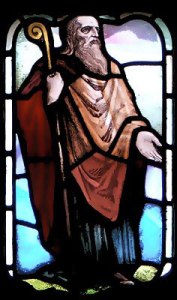
saint-colmanColmán of Lindisfarne, also known as Saint Colmán, the Bishop of Lindisfarne from 661 until 664, dies on February 18, 675 of natural causes on the island of Inishbofin.

Colman is believed to have been born in Connacht, in the west of Ireland and receives his education on Iona. He is likely a nobleman of Canmaicne. He succeeds Aidan and Finan as bishop of Lindisfarne but resigns the Bishopric of Lindisfarne after the Synod of Whitby called by King Oswiu of Northumbria decides to calculate Easter using the method of the First Ecumenical Council instead of his preferred Celtic method.

Later tradition states that between the years 665 and 667 St. Colman founds several churches in Scotland before returning to Iona, but there are no seventh-century records to validate such activity by him. From Iona he sails for Ireland, settling at Inishbofin in 668 where he founds a monastery. When Colman comes to Mayo he brings with him half the relics of Lindisfarne, including bones of St. Aidan, and a part of the true cross which is reputed to be in Mayo Abbey until the Reformation in 1537, when it vanishes.

The Saxon monks are industrious and, during spring and summer, they till the land and grow the corn necessary for the survival of the community. Meanwhile, the Irish visit their kinsfolk on the mainland, returning to the island in winter where they help to consume the fruits of the Saxons’ labours. This situation inevitably leads to tensions within the community and disputes soon arise between the Saxon and Irish monks. Colman brings his Saxon followers onto the mainland and founds a monastery for them at “Magh Eó” – the Plain of Yew Trees, subsequently known as “Mayo of the Saxons.”

Colman’s last days are spent on the island of Inishbofin, where he dies in 675. His feast is celebrated on August 8.


Leave a comment

Birth of Academy Award Winning Actress Brenda Fricker

(Newscom TagID: mrpphotos209322) [Photo via Newscom]

Brenda Fricker, Irish actress of theatre, film, and television, is born in Dublin on February 17, 1945. In 1989, she becomes the first Irish actress to win an Oscar, earning the Academy Award for Best Supporting Actress for My Left Foot.

In her teens, Fricker aspires to follow her parents’ footsteps into journalism. Before becoming an actress, she is assistant to the art editor of The Irish Times, with hopes to become a reporter. At age 19, she becomes an actress “by chance,” as her feature film career begins with a small uncredited part in the 1964 film Of Human Bondage, based on the 1915 novel by W. Somerset Maugham. She also appears in Tolka Row, Ireland’s first ever soap opera.

One of Fricker’s first TV roles is as staff nurse Maloney in Coronation Street, debuting on January 10, 1977. Fricker comes to wider public attention in the United Kingdom in another nursing role, as Megan Roach in the BBC One television drama series Casualty, appearing in 65 episodes. After making cameo appearances in three additional episodes, Fricker’s final appearance as Megan is in August 2010, when her character takes a lethal cocktail of drugs to end her life.

Fricker finds international acclaim after she wins the 1989 Academy Award for Best Supporting Actress for her performance as Christy Brown‘s mother in My Left Foot, becoming the first Irish actress to win an Oscar. The film is a triumph for Irish film making. Daniel Day-Lewis wins best actor for his portrayal of the disabled Brown while director Jim Sheridan receives numerous Best Director nominations at various film festivals.

She rejoins  Sheridan to make the 1990 film The Field, starring alongside Richard Harris as Maggie McCabe. She continues her television work during this period, starring in the Australian-produced short series Brides of Christ (1991). She then co-stars in the 1992 TV miniseries Seekers alongside Josette Simon and produced by Sarah Lawson.

Buoyed by her Oscar win, Fricker goes on to appear in several high profile Hollywood films, most notably in Home Alone 2: Lost in New York. The following year she portrays May Mackenzie in So I Married an Axe Murderer, and next portrayed Joseph Gordon Levitt’s character’s motherly caretaker Maggie in Angels in the Outfield. One of her last Hollywood film roles comes with A Time to Kill, as Ethel Twitty, loyal secretary to Matthew McConaughey‘s Jake Brigance. She then focuses almost exclusively on film and television work in Canada and the British Isles.

In July 2014, Fricker tentatively retires from acting. Previously married to director Barry Davies, Fricker currently lives in the Liberties in Dublin.


Leave a comment

The 1932 Irish General Election

1932-general-electionAn Irish general election is held on February 16, 1932, just over two weeks after the dissolution of the Dáil on January 29. The general election takes place in 30 parliamentary constituencies throughout the Irish Free State for 153 seats in the lower house of parliament, Dáil Éireann. The 1932 general election is one of the most important general elections held in Ireland in the 20th Century, resulting in the formation of the first Fianna Fáil government. Fianna Fáil becomes the largest party and would continue to be the largest party in Dáil Éireann and at every general election until 2011.

Cumann na nGaedheal fights the general election on its record of providing ten years of stable government. The party brings stability following the chaos of the Irish Civil War and provides honest government. However, by 1932 support of the government is wearing thin, particularly since the party has no solution to the collapse in trade which follows the depression of the early 1930s. Instead of offering new policies the party believes that its record in government will be enough to retain power. Cumann na nGaedheal also employs “red scare” tactics, describing Fianna Fáil as communists and likening Éamon de Valera to Joseph Stalin.

In comparison, Fianna Fáil has an elaborate election programme designed to appeal to a wide section of the electorate. It plays down its republicanism to avoid alarm but provides very popular social and economic policies. The party promises to free Irish Republican Army (IRA) prisoners, abolish the Oath of allegiance, and reduce the powers of the Governor-General and the Senate. It also promises the introduction of protectionist policies, industrial development, self-sufficiency, and improvements in housing and social security benefits.

The election campaign between the two ideologically opposed parties is reasonably peaceful. However, during the campaign the government prosecutes de Valera’s newly established newspaper, The Irish Press. The editor is also brought before a military tribunal. This is seen by many as a major blunder and a serious infringement on the belief of freedom of speech. The “red scare” tactics also seemed to backfire on the government, who seem to have little else to offer the electorate.

When the results are known Fianna Fáil is still 5 seats short of an overall majority but looks like the only party capable of forming a government. Discussions get underway immediately after the election and an agreement is reached in which the Labour Party would support Fianna Fáil. The party now has the necessary votes to form a minority government.

On March 9, 1932, the first change of government in the Irish Free State takes place. Similar to when the party first enters the Dáil in 1927, a number of Fianna Fáil Teachtaí Dála (TDs) have guns in their pockets. However, the feared coup d’état does not take place. W. T. Cosgrave is determined to adhere to the principles of democracy that he has practised while in government. Likewise, the army, Garda Síochána, and the civil service all accept the change of government, despite the fact that they will now be taking orders from men who had been their enemies less than ten years previously. After a brief and uneventful meeting in the Dáil chamber, Éamon de Valera is appointed President of the Executive Council of the Irish Free State by the Governor-General, James McNeill, who has come to Leinster House to make the appointment rather than require de Valera travel to the Viceregal Lodge, formerly a symbol of British rule. Fianna Fáil, the party most closely identified with opposing the existence of the state ten years earlier, is now the party of government. The 1932 general election is the beginning of a sixteen-year period in government for Fianna Fáil.


Leave a comment

Laying of the Foundation Stone of Nelson Pillar

nelson-pillar

Construction of Nelson Pillar, a large granite pillar topped by a statue of Horatio Nelson in the middle of O’Connell Street (formerly Sackville Street) in Dublin, begins with the laying of the foundation stone on February 15, 1808, by the Lord Lieutenant the Duke of Richmond.

News of Nelson’s victory at Trafalgar reaches Dublin on November 8, 1805, and is greeted with boisterous celebrations in the streets, alongside mourning for the death of the hero. Within a month the Lord Mayor of Dublin, James Vance, calls a meeting of nobility, clergy, bankers, merchants, and citizens to plan a monument in Nelson’s memory, which is to be funded by public subscription.

The duke, dressed in a general’s uniform and accompanied by the Duchess in deep mourning for the dead hero, arrive at the foundation stone laying in a state coach drawn by six horses. The procession from Dublin Castle to the site includes Horse Yeomanry and Foot Yeomanry, sailors, officers of the Army and the Navy, subscribers, the committee, the Provost and Fellows of Trinity College, the Lord Mayor, the Common Council, sheriffs, aldermen, and peers according to their degrees.

The pillar is a Doric column that rises 121 feet from the ground and is topped by a 13-foot-tall statue of Nelson carved in Portland stone, giving it a total height of 134 feet, some 35 feet shorter than Nelson’s Column in London. The diameter of the column is 13 feet at the bottom and 10 feet at the top. All of the outer and visible parts of the pillar are granite from the quarry of Goldenhill, Manor Kilbride, County Wicklow. The interior is black limestone.

The pillar is completed by August 1809 and the statue of Nelson is hoisted into place. The statue is the work of Thomas Kirk, a young Cork-born sculptor then at the beginning of a successful career. The statue adds £630 to the cost of the pillar, which totals almost £7,000.

The monument is opened to the public on Trafalgar Day, October 21, 1809, the fourth anniversary of the battle. It offers the citizens of Dublin an unprecedented perspective on their city. For the payment of ten pence, they can climb the 168 steps of the inner stone staircase to the viewing platform.

nelson-pillar-bombing

On October 29, 1955, a group of University College Dublin students lock themselves inside the pillar and try to melt the statue with flame throwers. From the top they hang a poster of Kevin Barry, a Dublin Irish Republican Army (IRA) volunteer who is executed by the British during the Irish War of Independence. Gardaí force their way inside with sledgehammers. They take the students’ names and addresses and bring them downstairs. Rather than arrest the students, the Gardaí merely confiscate their equipment and tell everyone to leave quietly. None are ever charged.

At 1:32 AM on March 8, 1966, a bomb destroys the upper half of the pillar, throwing the statue of Nelson into the street. The bomb is planted by a group of former Irish Republican Army (IRA) volunteers in what is believed to mark the commemoration the 50th anniversary of the Easter Rising.

Six days after the original damage, on the morning of Monday, March 14, 1966, Irish Army engineers blow up the rest of the pillar after judging the structure to be too unsafe to restore. This planned demolition causes more damage on O’Connell Street than the original blast, breaking many windows.

The rubble from the monument is taken to the East Wall dump and the lettering from the plinth is moved to the gardens of Butler House, Kilkenny.


Leave a comment

Birth of IRA Leader Seán Treacy

sean-allis-treacy

Seán Allis Treacy, one of the leaders of the Third Tipperary Brigade of the Irish Republican Army during the Irish War of Independence, is born on February 14, 1895, in Soloheadbeg, County Tipperary.

Treacy leaves school at the age of 14 and works as farmer while also developing deep patriotic convictions. He is a member of the Gaelic League, and of the Irish Republican Brotherhood (IRB) from 1911 and the Irish Volunteers from 1913.

He is picked up in the mass arrests following the Easter Rising in 1916. He spends much of the following two years in prison, where he goes on hunger strike on several occasions.

In 1918, Treacy is appointed Vice Officer-Commanding of the 3rd Tipperary Brigade of the Irish Volunteers, which becomes the Irish Republican Army in 1919.

On January 21, 1919, Treacy and Dan Breen, together with Seán Hogan, Séamus Robinson, and five other volunteers, help to ignite the conflict that is to become the Irish War of Independence. They ambush and shoot dead Constables Patrick MacDonnell and James O’Connell of the Royal Irish Constabulary (RIC), who are guarding a transport of gelignite explosives, during the Soloheadbeg Ambush near Treacy’s home. Treacy leads the planning of the ambush and briefs the brigade’s OC Robinson on his return from prison in late 1918. Robinson supports the plans and agrees they will not go to GHQ for permission to undertake the attack.

As a result of the Soloheadbeg Ambush, South Tipperary is placed under martial law and declared a Special Military Area under the Defence of the Realm Act. After Soloheadbeg ambush party member Seán Hogan is arrested on May 12, 1919, Treacy, Breen, and Séamus Robinson are joined by five men from the IRA’s East Limerick Brigade to organise Hogan’s rescue. Hogan is brought to the train which is intended to take him from Thurles to Cork city on May 13, 1919. As the train steams across the Tipperary border and into County Limerick, the IRA party boards the train in Knocklong. A close-range struggle ensues on the train. Treacy and Breen are seriously wounded in the gunfight and two RIC men die, but Hogan is rescued. His rescuers rush him into the village of Knocklong where a butcher cuts off his handcuffs using a cleaver.

A search for Treacy and the others is mounted across Ireland. Treacy leaves Tipperary for Dublin to avoid capture. In Dublin, Michael Collins employs Treacy on assassination operations with “the Squad“. In the summer of 1920, he returns to Tipperary and organises several attacks on RIC barracks before again moving his base of operations to Dublin.

By spring 1920 the political police of both the Crimes Special Branch of the Royal Irish Constabulary (RIC) and G-Division (Special Branch) of the Dublin Metropolitan Police (DMP) have been effectively neutalised by IRA counterintelligence operatives working for Michael Collins. The British thoroughly reorganise their administration at Dublin Castle and begin to import dozens of professional secret service agents from all parts of the British Empire into Ireland to track down IRA operatives and Sinn Féin leaders.

On October 11, 1920, Treacy and Breen are holed up in a safe house on the north side of Dublin when it is raided by a police unit. In the ensuing shootout, two senior British officers are wounded and die the next day while Treacy and Breen are wounded, Breen seriously. Treacy and Breen manage to escape through a window and shoot their way through the police cordon.

Treacy is discovered at the Republican Outfitters shop at 94 Talbot Street on October 14 a British Secret Service surveillance team led by Major Carew and Lt. Gilbert Price. They were stalking him in hopes that he would lead them to Collins or to other high-value IRA targets. Treacy realises that he is being followed and runs for his bicycle but grabs the wrong bike, taking one that is far too big for him, and falls. Price draws his pistol and closes in on Treacy. Treacy draws his parabellum automatic pistol and shoots Price and another British agent before he is hit in the head, dying instantly.

Treacy is buried at Kilfeacle graveyard where, despite a large presence of British military personnel, a volley of shots is fired over the grave.


Leave a comment

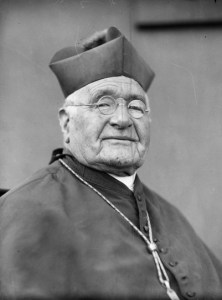
Birth of 4th Archbishop of Sydney Michael Kelly

archbishop-michael-kelly

Michael Kelly, Australian Roman Catholic clergyman and the fourth Archbishop of Sydney, is born on February 13, 1850.

Born in Waterford, to master mariner James Kelly and the former Mary Grant, Kelly is educated at Christian Brothers in Enniscorthy and the Classical Academy in New Ross.

Kelly receives his seminary formation at St. Peter’s College in Wexford and the Irish College in Rome. He is ordained at Enniscorthy on November 1, 1872, by Bishop Thomas Furlong.

Kelly serves on the staff of the House of Missions in Wexford and is made vice-Rector of the Irish College in Rome in 1891. In 1894, he is made head of Irish College. Kelly also becomes a leader in the temperance movement.

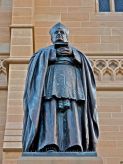
archbishop-kelly-statue

Elected Archbishop of Achrida in Partibus Infidelium and coadjutor cum jure successionis of Sydney on July 20, 1901, Kelly is Consecrated Coadjutor Archbishop on August 15, 1901, at St. Joachim’s Church, Rome, by Cardinal Francesco Satolli.

Kelly succeeds to the See of Sydney on August 16, 1911, upon the death of Cardinal Patrick Francis Moran. Kelly continues his crusade for temperance in Australia. Fund-raising for schools is undertaken by Kelly, and it is estimated £12,000,000 is spent on scholastic and church properties from the time of Kelly’s arrival in Sydney until his death. St. Mary’s Cathedral is completed in 1928, and statues of Kelly and Moran stand in the main portal.

Kelly is named Bishop Assistant at the Papal Throne and Count of the Holy Roman Empire on June 25, 1926. Kelly dies in Sydney on March 8, 1940, at the age of 90. He is buried in the Kelly Memorial Chapel in the crypt of St. Mary’s Cathedral.


Leave a comment

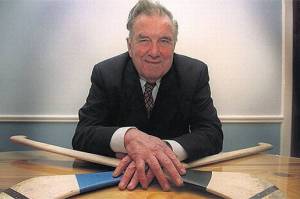
Birth of Tipperary Hurling Legend John Doyle

john-doyle

John Doyle, Irish sportsperson and politician, hailed as one of the best defenders in hurling and his county’s most iconic player upon his death, is born in Holycross, County Tipperary, on February 12, 1930.

Doyle first excels at hurling while at school in Thurles CBS. Regarded as too good for CBS Primary School team, he is drafted into the secondary school’s under-15 Croke Cup team in 1942. Doyle plays at wing-forward as Thurles CBS wins the championship that year.

Doyle arrives on the inter-county scene at the age of sixteen when he first links up with the Tipperary minor team. He makes his senior debut in the 1947-48 National League. A 5-6 to 4-2 defeat of Cork in the provincial decider gives him his first Munster medal. Tipperary retains their provincial crown in 1947, with Doyle collecting a second Munster medal following a 2-4 to 1-2 defeat of Waterford. Doyle goes on to play a key role for Tipperary during a hugely successful era for the team, winning eight All-Ireland medals, ten Munster medals, and ten National Hurling League medals.

On June 26, 1949, Doyle makes his senior championship debut in a Munster quarter-final replay against Cork. As a member of the Munster inter-provincial team for fifteen years, Doyle wins six Railway Cup medals. At club level he wins three championship medals with Holycross-Ballycahill.

After surrendering their provincial crown in 1966, Tipperary bounces back the following year, with Doyle winning a record tenth Munster medal following a 4-12 to 2-6 defeat of Clare. On September 3, 1967, Tipperary faces Kilkenny in the All-Ireland decider, a game which presents Doyle win the opportunity of making history by winning a record-breaking ninth All-Ireland medal. Despite leading at halftime 2-6 to 1-3, Kilkenny goalkeeper Ollie Walsh makes a series of spectacular saves in the second half and Kilkenny is victorious 3-8 to 2-7 and lays to rest a bogey that Tipperary has had over the team since 1922. The defeat brings the curtain down on Doyle’s inter-county career.

For almost fifty years Doyle, together with Christy Ring, hold a unique record as the only players to win eight All-Ireland medals on the field of play. This record is subsequently surpassed by Henry Shefflin on September 30, 2012. His record of National League medals has yet to be equalled. Throughout his career, Doyle makes 54 championship appearances, a Tipperary record which stands until August 9, 2009 when it is surpassed by Brendan Cummins.

In retirement from inter-county hurling, Doyle continues to work on his farm in Holycross. In later years he enters politics. He stands unsuccessfully as a Fianna Fáil candidate at the 1969 general election for the Tipperary North constituency, but is subsequently elected to Seanad Éireann on the Agricultural Panel. He serves until 1973 when he loses his seat.

Doyle is widely regarded as one of the greatest hurlers in the history of the game. During his playing days he wins two Cú Chulainn awards, and is named Texaco Hurler of the Year in 1964. He is repeatedly voted onto teams made up of the sport’s greats, including as left corner-back on the Hurling Team of the Century in 1984 and the Hurling Team of the Millennium in 2000.

John Doyle dies on December 29, 2010. Taoiseach Brian Cowen is among those who pay tribute saying “He was an immense hurler and an incredibly decent man, his love of the GAA was matched by his concern for his country and his own community, he was a Tipperary legend and a proud Irishman.” Doyle is buried at Holy Cross Abbey outside Thurles on December 31, 2010.


Leave a comment

The Daunt Rock Rescue

daunt-rock-rescue

The Ballycotton lifeboat Mary Stanford returns to its home port in East Cork on February 11, 1936, following what is likely the most famous sea rescue in Irish maritime history.

Riding at anchor, the Daunt rock lightship Comet, with a crew of eight, breaks from her mooring off Roberts Head on the southern coast of Ireland on the morning of February 8, 1936, during a three-day gale. The seas are so mountainous that spray is flying over the lantern of the 196-foot-tall lighthouse.

In one of the most exhausting and gallant services in the history of the Royal National Lifeboat Institute (RNLI), Patrick “Patsy” Sliney, Coxswain of the Mary Stanford, and a crew of six take to the sea in response to an SOS call from the Comet.

The Mary Stanford makes several attempts to get a steel cable aboard the Comet, but on every attempt, a terrible wave crashes the ships further apart and the cable snaps. When darkness falls, the Mary Stanford heads for Cobh to get stronger cables. Early the following morning, the Mary Stanford returns to Daunt rock. The sea is just as stormy and a thick fog has set in, making it impossible to affect a rescue. The Mary Stanford remains in the storm all day and all night.

That evening, as the storm increases, the Comet drifts dangerously close to Daunt rock. When she is just 60 yards from the rock, Sliney decides the only option, albeit a dangerous one, is to try and get alongside the Comet so the crew can jump for the lifeboat. On the first attempt, one man jumps to safety aboard the Mary Stanford. No one is able to jump on the second attempt but on the third attempt five men are successfully rescued. A fourth and fifth attempt are unsuccessful as no one is able to jump to the Mary Stanford. Two men remain on board the Comet, clinging to the rails and too exhausted to jump. As the Mary Stanford comes alongside on the sixth attempt, the two are seized by the lifeboat crew and dragged aboard.

The Mary Stanford is away from its Ballycotton station for 79 hours and at sea for 49 hours. The crew has no food for 25 hours and they only have three hours sleep. All suffer from colds, saltwater burns, and hunger.

A Gold Medal is awarded by the RNLI to Sliney, Silver Medals to Second Coxswain John Lane Walsh and Motor Mechanic Thomas Sliney, and Bronze Medals to Crew Members Michael Coffey Walsh, John Shea Sliney, William Sliney, and Thomas Walsh for their service.


Leave a comment

Birth of N.I. Footballer Robert Dennis “Danny” Blanchflower

danny-blanchflower

Robert Dennis “Danny” Blanchflower, former Northern Ireland international footballer and football manager, is born on February 10, 1926 in the Bloomfield district of Belfast, the first of five children born to John and Selina Blanchflower.

Blanchflower is educated at Ravenscroft public elementary school and is awarded a scholarship to Belfast College of Technology. He leaves school early to become an apprentice electrician at Gallaher’s cigarette factory in Belfast. He also joins the Air Raid Precautions and, in 1943, joins the Royal Air Force after lying about his age. By 1946, after a trainee navigator course at St. Andrews University and further training in Canada, he is back at Gallaher’s in Belfast and building a reputation as an outstanding footballer.

Blanchflower signs with Glentoran F.C. in 1946 before crossing the Irish Sea and signing with Barnsley F.C. for £6000 in 1949 at the age of 23. He transfers from Barnsley to Aston Villa F.C. for a fee of £15,000 and makes his First Division debut in March 1951. He makes 155 senior appearances for Villa before being bought by Tottenham Hotspur F.C. in 1954 for a fee of £30,000. During his ten years playing at White Hart Lane he makes 337 League appearances and 382 total appearances.

The highlight of his time with the Spurs comes in the 1960–61 season, while serving as captain, the Spurs win their first 11 games and eventually win the league by 8 points. They beat Leicester City F.C. in the final of the FA Cup, becoming the first team in the 20th century to win the League and Cup double and a feat not achieved since Aston Villa in 1897.

In 1962, Blanchflower again captains the Spurs team to victory in the FA Cup in 1962, narrowly missing out on a second double when they finish a close third in the league behind Ipswich Town F.C. and Burnley F.C. In 1963, he captains the team to victory over Atlético Madrid in the final of the European Cup Winners’ Cup, making Spurs the first English team to win a European trophy.

Between 1949 and 1963, he earns 56 caps for Northern Ireland, often playing alongside his brother Jackie until the younger Blanchflower’s playing career is cut short as a result of injuries sustained in the Munich air disaster of February 1958. In 1958, captains his country when they reached the quarter-finals of the World Cup.

On December 4, 1957, he captains the Northern Ireland team against Italy in Belfast in a bad tempered game that comes to be known as the “Battle of Belfast.” Blanchflower attempts to keep the peace as the game turns nasty.

Blanchflower announces his retirement as a player on April 5, 1964, having played nearly 400 games in all competitions for the Spurs and captains them to four major trophies.

Following his retirement as a player, Blanchflower coachs for the Spurs for a number of years. Manager Bill Nicholson intends for Blanchflower to be his successor but, when Nicholson resigns in 1974, Blanchflower is passed over in favour of Terry Neill. He leaves the Spurs and becomes manager of Northern Ireland for a brief spell in 1978 before being appointed boss of Chelsea F.C. The team wins only three of fifteen games under his charge and he leaves the team in September 1979.

On May 1, 1990, Tottenham holds a testimonial match for Blanchflower at White Hart Lane, but at this point he is in the early stages of what is later diagnosed as Alzheimer’s disease and Parkinson’s disease. He is eventually placed in a Staines nursing home where he dies as a result of pneumonia on December 9, 1993, at the age of 67.

Blanchflower’s hometown of Belfast has honoured him with an Ulster History Circle plaque, located at his childhood home at 49 Grace Avenue, recognising the late sportsman as one of the greatest players in the history of Tottenham Hotspur FC.