
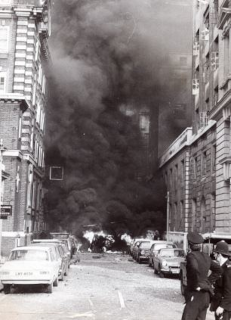
The 1973 Old Bailey bombing, a car bomb attack carried out by the Provisional Irish Republican Army (IRA) and dubbed as Bloody Thursday by newspapers in Britain, takes place outside the Central Criminal Court of England and Wales, commonly referred to as the Old Bailey, in London on March 8, 1973. This is the Provisional IRA’s first major attack in England since the Troubles began in the late 1960s. The unit also explodes a second bomb outside the Ministry of Agriculture building near Whitehall at around the same time the bomb at the Old Bailey explodes.
The Troubles had been ongoing in Northern Ireland and to a lesser extent in the Republic of Ireland since the late 1960s. Rioting, protests, gun battles, sniper attacks, bombings and punishment beatings became part of everyday life in many places in Northern Ireland, especially in the poorer working-class areas of Belfast and Derry. These events and others help to heighten sectarianism and boost recruitment into Irish republican and Ulster loyalist paramilitary groups and the security forces, mainly the newly created Ulster Defence Regiment (UDR).
England had been relatively untouched by the violence up until the beginning of 1973, but the IRA Army Council draws up plans for a bombing campaign to take place in England some time early in 1973. In the late 1960s and early 1970s, loyalist paramilitaries had bombed Dublin and other parts of the Republic of Ireland a number of times before the IRA began its bombing campaign in England. Following the Dublin bombings in late 1972 and in January 1973 carried out by Loyalists which killed three people and injured over 150, the media attention these bombings received helped the IRA decide to take its campaign to Britain in return. The arrest of top IRA personnel in both the Republic and Northern Ireland like Máire Drumm, Seán Mac Stíofáin, Ruairí Ó Brádaigh and Martin McGuinness in late 1972 help to convince the IRA to bomb England to take the heat off of the IRA in Ireland.
The IRA selects the volunteers who constitute the Active Service Unit (ASU) for the England bombing operation, which is scheduled to take place on March 8, 1973, the same day that a border poll, boycotted by Nationalists and Roman Catholics, is being held in Belfast. Volunteers from all three of the IRA’s Belfast Brigade Battalions are selected for the bombing mission. The team includes Gerry Kelly (19), Robert “Roy” Walsh (24), an expert bomb maker from Belfast, Hugh Feeney, a Belfast-born IRA volunteer and explosives expert, and two sisters, Marian (19) and Dolours Price (22) from Belfast and are from a staunchly Republican family, along with five other lesser-known volunteers from Belfast: Martin Brady (22), William Armstrong (29), Paul Holmes (19), William McLarnon (19), and Roisin McNearney (18).
Several days before the bombing, the leaders of the IRA ASU, which includes sisters Marian and Dolours Price, go to London and pick out four targets: the Old Bailey, the Ministry of Agriculture, an army recruitment office near Whitehall and New Scotland Yard. They then report back to their Officer Commanding (OC) in Belfast, and the IRA Army Council gives the go ahead. The bombs are made in Ireland and transported to London via ferry, according to Marian Price.
The Royal Ulster Constabulary (RUC) warns the British that the ASU is traveling to England, but are unable to provide specifics as to the target.
The drivers and the volunteers who are to prime the bombs wake up at 6:00 a.m. and drive the car bombs to their various targets. Gerry Kelly and Roy Walsh drive their car bomb to the Old Bailey. It is planned that by the time the bombs go off around 3:00 p.m., the ASU will be back in Ireland. The bomb at New Scotland Yard is found at 8:30 a.m. by a policeman who notices a discrepancy in the licence plate. The bomb team starts lifting out 5-pound (2.3 kg) bags of explosives and separates them, so that if the bomb does go off, the force of the explosion will be greatly reduced. The bomb squad eventually finds the detonating cord leads, which run under the front passenger seat of the car. Peter Gurney, a senior member of New Scotland Yard, cuts the detonator cord leads, defusing the bomb.
However, at the Old Bailey the bomb explodes, injuring many and causing extensive damage. Scotland Yard states it had warned the City of London police at 2:01 p.m. to search near the Old Bailey for a green Ford Cortina. The car is not located until 2:35 p.m. and explodes at 2:49 p.m. while police are evacuating the area. Several more people are injured by the car bomb near the Ministry of Agriculture, which brings the total number injured to over two hundred. A British man, Frederick Milton (60), dies of a heart attack. Dolours Price writes in her memoir, “There were warnings phoned in but people had stood about, curious to see… If people ignored the warnings and stood around gawking, they were stupid. The numbers of injured came about through curiosity and stupidity.” The ASU is caught trying to leave the country at Heathrow Airport prior to the explosions, as the police had been forewarned about the bombings and are checking all passengers to Belfast and Dublin. All ten give false names that do not match their documents and they are detained. The IRA Volunteer who gave a warning about the bombs an hour before they exploded is the only one not captured.
The IRA volunteers have to be tried at Winchester Crown court in Winchester Castle as the Old Bailey is wrecked by the car bomb. The trial takes ten weeks and is set amid extremely strict security. William McLarnon pleads guilty to all charges on the first day of the trial. On November 14, 1973, a jury convicts six men and two women of the bombings. The jury acquits Roisin McNearney in exchange for information and she is given a new identity. As her verdict is handed down, the other defendants begin to hum the “Dead March” from Saul, and one throws a coin at her, shouting, “Take your blood money with you” as she leaves the dock in tears. Six of the nine people convicted admit to Provisional IRA membership.
The judge sentences the eight to life imprisonment for the bombings and 20 years for conspiracy, while William McLarnon, whose family was forced out of their home in August 1969, is sentenced to 15 years. When his sentence is read he shouts, “Up The Provisional IRA.” As the eight are led to the cells below the court, several give raised fist salutes to relatives and friends in the public gallery. The Price sisters immediately go on hunger strike, soon followed by Feeney and Kelly, for the right not to do prison work and to be repatriated to a jail in Ireland. The bombers on hunger strike are eventually moved to jails in Ireland as part of the 1975 IRA truce agreed with the British. In 1983, Kelly escapes from Maze Prison and becomes part of an IRA ASU in the Netherlands. He is recaptured three years later by the Dutch authorities and extradited.
The Old Bailey bomb is the beginning of a sustained bombing campaign in England. The next major bombing by the IRA in England is the King’s Cross station and Euston station bombings which injured 13 people and do widespread damage. Another significant attack that year is the 1973 Westminster bombing which injures 60 people. Two more people die in England from IRA bombings in 1973, bringing the total to three for the year in that part of United Kingdom. The next year, 1974, is the bloodiest year of the Troubles outside of Northern Ireland with over 70 people being killed in the Republic of Ireland and England combined. Thirty-four are killed in the Dublin and Monaghan bombings, 21 from the Birmingham pub bombings, 12 from the M62 coach bombing, and several people are killed by the IRA’s Balcombe Street Gang.
One of the Old Bailey bombers, Marian Price, explains the IRA’s reasoning for bombing England. “It doesn’t seem to matter if it’s Irish people dying.” So if the armed struggle was to succeed then it was necessary to “bring it to the heart of the British Establishment.” Hence symbolic targets such as the Old Bailey “were carefully chosen.”

 seamus dubhghaill
March 10, 2023 at 11:42 AM
I was a constable with the City of London Police and was injured by the IRA Old Bailey Bomb 8th March 1973.
The injury I received was and remains, deafness. I lost hearing in both ears with hearing returning to my left ear a day or two later. I remain totally deaf in my right ear and, somehow, continued with my police career.
I have only just read your masterpiece of writing about Bloody Thursday. I have not seen that amazing photograph before. It must have been taken a few seconds after the blast and from the Ludgate Hill end of Old Bailey. I was standing at the other end of Old Bailey by the junction with Newgate Street.
Fifty years have passed and, having read your report, I now know exactly what happened, who was concerned and why? I thank you most sincerely for your writings as it means so much to me now.
I hope you are keeping well and continue to write so truthfully and clearly.
Thankyou.
With much respect,
Michael Cook
LikeLike
March 10, 2023 at 6:40 PM
Hello, Michael! Thank you for visiting my site and for your kind words! One unexpected benefit of maintaining this blog is hearing from people who knew or are related to the subject of a post or individuals such as yourself who personally experienced an event. I hate to hear about your hearing loss but am thankful your injuries were not more serious! Again, thanks for commenting and I wish you all the best!
LikeLike
November 25, 2025 at 10:24 AM
I was on a school trip to the St Paul’s Cathedral with all my school mates in a coach from Hartsdown School in Margate. All I remember was the coach stopping right outside the Old Bailey (wrong place wrong time) and a Policeman getting on the stationary coach shouting – ” Get off the coach now and make a crocodile, leave everything behind and run” – We thought it was a hoax, and I remember putting on my coat and all of us getting off, not for one minute thinking what was actually going to happen next. This was the Old Bailey Car Bomb actually going of and we saw awful things that day, so much smoke and glass raining down on us as we screamed and run as if we were about to all die. We were only 12 and this was our first trip in our new senior school!
We run through to the tunnel and didn’t know what to do or think, blind terror kicked in. We came out of the dark tunnel which we thought was going to fall in on us, and there was a sea of Fleet St Photographer’s and friends were on the front of that nights Evening News/Standard and in the next days papers and on the radio. Most of this is still a blur, but I do remember being put into ambulances and taken to Barts, and St Thomas’ hospital and later in the day we had a visit from Edward Heath. One stand out thing of that time, is that no one could ring their parents who would have been so worried as we were on the news!!! The other thing I remember is our Head Master giving us all one day off to get over this terrible ordeal. We never to to St Pauls, and thank goodness we were all ok other than a few minor injuries we did get off lightly considering how close we were to the explosion. Tracie Breakey (was Askew) – Hartsdown School – I have seen newspapers with friends pictures on the front pages
LikeLike
November 25, 2025 at 12:17 PM
Hello, Tracie! Thank you for visiting my site and for sharing your story! One of the unexpected pleasures of maintaining this site is hearing from people such as you who were directly or indirectly affected by the events of a post. I’m glad you and your classmates escaped with no more than a few minor injuries (and a few bad memories). Thanks again for sharing and best wishes!
LikeLike
November 26, 2025 at 10:40 AM
Dear Jim,
I hope you are well. Thank you for all posts which I read every day. I was particularly taken aback by yesterdays post in which Tracie Breakley told of her experience on the afternoon of Thursday 8th March 1973. As a uniformed City of London Police constable on that quite terrifying day, I was on duty in the street, Old Bailey and under the command of Inspector George Murrell. I remember the car bomb beiing photographed by Dale Wilkinson, a Scenes of Crime photographer. A telephone warning had been by the IRA apparently stating the bomb would explode at 3pm. At approximately 2.50pm, whilst Dale Wilkinson was photographing the car, Inspector George Murrell was concerned that a coach had stopped in Old Bailey outside the public house on the corner of Seacole Lane. Inspector Murrell climbed into the coach which had 40 school children in it. Inspector Murrell was the policeman remembered by Tracie. He had ordered all the children out of the coach and instructed them to run to the nearby tunnel that leads to Farringdon Street and to stay there for safety. As the children were running to towards the tunnel so the car bomb exploded. Over 200 people were injured in that bomb blast including Detective Dale Wilkinson. He survived and was invalided out of the police force. There is no doubt that Tracie life, and the lives of all her school chums and teachers, was saved by the instruction from Inspector George Murrell to immediately leave the coach and run to safety under the railway bridge road tunnel.
Ashamedly, it took another 30 years for (retired) Inspector George Murrell to receive a commendation for his bravery from the then Commissioner of Police for the City of London.
Sadly, both DC Dale Wilkinson and Inspector Murrell have since passed away. Their heroism on that day is still talked about.
I thank Tracie for that memory of a horrible experience on her first trip to London. I also thank you Jim for publishing it.
Best regards,
Michael Cook……..retired City of London Police
LikeLike
November 26, 2025 at 11:14 AM
Hello, Michael! Thank you for visiting my site! I don’t think I have ever received notification from two individuals so closely involved with an event in one of my posts! Thanks to you and Tracie for recounting your heroic and harrowing experiences. Thank you also for your service to the City of London Police Department! Enjoy every minute of your retirement!
LikeLiked by 1 person