
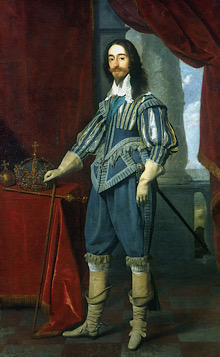
On September 22, 1626, Charles I, king of England, Scotland, and Ireland agrees to offer twenty-six concessions — later expanded to fifty-one articles— to Irish Catholics and landlords in return for £120,000 sterling in subsidies to help fund his army. These concessions become known as “The Graces.”
After the Anglo-Spanish War (1625–1630), Charles needs to maintain troops in Ireland to defend against a possible Spanish invasion. Many Irish Catholics, who had been marginalized under the English Reformation, hope the new Catholic-leaning king will relax anti-Catholic laws. Wealthy Catholic and some Protestant Irish nobles form a committee to petition for reform.
In 1628, at Whitehall, Charles and an Irish delegation (including figures like Luke Plunket, Sir William Talbot, and Sir Lucas Dillon) negotiate fifty-one articles of “Matters of Grace and Bounty.” Key provisions included:
- Religious freedom: Catholics can take the oath of allegiance instead of the oath of supremacy, which excludes them from public office.
- Land rights: Defects of title will not be traced beyond 60 years, securing estates for those with long-standing claims.
- Restraint on oppression: Limits on abuses by soldiers and officials.
- Confirmation of titles: Especially in Connacht.
The subsidies are to be paid in three yearly installments. The Graces are intended to secure loyalty from Irish Catholics and landlords by restoring their legal and public rights, while also funding Charles’s military needs.
Although the Graces are proclaimed and the first payment made, Lord Deputy of Ireland Thomas Wentworth (appointed 1632) and later Lord Falkland (1629–1633) refuse to summon the Irish Parliament to ratify them. This means the concessions are never formally confirmed, leaving Catholics hopeful but without legal security. The unratified Graces contribute to later unrest, including the Irish Rebellion of 1641.
In summary, the September 22, 1626, agreement is a pivotal moment in Irish–English relations, offering significant religious and property concessions in exchange for military funding — but its failure to secure parliamentary ratification leaves its benefits unenforced.


September 23, 2026 at 5:05 PM
Was the title Sir given by the English or why did Irishmen have that title? In speaking of the Irish Rebellion, I was unable to leave a question on the older article about Rory O’Moore. Sir Walter Bogan/Boggan was married to Lydia O’Rorie Moore. Does that mean she was named in his memory? She would have been born in the late 1600’s. My ancestor grandparent Patrick, their son, was born about 1725 or before. We have the family tradition of Patrick being Scots-Irish. I am trying to see if that was even possible. Patrick was born in Castlefin, County Donegal, Ireland. Thank you, Debbie Byrd debbie@mickbyrd.com
Peace Begins With A Smile – Mother Theresa Be The Change You Seek In The World – Mohandas Gandi
>
LikeLike
September 23, 2026 at 8:09 PM
Hello, Debbie. Thank you for visiting my site! Yes, the title “Sir” as an honorific for knights and baronets was introduced to Ireland by the English through centuries of conquest, legal integration, and the extension of the British honors system. Unfortunately, I don’t have an answer to your question regarding Lydia O’Rorie Moore.
LikeLike