
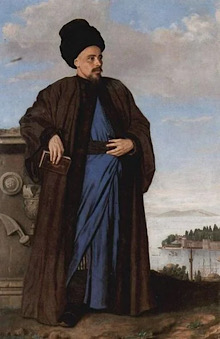
Richard Pococke, an 18th‑century English clergyman and pioneering travel writer, best known for his extensive journeys through Europe and the Near East and for his influential work A Description of the East, is born in Southampton, England, on November 19, 1704.
Pococke is born into a family deeply rooted in the Church of England. His father, also named Richard, is a rector, and his mother, Elizabeth Milles, comes from a prominent clerical family with strong Irish church connections. He studies at Corpus Christi College, Oxford, earning degrees including a Bachelor of Laws and later a Doctor of Laws. He is ordained in 1725.
Between 1733 and 1741, Pococke undertakes two major Grand Tours with his cousin Jeremiah Milles. His first tour (1733–34) covers France and Italy. His second (1737–41) expands into Egypt, Palestine, Lebanon, Syria, Asia Minor, and Greece, making him one of the earliest and most detailed European observers of these regions.
Pococke’s Near Eastern travels produce his most famous work, A Description of the East and Some Other Countries (Vol. I 1743; Vol. II 1745), praised by historian Edward Gibbon. He documents major archaeological sites including the pyramids at Giza, Saqqara, and Dahshur. Many of the monuments he describes are later damaged or lost, increasing the historical value of his accounts. He also provides an early European discussion of the Ashtiname of Muhammad, a medieval document concerning Saint Catherine’s Monastery in Egypt.
Pococke travels widely within the British Isles. He tours Ireland from 1747 to 1760, touring more than half the country in 1752. His notes are later published in 1891. He tours Scotland in 1747, 1750 and 1760. His 1760 tour lasts nearly five months and reaches as far as Orkney. His Scottish writings include early references to local customs such as breakfasts featuring marmalade and preserved orange peel.
Despite his extensive travels, Pococke advances steadily in the Church of Ireland, aided by family connections. His positions include Vicar‑General of Waterford and Lismore (1734), Archdeacon of Dublin (1745), Bishop of Ossory (1756–65) and Bishop of Meath (1765), appointed only months before his death.
Pococke is known as a conscientious churchman and a respected preacher, even preaching and confirming in Scottish Episcopal congregations at a time when this is unusual for an English bishop.
Pococke dies of apoplexy on September 25, 1765, at Charleville Castle in Ireland. He is buried at Ardbraccan, County Meath.
Pococke’s manuscripts, including travel diaries and letters, are deposited in the British Museum (now British Library). His works remain important for early Egyptology and archaeological documentation, detailed accounts of 18th‑century Europe and the Near East, and rich descriptions of Ireland and Scotland during a period of major cultural change.


