
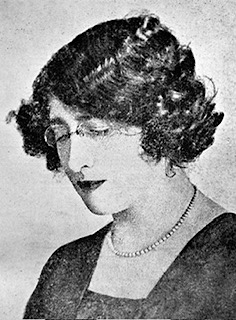
Kathleen O’Brennan, campaigner for Irish independence in the United States, a journalist and a playwright, is born Catherine Mary Brennan in Dublin on November 20, 1876.
O’Brennan is the daughter of Francis Brennan, auctioneer, and his wife, Elizabeth Anne Butler, while they live in 11 South Richmond Street, Dublin. They reclaim the “O” of their name at a time when many Irish families are returning to the “Mac” or “O” version that has been unrecognised for a century. Her sister, Áine O’Brennan, marries Éamonn Ceannt and her younger sister, Lily O’Brennan, is a writer and playwright. Her father dies in 1880, her mother in 1930. She is appointed Dublin correspondent to The London Times and goes on to submit work regularly to The Irish Times and the Irish Tatler.
While Lily and Áine are involved directly in the Easter Rising in 1916, O’Brennan is in the United States. She does not let her absence from Dublin prevent her from working hard to ensure the success of Ireland’s bid for independence.
According to research by historian Catherine M. Burns, O’Brennan arrives in the United States in October 1914 and stays there longer than expected due to the difficulty of transatlantic travel during World War I. Working as a journalist and lecturer, she travels to California and Oregon and speaks to women’s organisations as an authority on the Gaelic League and Irish art and culture. Her lectures include details she got from her sisters and photos of Éamonn Ceannt and his son, Rónán.
While on the U.S. West Coast, O’Brennan’s ties to the Industrial Workers of the World (IWW) brings her to the attention of the U.S. authorities, who track her movements and associations. She becomes involved in the IWW through Dr. Marie Equi, with whom she has a romantic relationship. When Equi is arrested, O’Brennan works to see her release and continues to agitate until her own arrest in 1919 during the Red Scare. The U.S. government issues a deportation order for her, but it is not enforced. During this period, she founds the Women’s Irish Education League in San Francisco in May 1919.
O’Brennan moves to the U.S. East Coast in 1920. As Burns finds, after an “American women” picketing venture demanding U.S. recognition of the Irish Republic is organised by William J. Maloney in Washington, D.C. in April 1920, O’Brennan, Gertrude Kelly and Gertrude Corless found the American Women Pickets for the Enforcement of America’s War Aims in New York City.
Burns argues that the organisation uses American identity as a tool to shield O’Brennan’s identity and to mask the radicalism of the women’s cause by tying support for the Irish Republic to historical memory of the American Revolution. According to Burns, during the April 1920 picketing O’Brennan takes advantage of her position as the pickets’ press connection to ensure that names other than her own, such as Kathleen Glennon, Maurya O’Brannon and Kathleen Butler appear in press reports about the pickets, concealing her identity in the face of the deportation order that might be enforced were she to be seen as associated with militant women’s activism for the Irish Republic.
Burns maintains that after picket Helen Golden challenges their leadership by publicly designating the women pickets loyal to O’Brennan, Kelly, and Corless as Irish, rather than American. O’Brennan and Kelly then form an American auxiliary to the Irish White Cross.
Fearful that the Irish republican movement in the United States might be perceived as Irish-run, radical, and un-American, Harry Boland opposes their efforts. He and Éamon de Valera attack O’Brennan, deeming her and Kelly as too un-American to work for the benefit of the as yet unrecognised Irish Republic in the United States. The women refuse to take orders from de Valera, sealing their fate. O’Brennan departs to Canada on a lecture tour in July 1921 and by June 1922 is living back in Dublin.
During the Irish Civil War, de Valera uses O’Brennan’s socialist reputation to approach Soviet foreign minister Georgy Chicherin while in Switzerland. The contact is hoped to provide finance and munitions but is unsuccessful.
O’Brennan’s play Full Measure premieres in the Abbey Theatre in 1928. She is secretary to the Irish PEN.
O’Brennan dies on May 12, 1948, and is buried in Dean’s Grange Cemetery with her sister Lily. Her personal papers are held in the National Library of Ireland along with those of other members of her family including Éamonn Ceannt, his wife Áine and her sister Lily.


