The first recorded parade honoring the Catholic feast day of St. Patrick, the patron saint of Ireland, is held in New York City on March 17, 1762 – fourteen years before the signing of the Declaration of Independence. The parade is comprised of a band of homesick, Irish ex-patriots and Irish military members serving with the British Army stationed in the colonies in New York. They march to an inn of one John Marshall located near the present-day intersection of Barclay and Church streets in lower Manhattan.
Early Irish settlers to the American colonies, many of whom are indentured servants, bring the Irish tradition of celebrating St. Patrick’s feast day to America. This is at a time when the wearing of green is a sign of Irish pride but is banned in Ireland. In the 1762 parade, participants revel in the freedom to speak Irish, wear green, sing Irish songs, and play the pipes to Irish tunes that are meaningful to the Irish immigrants of the time.
With the dramatic increase of Irish immigrants to the United States in the mid-19th century, the March 17th celebration becomes widespread. Today, across the United States, millions of Americans of Irish ancestry celebrate their cultural identity and history by enjoying Saint Patrick’s Day parades and engaging in general revelry.
Saint Patrick, born in the late 4th century, is one of the most successful Christian missionaries in history. Born in Britain to a Christian family of Roman citizenship, he is taken prisoner at the age of sixteen by a group of Irish raiders during an attack on his family’s estate. They transport him to Ireland where he spends six years in captivity before escaping back to Britain. Believing he has been called by God to Christianize Ireland, he joins the Catholic Church and studies for 15 years before being consecrated as the church’s second missionary to Ireland. Patrick begins his mission to Ireland in 432 and the island is almost entirely Christian at the time of his death in 461.
For the first time in the 230-year history of the New York City St. Patrick’s Day parade, members of an LGBT group, the Irish Lesbian & Gay Organisation, are allowed to march in the parade on March 16, 1991.
New York Mayor David N. Dinkins gives up the traditional lead-off position in the parade and instead marches with the Irish gay group more than two hours later. It marks the first time in memory that a New York City mayor has declined to lead a St. Patrick’s Day Parade.
On March 14, Dinkins agrees to march with the gay group “for reasons we all understand” as part of a compromise to get the group into the parade. The mayor and the 135-member gay group are guests of Division 7 of the Ancient Order of Hibernians, the midtown Manhattan chapter of the fraternal order that sponsors and organizes the parade.
Normally, politicians jockey for high-profile spots in the parade, which is billed as the world’s largest civilian parade. No mayor has ever been in the difficult spot of trying to resolve such a public dispute between Irish American groups, which have long been political powers in New York City, and gay groups, which have gained strength and are an important part of the coalition that helped bring Dinkins to office.
Police officials have 3,100 officers along the parade route to provide security for the estimated one million spectators and 150,000 people marching in the parade. The parade costs the city more than $500,000 in overtime for police, sanitation, traffic, and other employees.
Dinkins is booed for nearly 40 blocks, briefly showered with beer, and dodges two thrown beer cans as he and other elected officials march up Fifth Avenue with the gay Irish group.
Governor Mario M. Cuomo also gives up a place at the front of the parade, marching with a group of handicapped children in wheelchairs that had been denied a place among the bands and bagpipes until they threatened to sue the parade organizers.
As in previous years, some marchers wear green sashes reading, “Free Joe Doherty,” referring to the Irish Republican Army soldier jailed in New York City. Others wear yellow ribbons to honor soldiers returning home from the Persian Gulf war. But the dispute about the homosexuals is the focus for much of the march.
After the parade, Dinkins says although he expected to draw protests for marching with the lesbian and gay group, he is surprised by the depth of anger directed against him and the homosexual marchers. “It was like marching in Birmingham, Alabama during the civil rights movement,” he said. “I knew there would be deep emotions, but I did not anticipate the cowards in the crowd. There was far, far too much negative comment.”
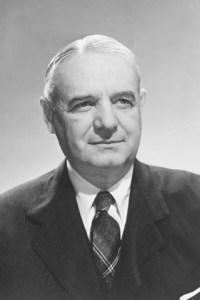
Of Irish descent, Donovan is born in Buffalo, New York, to first generation immigrants Anna Letitia “Tish” Donovan (née Lennon) of Ulster and Timothy P. Donovan of County Cork. His grandfather, Timothy O’Donovan, Sr., is from the town of Skibbereen, and marries Mary Mahoney, who belongs to a propertied family of substantial means who disapprove of him. They move first to Canada and then to New York, where their son Timothy, Jr., Donovan’s father, attempts to engage in a political career but with little success.
William attend St. Joseph’s Collegiate Institute and Niagara University before starring on the football team at Columbia University, where he earns the nickname “Wild Bill”, which remains with him for the rest of his life. He graduates from Columbia in 1905. He then attends and graduates from Columbia Law School, after which he becomes an influential Wall Street lawyer.
In 1912, Donovan forms and leads a troop of cavalry of the New York National Guard, which is mobilized in 1916 and serves on the U.S.-Mexico border during the American government’s campaign against Pancho Villa.
During World War I, Major Donovan organizes and leads the 1st battalion of the 165th Regiment of the 42nd Division. For his service near Landres-et-St. Georges, France, on October 14-15, 1918, he receives the Medal of Honor. By the end of the war, he receives a promotion to colonel, as well as the Distinguished Service Cross and Purple Heart.
Donovan serves as U.S. Attorney for the Western District of New York from 1922 to 1924. Due to his energetic enforcement of Prohibition in the United States, there are a number of threats to assassinate him and to dynamite his home, but he is not deterred. In 1924, President Calvin Coolidge names Donovan to the United States Department of Justice’s Antitrust Division as a deputy assistant to Attorney General Harry M. Daugherty. Donovan runs unsuccessfully for Lieutenant Governor of New York (1922) and for Governor of New York (1932) as a Republican.
During the years between the world wars, Donovan earns the attention and friendship of President Franklin D. Roosevelt. Although the two men were from opposing political parties, they were very similar in personality. In 1940 and 1941, Donovan traveled as an informal emissary to Britain, where he is urged by U.S. Secretary of the Navy Frank Knox and Roosevelt to gauge Britain’s ability to withstand Germany’s aggression. During these trips Donovan meets with key officials in the British war effort, including Winston Churchill and the directors of Britain’s intelligence services. Donovan returns to the U.S. confident of Britain’s chances and enamored of the possibility of founding an American intelligence service modeled on that of the British.
On July 11, 1941, Donovan is named Coordinator of Information (COI) where he is to oversee America’s foreign intelligence organizations which, at the time are fragmented and isolated from each other. He is plagued over the course of the next year with jurisdictional battles as few of the leaders in the intelligence community are willing to part with any of their power. Nevertheless, Donovan begins to lay the groundwork for a centralized intelligence program.
In 1942, the COI becomes the Office of Strategic Services (OSS) and Donovan is returned to active duty in the U.S. Army. He is promoted to brigadier general in March 1943 and to major general in November 1944. Under his leadership the OSS eventually conducts successful espionage and sabotage operations in Europe and parts of Asia. By 1943, relations with the British are becoming increasingly strained, partly due to British concerns that OSS operations are sometimes regarded as ill-disciplined and irresponsibly managed. MI6 chief Stewart Menzies is extremely hostile towards the idea of OSS operations anywhere in the British Empire and categorically forbids them to operate within the U.K.
After the end of World War II and the death of President Roosevelt in early April 1945, Donovan’s political position is substantially weakened as he finds himself opposed by President Harry S. Truman, J. Edgar Hoover, and others. Truman disbands the OSS in September 1945 and Donovan returns to civilian life. Several departments of the OSS survive the dissolution and, less than two years later, the Central Intelligence Agency is founded.
Donovan does not have an official role in the newly formed CIA, but he is instrumental in its formation. His opinions meet strong opposition from the State, War, and Navy Departments, as well as J. Edgar Hoover. President Truman is also unenthusiastic about some of Donovan’s arguments, but he prevails, and they are reflected in the National Security Act of 1947 and the Central Intelligence Agency Act of 1949.
After the end of the war ended, Donovan returns to his lifelong role as a lawyer and serves as special assistant to chief prosecutor Robert H. Jackson at the Nuremberg War Crimes Tribunal in Germany. On August 3, 1953, President Dwight Eisenhower appoints Donovan Ambassador to Thailand, and he serves in that capacity from September 4, 1953, until his resignation on August 21, 1954.
Donovan dies from complications of vascular dementia on February 8, 1959, at the age of 76, at Walter Reed Army Medical Center in Washington, D.C. He is buried in Section 2 of Arlington National Cemetery. President Eisenhower remarks, “What a man! We have lost the last hero.”
Clinton travels frequently to Ireland as First Lady and as U.S. Secretary of State, and often talks about the end of the civil strife, known as The Troubles, as a crowning foreign policy achievement of her husband’s administration. On her visit to Belfast in 2012, she pledges to continue to support peace in Ireland in whatever way possible.
“Hillary Rodham Clinton is one of the unsung heroes of the success of the Irish peace process,” says Niall O’Dowd, publisher of Irish America magazine. “As First Lady, U.S. Senator, and Secretary of State she always gave the issue top priority to help ensure it remained at the top of the U.S. foreign policy agenda. During that historic first trip to Northern Ireland with Bill Clinton in 1995, which I was privileged to be on, she galvanized women’s groups on both sides by meeting with them, shaping their agenda, and making sure they always had a friend in the U.S. administration. More than that, she constantly stayed involved, never giving up her focus on bringing an end to Europe’s longest conflict at the time.”
On the eve of St. Patrick’s Day, Clinton delivers the keynote address at the luncheon in Manhattan of high profile Irish-Americans who each year honor elected officials and others. She describes sitting at a table in Belfast, over cups of tea, with women from both sides of the conflict and watching as they discover how much they share.
She does not portray herself as instrumental to the Good Friday Agreement that President Clinton brokered in 1998, but says her outreach to women in Belfast on multiple visits during that period had played a critical role.
“You cannot bring peace and security to people just by signing an agreement,” she says. “In fact, most peace agreements don’t last.” She says that when “the work of peace permeates down to the kitchen table, to the backyard, to the neighborhood, around cups of tea, there’s a much greater chance the agreement will hold.”
Previous inductees into the Irish America Hall of Fame include former President John F. Kennedy, former President Bill Clinton, Vice President Joseph R. Biden, Jr., and former Maryland Governor Martin O’Malley, who addressed the luncheon in 2014 in a mix of English and Irish.
Major Thomas Buchanan McGuire, Jr., the second highest scoring United States ace of World War II and winner of the Medal of Honor, is shot down and killed over the Pacific on January 7, 1945.
McGuire is an Irish American born in Ridgewood, New Jersey on August 1, 1920. He spends most of his childhood in Sebring, Florida, where he and his mother move after his parents are divorced.
McGuire enlists in the army as a aviation cadet in July 1941 and earns his pilot’s wings in February 1942. Sent to Alaska, McGuire bristles at the lack of combat and requests a transfer to a combat squadron. In December he is sent to California to learn to fly the twin-engine P-38 Lightning in which he earns his fame. In March 1943 he ships out to the Pacific, joining the 49th Fighter Group. One of the veteran combat pilots in the 49th is Richard Bong, who becomes the highest scoring ace of World War II.
In just his second mission, on August 18, McGuire is credited with shooting down three Japanese planes. On his next mission, on the 21st, he shoots down two more, making him an ace after just three missions. In October he is shot down but manages to bail out over the ocean and is rescued by a PT boat. When he takes off from his base in the Philippines on Christmas day 1944, he has thirty-one kills. In the next two days he shoots down seven enemy planes to bring his total to thirty-eight, putting him only two behind Bong, who has been sent home for a fund-raising tour. McGuire is anxious to pass him.
Early on the morning of January 7, McGuire leads a flight of four P-38s over Japanese airbases on Negros Island. The group is confronted by a lone Ki-43 “Oscar.” As the Japanese fighter approaches from behind, McGuire makes an extremely sharp turn to the left. This extremely dangerous maneuver, performed at an altitude of only 300 feet, causes McGuire’s P-38 to stall. It snap rolls inverted and noses down into the ground. Despite the low altitude, McGuire nearly pulls out successfully. Had he jettisoned his drop tanks at the start of the dogfight, he might have managed it, however McGuire is killed on impact.
A memorial, placed by aviation archaeologist and former fighter pilot David Mason in 2007, stands at McGuire’s fatal crash site on Negros Island as a tribute. McGuire is posthumously awarded the Medal of Honor for his seven kills in two days in December. He is memorialized by the renaming of Fort Dix Army Air Force Base in Burlington County, New Jersey, to McGuire Air Force Base in 1948.


 On February 2, 2015, Irish America magazine announces that


