seamus dubhghaill

Promoting Irish Culture and History from Little Rock, Arkansas, USA


Leave a comment

Death of Frank McCourt, Author of “Angela’s Ashes”

frank-mccourt

Francis “Frank” McCourt, Irish American teacher and writer, dies of cancer in Manhattan, New York City, on July 19, 2009.

A New York city schoolteacher for more than thirty years, McCourt achieves literary fame later in life with his best-selling childhood memoir of the misery and squalor of his childhood, Angela’s Ashes. With a first printing of just 25,000 copies, the book becomes an instant favourite with critics and readers and is perhaps the ultimate case of the non-celebrity memoir, the extraordinary life of an ordinary man.

McCourt wins the annual Pulitzer Prize for Biography or Autobiography in 1997 and one of the annual National Book Critics Circle Awards for the book, which is eventually published in 25 languages and 30 countries. It is a bestseller and makes him a millionaire. Three years later, a movie version of Angela’s Ashes opens to mixed reviews with Northern Irish actor Michael Legge playing McCourt as a teenager.

McCourt is also the author of ‘Tis (1999), which continues the narrative of his life, picking up from the end of Angela’s Ashes and focusing on his life after returning to New York. He subsequently writes Teacher Man (2005) which details his teaching experiences and the challenges of being a teacher.

McCourt writes the book for a 1997 musical entitled The Irish…and How They Got That Way, which features an eclectic mix of Irish music – everything from the traditional Danny Boy to U2‘s I Still Haven’t Found What I’m Looking For.

It is announced in May 2009 that McCourt has been treated for melanoma and that he is in remission, undergoing home chemotherapy. On July 19, 2009, he died from the cancer, with meningeal complications, at a hospice in Manhattan.


Leave a comment

Birth of Irish Dancer & Choreographer Michael Ryan Flatley

michael-flatley

Michael Ryan Flatley, Irish American dancer, choreographer, and musician, is born to Irish parents in Chicago, Illinois on July 16, 1958. He becomes internationally known for Irish dance shows Riverdance, Lord of the Dance, Feet of Flames, and Celtic Tiger.

Flatley begins dancing lessons at age 11 and, at age 17, is the first American to secure a World Irish Dance title at the World Irish Dance Championships, the Oireachtas Rince na Cruinne. He is also an accomplished flautist, having won twice in the All-Ireland Fleadh Cheoil Concert Flute competitions from 1975-1976.

Flatley is taught dance by Dennis Dennehy at the Dennehy School of Irish Dance in Chicago. After graduating from Brother Rice High School, on Chicago’s Southwest Side, he opens a dance school but later closes it to focus on performing.

In 1978 and 1979 Flatley tours with Green Fields of America and then with The Chieftains in the 1980s. In May 1989, Flatley sets a Guinness Book world record for tapping speed at 28 taps per second, and subsequently breaks his own record in 1998 with 35 taps per second.

Flatley creates and choreographs the original Riverdance and leads the show to great success as the intermission act in the Eurovision Song Contest staged in Ireland on April 30, 1994. Flatley abruptly leaves the show over creative control disputes in October 1995.

Shortly after the Riverdance split, Flatley creates Lord of the Dance, which plays mostly in arenas and stadiums instead of stage theaters. He also puts together a dance production called Feet of Flames in 1998. Flately’s Irish dance show Celtic Tiger opens in July 2005. The show explores the history of the Irish people and Irish emigration to the United States, fusing a wide range of dance styles, including jazz.

Flatley returns to the stage in 2009 for a limited run of the “Hyde Park” version of Feet of Flames in Taiwan. His return is met with multiple standing ovations and the run of shows has to be extended to meet the demand for tickets.

Flatley premiers Lord of the Dance: Dangerous Games at the celebrated Palladium Theatre on London’s West End in 2014 and moves to the Dominion Theatre in 2015 where he makes his final appearance on the West End stage before revisiting another sold out Wembley Arena for his final performance in the United Kingdom.

Flatley embarks on his final tour on February 19, 2016 and performs on stage for the last time at The Colosseum at Caesar’s Palace in Las Vegas, NV, on March 17, 2016. He continues as the show’s creator, producer, and choreographer.


Leave a comment

The Last Official Bare-Knuckle Title Fight

sullivan-kilrain-fight

Heavyweight boxer John L. Sullivan defeats fellow Irish American Jake Kilrain in a world championship bout which lasts 75 rounds on July 8, 1889, the last official bare-knuckle title fight ever held.

Bare-knuckle boxing is the original form of boxing, closely related to ancient combat sports. It involves two individuals fighting without boxing gloves or other padding on their hands. The difference between a street fight and a bare-knuckle boxing match is an accepted set of rules, such as not striking a downed opponent.

The Sullivan-Kilrain fight is considered to be a turning point in boxing history because it is the last world title bout fought under the London Prize Ring Rules, and therefore the last bare-knuckle heavyweight title bout. It is one of the first sporting events in the United States to receive national press coverage.

For the first time, newspapers carry extensive pre-fight coverage, reporting on the fighters’ training and speculating on where the bout will take place. The traditional center of bare-knuckle fighting is New Orleans, but the governor of Louisiana has forbidden the fight in that state. Sullivan has trained for months in Belfast, New York under trainer William Muldoon, whose biggest problem has been keeping Sullivan from liquor. A report on Sullivan’s training regimen in Belfast is written by famed reporter Nellie Bly and published in the New York World.

Rochester reporter Arch Merrill comments that occasionally Sullivan would “escape” from his guard. In Belfast village, the cry is heard, “John L. is loose again. Send for Muldoon!” Muldoon would snatch the champ away from the bar and take him back to their training camp.

On July 8, 1889, an estimated 3,000 spectators board special trains for the secret location, which turns out to be Richburg, a town just south of Hattiesburg, Mississippi. The fight begins at 10:30, and it looks as if Sullivan is going to lose, especially after he vomits during the 44th round. But the champion gets his second wind after that, and Kilrain’s manager, Mike Donovan, finally throws in the towel after the 75th round. Kilrain does not want to give up thinking he can outlast Sullivan, but Donovan defends his actions insisting that Kilrain would die if the fight continued. In any case, the Kilrain-Sullivan fight can rightly be listed among the greatest fights of the pre-modern era.


Leave a comment

State Visit of U.S. President John F. Kennedy

jfk-state-visit

John F. Kennedy, an Irish American and the first Catholic to become president of the United States, arrives in Ireland on a state visit on June 26, 1963. After Air Force One touches down at Dublin airport, Kennedy’s motorcade weaves through the streets of Dublin city, the thrilled crowd, lacking ticker tape, improvises by throwing rolls of bus tickets.

Kennedy is proud of his Irish roots and makes a special visit to his ancestral home in Dunganstown, County Wexford, while in the country. There, he is greeted by a crowd waving both American and Irish flags and is serenaded by a boys’ choir that sings The Boys of Wexford. Kennedy breaks away from his bodyguards and joins the choir for the second chorus, prompting misty-eyed reactions from both observers and the press.

Kennedy meets with 15 members of his extended Irish family at the Kennedy homestead in Dunganstown. There he enjoys a cup of tea and some cake and makes a toast to “all those Kennedys who went and all those Kennedys who stayed.” His great-grandfather, Thomas Fitzgerald, had left Ireland for the United States in the middle of the Great Famine of 1848 and settled in Boston, becoming a cooper. Generations of his descendants go on to make their mark on American politics.

At the time of JFK’s visit to Ireland, the predominantly Catholic Irish Republic has been an independent nation for 41 years. The northern counties of the island, however, remain part of the largely Protestant British Empire and still suffer from long-standing sectarian violence. On the day after his arrival in Dublin, Kennedy speaks before the Irish parliament, where he openly condemns Britain’s history of persecuting Irish Catholics. Two days later, he travels to England, America’s oldest ally, to meet with British Prime Minister Harold Macmillan and his cabinet to discuss setting up a pro-democratic regime in British Guiana.

Kennedy later tells his aides that his favourite part of the trip was the wreath laying and silent funeral drill done by the Irish Army cadets at Arbour Hill military cemetery in Dublin.

Five months later, his widow, Jacqueline Kennedy, makes a special request to the Irish government. She asks that those same Irish army cadets, who so impressed the President on his visit, perform the drill again at his state funeral. Within days, those awe-stuck, trembling young men stand just inches away from foreign dignitaries from over 90 countries and perform their silent funeral drill in memory of a president that had inspired their country just a few short months earlier.


2 Comments

Black Thursday – The Molly Maguire Executions

molly-maquires-gallows

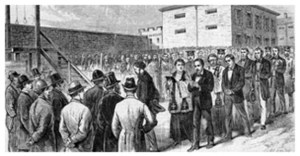
On June 21, 1877, a day that will long be remembered as Black Thursday, ten members of the Molly Maguires, an Irish labor organization, are executed in Pennsylvania, the first of twenty executions that make up the largest mass execution of any group by the U.S. federal government in history.

The Molly Maguires is an Irish 19th-century secret society active in Ireland, Liverpool, and parts of the eastern United States, best known for their activism among Irish American and Irish immigrant coal miners in Pennsylvania. The Mollies are believed to have been present in the anthracite coal fields of Pennsylvania in the United States since at least the Panic of 1873.

Members of the Mollies are accused of murder, arson, kidnapping and other crimes, in part based on allegations by Franklin B. Gowen and the testimony of a Pinkerton detective, James McParland, a native of County Armagh. Fellow prisoners testified against the defendants, who were arrested by the Coal and Iron Police. Gowen acts as a prosecutor in some of the trials. The Molly Maguires become largely inactive following the executions of 1877 and 1878.

On June 21, 1877, the first ten executions take place. Six Mollies – James Carroll, James Roarity, Hugh McGehan, James Boyle, Thomas Munley, and Thomas Duffy – are hanged in the prison at Pottsville, Pennsylvania. The sheriff hangs them successively two-by-two rather than build special gallows to accommodate six. An immense crowd gathers covering the surrounding hills. Boyle carries a blood-red rose and McGehan has two roses in his lapel. Carrol and Roarity declare their innocence from the scaffold. In County Donegal, McGehan’s relatives meet in the kitchen and, it is said, the sky blackens at the moment of hanging.

On the same date, Alexander Campbell, John “Yellow Jack” Donohue, Michael J. Doyle, and Edward J. Kelly are hanged at a Carbon County prison in Mauch Chunk for the murders of John P. Jones and Morgan Powell, both mine bosses. Here gallows have been erected to accommodate four hangings and the four are hung at the same instant. Campbell, just before his execution, allegedly slaps a muddy handprint on his cell wall stating, “There is proof of my words. That mark of mine will never be wiped out. It will remain forever to shame the county for hanging an innocent man.” The handprint remains to this day.

Ten more condemned, Thomas Fisher, John “Black Jack” Kehoe, Patrick Hester, Peter McHugh, Patrick Tully, Peter McManus, Dennis Donnelly, Martin Bergan, James McDonnell, and Charles Sharpe, are hanged at Mauch Chunk, Pottsville, Bloomsburg, and Sunbury over the next year. Peter McManus is the last Molly Maguire to be tried and convicted for murder at the Northumberland County Courthouse in 1878.


Leave a comment

Six Irish Students Killed in Berkeley Balcony Collapse

berkeley-balcony-collapse

Five Irish J-1 visa students and one Irish American die and seven others are injured in Berkeley, California, on June 16, 2015, after a fourth-floor balcony on which they are standing collapses. Thirteen people fall from the balcony and four are pronounced dead at the scene while two die later at the hospital.

One of the six killed is a dual Irish American citizen, Ashley Donohoe, 22, of Rohnert Park, California. The other five are Olivia Burke (Donohue’s cousin), Eoghan Culligan, Niccolai ‘Nick’ Schuster, Lorcán Miller, and Eimear Walsh, all aged 21 and from Dublin.

In June 2015, Berkeley Mayor Tom Bates promises a broad and wide-ranging investigation into the cause of the accident with the likely cause being that the balcony of the building had not been constructed properly leading to the development of dry rot, leading to the balcony becoming structurally compromised. Overwhelming evidence points to dry rot as the cause of the collapse, and not the weight of the 13 students on it at the time.

The New York Times publishes an article reporting the deaths and suggesting the deceased are to blame for the collapse. The paper states that Irish students coming to the U.S. on J-1 visas are an “embarrassment to Ireland.” Taoiseach Enda Kenny and former President Mary McAleese criticise the newspaper for “being insensitive and inaccurate” in its handling of the story. The newspaper subsequently apologizes, although the article remains available at its website.

Alameda County prosecutors open up a criminal investigation on the accident on June 25. They state that involuntary manslaughter charges could be filed. Berkeley District Attorney Nancy O’Malley denies that pressure from the Irish community have led to the collapse inquiry.

On July 3, 2015, the Alameda County Superior Court rejects a restraining order bid against the examination of evidence by construction company Segue Builders. D.A. O’Malley had argued that the granting of a restraining order would amount to an interference in her duty to investigate the tragedy.

In December 2015, a court is told that the collapse happened because contractors cut corners to save costs. It is alleged that Greystar, the management company for the building, ignored a “red flag” when students who rented the apartment complained about the presence of mushrooms growing on the balcony. Legal cases by some of the victims are set to be combined and heard together sometime in 2016.

A joint funeral service for Olivia Burke and her cousin Ashley Donohoe takes place on June 20, four days after the collapse, in a church in Cotati, California. Funeral services are held in Dublin for the remaining victims.


Leave a comment

John Joseph “Jack” Doyle Becomes First Major League Pinch Hitter

jack-doyle

John Joseph “Jack” Doyle, Irish-American first baseman of the Cleveland Spiders in Major League Baseball, becomes the first to pinch hitter in a baseball game on June 7, 1892. He comes through with a game-winning single against the Brooklyn Dodgers.

Doyle is born in Killorglin, County Kerry, on October 25, 1869, and emigrates with his family to the United States when he is a child, settling in Holyoke, Massachusetts. After attending Fordham University, Doyle embarks on a baseball career that lasts 70 years. He makes his first appearance at the major league level by signing and playing two years for the Columbus Solons of the American Association. Doyle plays for ten clubs between 1889 and 1905, batting .299 in 1,564 games with 516 stolen bases. He begins as a catcher–outfielder and becomes a first baseman in 1894. His best years are in 1894, when he bats .367 for the New York Giants, and in 1897, when he hits .354 with 62 stolen bases for the Baltimore Orioles.

Because of his aggressive playing style, Doyle is known as “Dirty Jack”, often feuding with umpires, fans, opposing players, and even at times, his own teammates. He carries on a lengthy feud with John McGraw that starts when they are teammates in Baltimore. McGraw, of course, has to have the last word. In 1902, McGraw is appointed manager of the Giants and his first act is to release Doyle, even though he is batting .301 and fielding .991 at the time. Even with these seemingly out-of-control traits, Doyle is deemed a natural leader and is selected as team captain in New York, Brooklyn and Chicago, and serves as an interim manager for the Giants in 1895 and Washington Senators in 1898.

In 1905, after playing one game with the New York Highlanders, Doyle becomes manager of Toledo of the Western Association. One year later, he is named the manager of the Des Moines Champions, so named because they won the league championship the previous year, and they win it again under Doyle’s helm. Following his championship season at Des Moines, he manages Milwaukee in 1907.

In 1908–1909, the only years of his adult life spent outside of baseball, Doyle serves as police commissioner of his hometown of Holyoke. He returns to baseball as an umpire and works in the National League for 42 games in 1911. He later joins the Chicago Cubs as a scout in 1920. He remains in that capacity until his death at age 89 on New Year’s Eve 1958. Doyle is buried at St. Jerome Cemetery in Holyoke.


Leave a comment

Assassination of Robert F. Kennedy

robert-f-kennedy

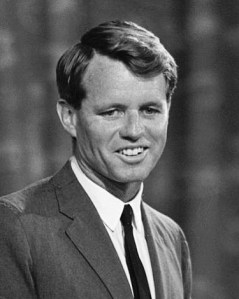
Robert F. Kennedy, Irish-American, United States Senator, Democratic presidential candidate, and brother of assassinated President John F. Kennedy, dies on June 6, 1968 in Los Angeles, California after being shot in the early morning hours of June 5.

After winning the California and South Dakota primary elections for the Democratic nomination for President of the United States and speaking to supporters in a ballroom at the Ambassador Hotel, Kennedy walks through the kitchen area frequently shaking hands with those he encounters. Kennedy starts down a passageway narrowed by an ice machine against the right wall and a steam table to the left. He turns to his left and shakes hands with busboy Juan Romero just as Sirhan Sirhan, a 24-year-old Palestinian/Jordanian immigrant, steps down from a low tray-stacker beside the ice machine and repeatedly fires what is later identified as a .22 caliber Iver-Johnson Cadet revolver.

After Kennedy had falls to the floor, former FBI agent William Barry sees Sirhan holding a gun and hits him twice in the face while others force Sirhan against the steam table and disarmed him as he continues firing his gun in random directions. Five other people are also wounded.

Kennedy is transferred several blocks to Good Samaritan Hospital for surgery. Surgery begins at 3:12 AM PDT and lasts three hours and 40 minutes. Despite extensive neurosurgery to remove bullet and bone fragments from his brain, his condition remains extremely critical until he dies at 1:44 AM PDT on June 6, nearly 26 hours after the shooting.

Sirhan pleads guilty on April 17, 1969, and is sentenced to death. The sentence is commuted to life in prison in 1972 after the California Supreme Court, in its decision in California v. Anderson, invalidates all pending death sentences imposed in California prior to 1972. Since that time, Sirhan has been denied parole fifteen times and is currently confined at the Richard J. Donovan Correctional Facility in southern San Diego County.

Kennedy’s body lay in repose at St. Patrick’s Cathedral in New York City for two days before a funeral Mass is held on June 8. His body is interred near his brother at Arlington National Cemetery in Washington, D.C. His death prompts the protection of presidential candidates by the United States Secret Service. Hubert Humphrey later goes on to win the Democratic nomination for the presidency, but ultimately loses the election to Republican Richard Nixon.

As with his brother’s death, Kennedy’s assassination and the circumstances surrounding it have spawned a variety of conspiracy theories. Kennedy remains one of only two sitting United States Senators to be assassinated, the other being Huey Long.


1 Comment

Ronald Reagan Visits His Ancestral Home in Ballyporeen

reagan-visits-ballyporeen-1984U.S. President Ronald Reagan visits his ancestral home in Ballyporeen, County Tipperary, on June 3, 1984. Reagan’s great-grandfather, Michael Regan, who later changed the spelling of his name, is baptised in the village in 1829. Around 1851, after the Great Famine, he emigrates to London and ultimately the United States in 1857.

Surrounded by throngs of photographers and security people, Reagan slowly makes his way through the tiny village in the bright green hills of County Tipperary. Speaking to 3,000 applauding and cheering visitors gathered under drizzly skies at the main crossroads of Ballyporeen, Reagan explains that until recently he had never known of his roots because his father had been orphaned before reaching the age of six.

“And now,” Reagan tells the exuberant crowd, “thanks to you and the efforts of good people who have dug into the history of a poor immigrant family, I know at last whence I came. And this has given my soul a new contentment. And it is a joyous feeling. It is like coming home after a long journey.”

Reagan, joined by his wife, Nancy, aides, dignitaries, and townspeople worship at the modest Church of the Assumption in Ballyporeen, where his great-grandfather was supposedly baptized in 1829.

After the service, Reagan makes his way down Church Street, shaking the hands of well-wishers. Amid the handshaking, a marching bagpipe corps plays A Nation Once Again and other patriotic tunes.

At the town center, the Reagans visit the pub run by John O’Farrell, who first capitalizes on the news of the President’s lineage and names his establishment “The Ronald Reagan” in 1981. Reagan unveils a plaque for the President Reagan tourist center that is to be built here. While the building housing the pub still stands, the pub closes in 2004 and the following year its fittings and external signage are transported to the Ronald Reagan Presidential Library in Simi Valley, California, where it still stands today.

There is some opposition to Reagan’s visit to Ireland. Authorities keep approximately 600 protesters behind barriers on the outskirts of the village and they are not permitted into the village until after the presidential party had departed. The main focus of the protesters is toward the Reagan administration’s foreign policy, in particular its support of the Contras in Nicaragua.


Leave a comment

Martin O’Malley Announces Run for U.S. President

martin-omalley

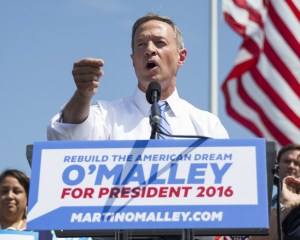
Martin O’Malley, Irish American whose relatives come from Galway, two-term Governor of Maryland, and two-term Mayor of Baltimore, announces his intention to run for president of the United States on May 30, 2015, on Federal Hill overlooking Baltimore.

First elected Mayor of Baltimore in 1999, O’Malley is re-elected as mayor in 2003. Considering a run for governor in 2002, O’Malley instead focuses on his mayoralty. In 2006, nearing the end of his second term as mayor, O’Malley announces his candidacy for Governor of Maryland, an office he wins by a sizeable margin. He is re-elected by a wider margin in a rematch against Bob Ehrlich in 2010. O’Malley has been seen as a potential presidential candidate since at least November 2012.

O’Malley’s announcement includes a swing at Democratic candidate Hillary Rodham Clinton and Republican candidate Jeb Bush, “Recently, the CEO of Goldman Sachs let his employees know that he’d be just fine with either Bush or Clinton. Well, I’ve got news for the bullies of Wall Street—the presidency is not a crown to be passed back and forth by you between two royal families.”

During his speech, O’Malley cast Baltimore’s recent racial unrest, including a night of riots after the funeral of Freddie Gray who died of injuries sustained in police custody, as a symptom of a larger American problem. “What took place here was not only about race…not only about policing in America. It’s about everything it is supposed to mean to be an American,” he said. “The scourge of hopelessness that happened to ignite here that evening, transcends race or geography.”

O’Malley also takes swings at Wall Street. “Tell me how it is, that you can get pulled over for a broken taillight in our country, but if you wreck the nation’s economy you are untouchable.”

Highlighting his record as Maryland’s governor, O’Malley notes that he supported a successful bid to legalize gay marriage and helped raise the minimum wage.

After making his announcement from the stage, O’Malley is played out to U2‘s Pride (In the Name of Love).

O’Malley suspends his campaign on February 1, 2016, after a poor showing in the Iowa caucuses.