seamus dubhghaill

Promoting Irish Culture and History from Little Rock, Arkansas, USA


Leave a comment

Birth of Constance Georgine Gore-Booth (Countess Markievicz)

countess-markievicz

Constance Georgine Gore-Booth is born on February 4, 1868, at Buckingham Gate, London, the eldest daughter of Arctic explorer and philanthropist Sir Henry Gore-Booth and Georgina May Hill.

The Gore-Booths are known as model landlords in County Sligo as they provide free food for the tenants on their estate. Perhaps being raised in this atmosphere of concern for the common man has something to do with the way Constance and her younger sister, Eva, conduct their later lives.

Gore-Booth decides to train as a painter and, in 1892, she enters the Slade School of Art in London because, at the time, only one art school in Dublin accepts female students. While in school in London Gore-Booth first becomes politically active and joins the National Union of Women’s Suffrage Societies.

She later moves to Paris and enrolls at the prestigious Académie Julian where she meets her future husband, Count Casimir Markievicz. They are married in London on September 29, 1900, making her Countess Markievicz. The Markieviczes relocate to Dublin in 1903 and move in artistic and literary circles, with Constance being instrumental in founding the United Artists Club.

In 1908, Markievicz becomes actively involved in nationalist politics in Ireland and joins Sinn Féin and Inghinidhe na hÉireann (Daughters of Ireland), a revolutionary women’s movement founded by Maud Gonne. In the same year, Markievicz plays a dramatic role in the women’s suffrage campaigners’ tactic of opposing Winston Churchill‘s election to Parliament during the Manchester North West by-election. Churchill ultimately loses the election to Conservative candidate William Joynson-Hicks.

In 1909, Markievicz founds Fianna Éireann, a para-military nationalist scouts organisation that instructs teenage boys and girls in the use of firearms. Patrick Pearse says that the creation of Fianna Éireann is as important as the creation of the Irish Volunteers in 1913. She is jailed for the first time in 1911 for speaking at an Irish Republican Brotherhood demonstration organised to protest against George V’s visit to Ireland.

Markievicz joins James Connolly‘s socialist Irish Citizen Army, a small volunteer force formed in response to the lock-out of 1913, to defend the demonstrating workers from the police. During the Howth gun-running on July 26, 1914, Irish Citizen Army members led by Markievicz, and including Thomas MacDonagh, Bulmer Hobson, Douglas Hyde and Darrell Figgis, unload arms from Erskine Childers‘ yacht Asgard in Howth harbour with hand carts and wheelbarrows.

As a member of the Irish Citizen Army, Markievicz takes part in the 1916 Easter Rising. Under Michael Mallin and Christopher Poole, she supervises the erection of barricades as the Rising begins and is in the middle of the fighting all around Stephen’s Green. Mallin and Poole and their men and women, including Markievicz, hold out for six days, ending the engagement when the British bring them a copy of Patrick Pearse’s surrender order.

They are taken to Dublin Castle and Markievicz is transported to Kilmainham Gaol, where she is the only one of 70 women prisoners who is put into solitary confinement. At her court martial on May 4, 1916, Markievicz is sentenced to death, but General Maxwell commutes this to life in prison on “account of the prisoner’s sex.” It is widely reported that she tells the court, “I do wish your lot had the decency to shoot me.” Markievicz is transferred to Mountjoy Prison and then to Aylesbury Prison in England in July 1916. She is released from prison in 1917, along with others involved in the Rising.

In the 1918 general election, Markievicz is elected for the constituency of Dublin St Patrick’s, making her the first woman elected to the British House of Commons. However, in line with Sinn Féin abstentionist policy, she does not take her seat in the House of Commons. She is re-elected to the Second Dáil in the elections of 1921. Markievicz serves as Minister for Labour from April 1919 to January 1922, holding cabinet rank from April to August 1919, becoming both the first Irish female Cabinet Minister and only the second female government minister in Europe.

Markievicz leaves government in January 1922 along with Éamon de Valera and others in opposition to the Anglo-Irish Treaty. She fights actively for the Republican cause in the Irish Civil War. She is returned in the 1923 general election for the Dublin South constituency but again, in common with other Republican candidates, she does not take her seat.

She joins Fianna Fáil on its foundation in 1926, chairing the inaugural meeting of the new party in La Scala Theatre. In the June 1927 general election, she is re-elected to the 5th Dáil as a candidate for the new Fianna Fáil party, which is pledged to return to Dáil Éireann.

Before she can take up her seat, Markievicz dies at the age of 59 on July 15, 1927, in a public ward “among the poor where she wanted to be” of complications related to appendicitis. One of the doctors attending her is her revolutionary colleague, Kathleen Lynn. Also at her bedside are Casimir and Stanislas Markievicz, Éamon de Valera, and Hanna Sheehy-Skeffington. Refused a state funeral by the Free State government, Markievicz is buried at Glasnevin Cemetery, Dublin, and de Valera gives the funeral oration.


Leave a comment

Éamon de Valera Escapes from Lincoln Gaol

boland-collins-devalera

Éamon de Valera, along with Seán McGarry and Seán Milroy, escape from Lincoln Gaol in Lincoln, Lincolnshire, England on February 3, 1919.  The escape plot is engineered by fellow Sinn Féin members Harry Boland and Michael Collins (pictured to the left of de Valera).

After his participation as a leader of the Easter Rising of 1916, de Valera is arrested and sentenced to death for his role in the uprising, but the sentence is later commuted due to his American citizenship. Following his release from prison in 1916, he quickly gains fame on the Irish political scene, ultimately becoming the leader of Sinn Féin. He also gains notoriety amongst the British political elites, which ensures his eventual re-arrest and imprisonment in Lincoln Gaol.

De Valera is sent to Lincoln Gaol presumably for his participation in a “German Plot” against the British. Once incarcerated at Lincoln, de Valera, wanting to embarrass the English, quickly begins to plan his escape with the assistance of Milroy and McGarry. Irish Republicans on the outside, including Boland and Collins, also assist in the planning.

Open fields surrounded by barbed wire are to the rear and east of the prison. The Republicans hope to use this to their advantage by sneaking de Valera through a rear door. The plans are sung in Gaelic to de Valera through a window in his cell by a fellow Irish inmate in order to confuse the guards. The first song tells him of the escape route and the second gives him instructions to obtain a copy of the master-key for the prison.

De Valera, being a deeply religious man, is active in the prison’s chapel from the beginning of his internment. Using his connections within the chapel, over time he manages to steal candles from the altar. While Mass is being read, he “borrows” the master-key of the chaplain and makes an impression of it in the candle wax. The mould is then wrapped in paper and tossed over the prison wall so a duplicate can be made.

The key is duplicated and smuggled back into the prison concealed in a cake and the escape begins on the evening of February 3, 1919. While Collins and other members of Sinn Féin cut through the barbed wire, a group of Irish girls are sent to flirt with the prison guards to ensure they are preoccupied. With the guards’ attention diverted, de Valera, wrapped in a fur coat, McGarry, and Milroy are able to walk to the back door of the prison and, after some difficulty with the key, walk away from the prison.

They stroll down Wragby Road to the Adam & Eve Pub where a taxi driver, unaware of who his passengers are, awaits them. De Valera is swiftly moved to the railway station where they split up. Collins and Boland catch a train to London from St. Mark’s while the rest drive to Worksop where another innocent taxi driver drives them to Sheffield. De Valera then returns to Ireland briefly before traveling on to the United States. The prison officials, realizing that the men will be virtually impossible to locate, concede defeat after a one-day search of the city.

The escape from Lincoln Gaol is major news and is covered in all the national papers. Prison officials blame the escape on the ability of special prisoners to interact with the general prison population. The escape proves to be an important moment in Irish history – when a cake, a wax key, and some pretty Irish girls help spring the future Irish president from Lincoln Gaol.


Leave a comment

Hillary Clinton Announced for Induction into Irish America Hall of Fame

hillary-clintonOn February 2, 2015, Irish America magazine announces that Hillary Rodham Clinton will be inducted into the Irish America Hall of Fame in March, in recognition of her work on the Irish peace process.

Clinton travels frequently to Ireland as First Lady and as U.S. Secretary of State, and often talks about the end of the civil strife, known as The Troubles, as a crowning foreign policy achievement of her husband’s administration. On her visit to Belfast in 2012, she pledges to continue to support peace in Ireland in whatever way possible.

“Hillary Rodham Clinton is one of the unsung heroes of the success of the Irish peace process,” says Niall O’Dowd, publisher of Irish America magazine. “As First Lady, U.S. Senator, and Secretary of State she always gave the issue top priority to help ensure it remained at the top of the U.S. foreign policy agenda. During that historic first trip to Northern Ireland with Bill Clinton in 1995, which I was privileged to be on, she galvanized women’s groups on both sides by meeting with them, shaping their agenda, and making sure they always had a friend in the U.S. administration. More than that, she constantly stayed involved, never giving up her focus on bringing an end to Europe’s longest conflict at the time.”

On the eve of St. Patrick’s Day, Clinton delivers the keynote address at the luncheon in Manhattan of high profile Irish-Americans who each year honor elected officials and others. She describes sitting at a table in Belfast, over cups of tea, with women from both sides of the conflict and watching as they discover how much they share.

She does not portray herself as instrumental to the Good Friday Agreement that President Clinton brokered in 1998, but says her outreach to women in Belfast on multiple visits during that period had played a critical role.

“You cannot bring peace and security to people just by signing an agreement,” she says. “In fact, most peace agreements don’t last.” She says that when “the work of peace permeates down to the kitchen table, to the backyard, to the neighborhood, around cups of tea, there’s a much greater chance the agreement will hold.”

Previous inductees into the Irish America Hall of Fame include former President John F. Kennedy, former President Bill Clinton, Vice President Joseph R. Biden, Jr., and former Maryland Governor Martin O’Malley, who addressed the luncheon in 2014 in a mix of English and Irish.


Leave a comment

Birth of Revolutionary Leader Thomas MacDonagh

thomas-macdonagh

Thomas MacDonagh, political activist, poet, playwright, educationalist, revolutionary leader, and one of the seven leaders of the Easter Rising of 1916, is born in Cloughjordan, County Tipperary, on February 1, 1878.

MacDonagh grows up in a household filled with music, poetry, and learning and is instilled with a love of both English and Irish culture from a young age. He attends Rockwell College and spends several years in preparation for a missionary career but soon realizes that it isn’t the life for him and leaves the college. He teaches briefly at St. Kieran’s College in Kilkenny and, from 1903, is employed as a professor of French, English, and Latin at St. Colman’s College, Fermoy, County Cork, where he forms a branch of the Gaelic League. He moves to Dublin and establishes strong friendships with such men as Eoin MacNeill and Patrick Pearse.

In Dublin, MacDonagh joins the staff St. Enda’s School upon its establishment in 1908, as a French and English teacher and Assistant Headmaster. In January 1912 he marries Muriel Gifford and takes the position of lecturer in English at the National University, while continuing to support St Enda’s. MacDonagh remains devoted to the Irish language and, in 1910, he becomes tutor to a younger member of the Gaelic League, Joseph Plunkett.

In 1913, MacDonagh and Plunkett attend the inaugural meeting of the Irish Volunteers and join its Provisional Committee. MacDonagh is later appointed Commandant of Dublin’s 2nd battalion and eventually made commandant of the entire Dublin Brigade. MacDonagh develops strong republican beliefs and joins the Irish Republican Brotherhood (IRB) in the summer of 1915. Around this time, Tom Clarke asks MacDonagh to plan the grandiose funeral of Jeremiah O’Donovan Rossa, which is a resounding propaganda success largely due to the graveside oration delivered by Pearse.

MacDonagh joins the secret Military Council that is planning the rising in April 1916, just weeks before the rising takes place. Although joining the Council during the late stages of the planning process, MacDonagh is, nevertheless, a signatory of the Proclamation of the Irish Republic.

During the rising, MacDonagh’s battalion is stationed at the massive Jacob’s Biscuit Factory complex. On the way to this destination the battalion encounters veteran Fenian John MacBride, who joins the battalion as second-in-command.

Although MacDonagh’s battalion is one of the strongest, they see little fighting as the British Army avoids the factory and establishes positions in central Dublin. MacDonagh receives the order to surrender on April 30, although his entire battalion is fully prepared to continue the engagement. Following the surrender, MacDonagh is court martialled and executed by firing squad at Kilmainham Gaol in Dublin on May 3, 1916, at the age of thirty-eight.


1 Comment

Tomás MacCurtain Elected Sinn Féin Lord Mayor of Cork

tomas-maccurtain

Tomás MacCurtain is elected Sinn Féin Lord Mayor of Cork on January 31, 1920.

MacCurtain is born at Ballyknockane in the Parish of Mourne Abbey on March 20, 1884. He attends Burnfort National School until the family moves to Blackpool on the north side of Cork city in 1897, where he attends The North Monastery School. He becomes active in numerous cultural and political movements and joins the Blackpool branch of the Gaelic League, becoming its secretary in 1902. He works in his early career as a clerk and in his free time teaches the Irish language. He joins the Fianna Éireann in 1911 and is a founding member of the Irish Volunteers.

At the outset of the Easter Rising in April 1916, MacCurtain commands a force of up to 1,000 men of the Irish Volunteers who assemble at various locations around County Cork. MacCurtain and his officers await orders from the volunteer leadership in Dublin, but conflicting instructions and confusion prevail, and the Cork volunteers never entered the fray. A tense week-long stand-off develops when British forces surround the volunteer hall. A negotiated agreement leads to the surrender of the volunteers’ arms to then Lord Mayor of Cork Thomas Butterfield on the understanding that they will be returned. The weapons are not returned and MacCurtain is jailed in the Frongoch Prisoner of War camp in Wales. Eighteen months later, after the general amnesty of participants in the Rising, MacCurtain returns to active duty as a Commandant of what is now the Irish Republican Army (IRA).

By 1918, MacCurtain is a brigade commander in the IRA. During the Conscription Crisis in the autumn 1918, he actively encourages the hiring of the women of Cumann na mBan to cater for Volunteers. MacCurtain is personally involved with Michael Collins‘ Squad that attempts to assassinate Lord John French, whose car is missed as the convoy passes through the ambush positions. Despite the setback he remains brigadier of No.1 Cork when he is elected the Sinn Féin councillor for NW Ward No. 3 of Cork in the January 1920 council elections and is chosen by his fellow councillors to be the Lord Mayor. He begins a process of political reform within the city.

On his 36th birthday, March 20, 1920, MacCurtain is shot dead in front of his wife and son by a group of men with blackened faces in retaliation for the shooting of a policeman. MacCurtain’s house in the city’s Blackpool area is also ransacked. The assassins are found to be members of the Royal Irish Constabulary (RIC) by the official inquest into the event.

The killing causes widespread public outrage. The coroner’s inquest passes a verdict of wilful murder against British Prime Minister Lloyd George and against certain members of the RIC. Michael Collins later orders his personal assassination squad to hunt down and kill the police officers involved in the attack. RIC District Inspector Oswald Swanzy, who had ordered the attack, is fatally shot with MacCurtain’s own revolver while leaving a Protestant church in Lisburn, County Antrim on August 22, 1920, sparking a “pogrom” against the Catholic residents of the town. MacCurtain is buried in St. Finbarr’s Cemetery, Cork.


Leave a comment

Bloody Sunday in Derry, Northern Ireland

bogside-mural

Bloody Sunday, sometimes referred to as the Bogside Massacre, occurs on January 30, 1972, in the Bogside area of Derry, Northern Ireland. Twenty-six unarmed civilians are shot by British soldiers of the 1st Battalion, Parachute Regiment, as they march in protest of internment (imprisonment without trial). Thirteen people are killed on the spot, and another dies over four months later as a result of his injuries.

The march, organised by the Northern Ireland Civil Rights Association and the Northern Resistance Movement, begins at about 2:45 PM at Bishop’s Field and is to conclude at the Guildhall, in the city centre, where a rally is to take place. There are as many as 15,000 people in the march, with many joining along the route.

As the march makes its way along William Street and nears the city centre, its path is blocked by British Army barricades. The organisers then redirect the march down Rossville Street with the intention of holding the rally at Free Derry Corner instead. Some of the marchers, however, break away from the march and begin throwing stones at soldiers manning the barricades. The soldiers fire rubber bullets, CS gas, and water cannon to try and disperse the rioters and observers report that this rioting is not intense.

Some of the marchers spot British paratroopers hiding in a derelict three-story building overlooking William Street and begin throwing stones at the windows. At about 3:55 PM, the first shots are fired as these paratroopers open fire with real bullets. Civilians Damien Donaghy and John Johnston are shot and wounded while standing on waste ground opposite the building. The soldiers claim Donaghy is holding a black cylindrical object.

At 4:07 PM, the paratroopers are ordered to go through the barricades and arrest rioters. On foot and in armoured vehicles, the paratroopers chase people down Rossville Street and into the Bogside. Two people are knocked down by the vehicles. Although Brigadier Pat MacLellan orders that only one company of paratroopers be sent on foot through the barricades and that they should not chase people down Rossville Street, Lieutenant Colonel Derek Wilford disobeys this order. This results in no separation between the rioters and the peaceful marchers.

There are many claims of paratroopers beating people, clubbing them with rifle butts, firing rubber bullets at them from close range, making threats to kill, and hurling abuse. One group of paratroopers take up position at a low wall about 80 yards in front of a rubble barricade that stretches across Rossville Street. Some of the people near the barricade throw stones at the soldiers but they are not close enough to hit the soldiers. The soldiers then open fire on the people at the barricade, killing six and wounding another.

A large group of people flee or are chased into the car park of Rossville Flats, which is like a courtyard, surrounded on three sides by high-rise flats. The soldiers open fire, killing one civilian, Jackie Duddy, who is shot in the back, and wounding six others.

Other people flee into the car park of Glenfada Park, which is also a courtyard-like area surrounded by flats. From a distance of approximately 50 yards, the soldiers shoot at people across the car park. Two civilians are killed and at least four others wounded. The soldiers pass through the car park and out the other side. Some soldiers exit the southwest corner, where they shoot and kill two civilians. The remainder exit the southeast corner and shoot four more civilians, killing two.

Only about ten minutes elapse between the time soldiers first drive into the Bogside and the time the last of the civilians is shot. Under the command of Major Ted Loden, more than 100 rounds are fired by the soldiers.

Some of those shot are given first aid by civilian volunteers, either on the scene or after being carried into nearby homes. The first ambulances arrive at 4:28 PM. The injured are then driven to the hospital, either in civilian cars or in ambulances. The three boys killed at the rubble barricade are driven to hospital by the paratroopers after, as witnesses claim, they lifted the bodies by the hands and feet and dumped them in the back of their vehicle as if they were “pieces of meat.”

In April 1972, the British government releases a report exonerating British troops from any illegal actions during the protest. The shootings act as a rallying call for the Irish Republican Army (IRA) as their numbers swell and Irish indignation over Britain’s Northern Ireland policies grow. As a result, Britain increases its military presence in the North while removing any vestige of Northern self-rule. On July 21, 1972, the IRA explode 20 bombs simultaneously in Belfast, killing British military personnel and a number of civilians. Britain responds by instituting a new court system composed of trial without jury for terrorism suspects and conviction rates exceed 90 percent. No criminal charges have ever been brought against the participating members of the British military.


Leave a comment

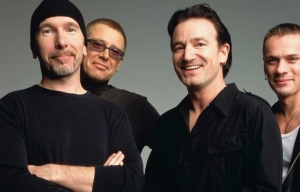
U2 Fights to Save Hanover Quay Recording Studio

u2

On January 29, 2002, at a public hearing at the Gresham Hotel, rock superstars U2 battle to save their recording studios at Hanover Quay in the Grand Canal Dock area of Ringsend, a southside inner suburb of Dublin, from being pulled to the ground.

The Dublin Docklands Development Authority wants to clear the way for a major new leisure development on a Hanover Quay site which contains a number of buildings including the band’s one-story recording studio. Talks between the band and the Dublin Docklands Development Authority fail to result in a compromise.

Citing the multi-million-pound records sales and musical heritage that have resulted from their use of the Hanover Street site since 1994, the band members submit to An Bord Pleanála (Irish Planning Appeals Board) a formal, nine page objection to the proposed plan. The band recorded their All That You Can’t Leave Behind album and a portion of their Pop album at the studio.

In addition to U2’s complaint, three other parties raise formal objections, including businessman Harrie Crosbie, millionaire businessman and Point Depot owner, who also owns small business premises at the Hanover Quay site.

In a statement released in the evening, the band says that while they love the docklands and are very happy with their present studio, they “appreciate that change is inevitable and often for the best.” They disclose that they are continuing discussions with the Dublin Docklands Development Authority but would consider moving to another location in the vicinity should a suitable property be offered.

The hearing continues into a second day.

Ultimately, on June 17, 2002, U2 loses the battle to save the Hanover Quay recording studio from demolition when An Bord Pleanála gives the go-ahead for the redevelopment of the Hanover Quay site. The band later reaches an agreement with the Dublin Docklands Development Authority for a replacement studio building which allows them to remain in the docklands area.


Leave a comment

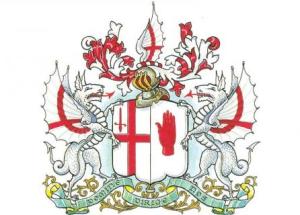
Creation of The Honourable The Irish Society

irish-society-coat-of-arms

On January 28, 1613, The Honourable The Irish Society, a consortium of livery companies of the City of London, is created by Royal Charter of James I of England to undertake the Plantation in the North West of Ulster that is then being driven by the English Crown.

Following the Gaelic defeat in the Nine Years’ War in 1603 and the Flight of the Earls in 1607, northwest Ulster is left open to colonisation. James I sets out to defend against a future attack from within or without. He finds that the town of Derry can become either a great asset as a control over the River Foyle and Lough Swilly, or it can become an inviting back door should the people of the area turn against him. He pressures the guilds of the City of London to fund the resettlement of the area, including the building of a new walled city. This results in the creation of the Society.

The city of Derry is renamed Londonderry in recognition of the London origin of the Irish Society. County Coleraine is enlarged and renamed County Londonderry after its new county town. The rural area of the county is subdivided between the Great Twelve livery companies, while the towns and environs of Londonderry and Coleraine are retained by the Irish Society.

In January 1635, the Irish Society, as well as the City of London, are found guilty of mismanagement and neglect of Derry plantation. They are sentenced to a fine of £70,000 and forfeiture of Derry property. The Society is suppressed in 1637 but is revived by Oliver Cromwell in 1650 and again after the Restoration by Londonderry’s 1662 royal charter.

The Society is involved in several controversies over the years including a dispute over fishing rights with the Church of Ireland and Bishop of Derry and a lawsuit brought by The Skinners’ Company in 1832 over the distribution of profits. The Society also has some disputes with the corporations over ownership and development of property. During the 17th and 18th centuries, four of the twelve livery companies sell their estates, with the Irish Society requiring a bond of indemnity in each case. Leases to middlemen granted by the remaining companies expire at various times during the nineteenth century, after which the companies “enormously increased the rental.”

The Society finances the building of the Guildhall in Derry. Construction begins in 1887 and it is opened in July 1890, at a cost of £19,000.

The Society remains in existence today as a relatively small grant-giving charitable body. Its educational grants are funded by its remaining property, including the Walls of Derry, a tourist attraction and heritage site, and fisheries on the River Bann. The Society is based in London, but maintains a “representative” resident in County Londonderry.


Leave a comment

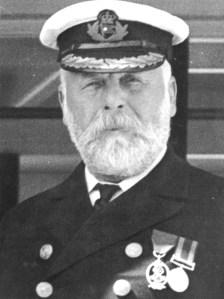
Birth of Edward J. Smith, Captain of the RMS Titanic

edward-john-smith

Edward John Smith, English naval reserve officer best known as the captain of the ill-fated RMS Titanic, is born on Well Street, Hanley, Staffordshire, England, on January 27, 1850.

Smith attends the Etruria British School until the age of 13, when he leaves school for a job at the Etruria Forge. In 1867, at the age of 17, he goes to Liverpool in the footsteps of his half-brother Joseph Hancock, a captain on a sailing ship. He begins his apprenticeship on Senator Weber, owned by A. Gibson & Co. of Liverpool.

Smith joins the White Star Line in March 1880 as Fourth Officer on the SS Celtic. He serves aboard the company’s liners to Australia and New York City, where he quickly rises in status. In 1887, shortly after his marriage to Sarah Eleanor Pennington, he receives his first White Star command on the SS Republic.

Beginning in 1895, Smith serves as captain of the SS Majestic for nine years. When the Second Boer War starts in 1899, Majestic is called upon to transport troops to Cape Colony. Smith makes two trips to South Africa, both without incident. From 1904 on, Smith commands the White Star Line’s newest ships on their maiden voyages, including RMS Baltic, RMS Adriatic, RMS Olympic, and RMS Titanic.

The RMS Titanic is built at the Harland & Wolff shipyard in Belfast. On April 10, 1912, Smith boards RMS Titanic at 7:00 AM to prepare for a noon departure. It’s final point of departure on the Atlantic crossing is Queenstown (now Cobh), County Cork, on April 11, 1912.

edward-john-smith-statue

The first four days of the voyage pass without incident, but shortly after 11:40 PM on April 14, Smith is informed by First Officer William McMaster Murdoch that the ship has just collided with an iceberg. It is soon apparent that the ship is seriously damaged with all of the first five watertight compartments having been breached. Smith, aware that there are not enough lifeboats for all of the passengers and crew, does everything in his power to prevent panic and assist in the evacuation. Just minutes before the ship sinks, Smith is still busy releasing Titanic‘s crew from their duties.

At 2:10 AM, Steward Edward Brown sees the captain approach with a megaphone in his hand. He is heard to say, “Well boys, do your best for the women and children, and look out for yourselves.” He then watches as Captain Smith walks onto the bridge alone. This is the last reliable sighting of Smith. Ten minutes later the ship disappears beneath the waves. His body is never recovered.

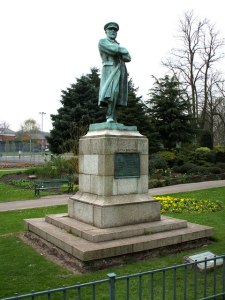
A statue, sculpted by Kathleen Scott, wife of Antarctic explorer Robert Falcon Scott, is unveiled in July 1914 at the western end of the Museum Gardens in Beacon Park, Lichfield. The pedestal is made from Cornish granite and the figure is bronze. Lichfield is chosen as the location for the monument because Smith was a Staffordshire man and Lichfield is the centre of the diocese.


1 Comment

Birth of Former IRA Chief of Staff Seán McBride

sean-macbride

Seán McBride, Irish government minister, prominent international politician, and a former Chief of Staff of the Irish Republican Army (IRA), is born in Paris on January 26, 1904. He is the son of Major John MacBride and Maud Gonne.

After his father’s execution for his participation in the Easter Rising of 1916, Seán is sent to school at Mount St. Benedict’s, Gorey, County Wexford in Ireland. In 1919, at the age of 15, he joins the Irish Volunteers, which fights as part of the Irish Republican Army, and takes part in the Irish War of Independence. He is imprisoned by the Irish Free State but is released in 1924 and resumes his IRA activities. He returns to Dublin in 1927 and becomes the Director of Intelligence of the IRA.

Toward the end of the 1920s, after many supporters have left the IRA to join Fianna Fáil, some members start pushing for a more left-wing agenda. After the IRA Army Council votes down the idea, MacBride launches a new movement, Saor Éire (“Free Ireland”), in 1931. Although it is a non-military organisation, Saor Éire is declared unlawful along with the IRA, Cumann na mBan, and nine other organizations.

In 1936, MacBride becomes Chief of Staff of the IRA after Moss Twomey is sent to prison for three years. At the time, the movement is in a state of disarray, with conflicts between several factions and personalities. In 1937, MacBride is called to the bar and then resigns from the IRA when the Constitution of Ireland is enacted later that year. As a barrister, MacBride frequently defends IRA political prisoners, but is not unsuccessful in stopping the execution of Charlie Kerins in 1944 who is convicted of killing Garda Detective Dennis O’Brien in 1942. In 1946, during the inquest into the death of Seán McCaughey, MacBride embarrasses the authorities by forcing them to admit that the conditions in Portlaoise Prison are inhumane.

In 1946, MacBride founds the republican/socialist party Clann na Poblachta, hoping it would replace Fianna Fáil as Ireland’s major political party. In October 1947, he wins a seat in Dáil Éireann at a by-election in the Dublin County constituency. However, at the 1948 general election Clann na Poblachta wins only ten seats.

MacBride is serving as Minister of External Affairs when the Council of Europe drafts the European Convention on Human Rights. He serves as President of the Committee of Ministers of the Council of Europe from 1949 to 1950 and is credited with being a key force in securing the acceptance of this convention, which is finally signed in Rome on November 4, 1950. He is instrumental in the implementation of the Repeal of the External Relations Act and the Declaration of the Republic of Ireland in 1949.

In 1951, Clann na Poblachta is reduced to only two seats after the general election. MacBride keeps his seat and is re-elected again in 1954. Opposing the internment of IRA suspects during the Border Campaign (1956–62), he contests both the 1957 and 1961 general elections but fails to be elected both times. He then retires from politics but continues practicing as a barrister. He expresses interest in running as an independent candidate in the 1983 Irish presidential election but does not receive sufficient backing and ultimately does not enter the contest.

Throughout the 1950s, 1960s, and 1970s, MacBride works tirelessly for human rights worldwide. He is a founding member of Amnesty International and serves as its international chairman from 1961 until 1975. During the 1980s, he initiates the Appeal by Lawyers against Nuclear War which is jointly sponsored by the International Peace Bureau and the International Progress Organization.

MacBride is awarded the Nobel Peace Prize in 1974 as a man who “mobilised the conscience of the world in the fight against injustice.” He later receives the Lenin Peace Prize (1975–76) and the UNESCO Silver Medal for Service (1980).

Seán MacBride dies in Dublin on January 15, 1988, just eleven days shy of his 84th birthday. He is buried in a simple grave in Glasnevin Cemetery, Dublin.