
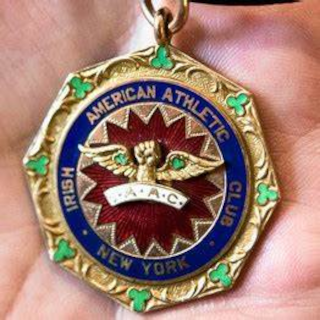
The Irish American Athletic Club, an amateur athletic organization based in Queens, New York, is established on January 30, 1898, originally as the Greater New York Irish Athletic Association. They shorten the name to the Irish American Athletic Club a few years later. They purchase a plot of land in what is then called Laurel Hill, Long Island, near Calvary Cemetery, Queens, and build a state-of-the-art athletic facility on what is farmland. The stadium, called Celtic Park, formally reopens after renovations on May 9, 1901, and until the facility is sold for housing in 1930, some of the greatest American athletes train or compete on Celtic Park’s track and field. The Irish American Athletic Club adopts a winged fist adorned with American flags and shamrocks as their emblem, with the Irish Gaelic motto “Láim Láidir Abú” or “A strong hand will be victorious,” and are often referred to as the “Winged Fists.” At one time they have clubs in Boston, Chicago, San Francisco and Yonkers, New York.
During the thirty odd years of its existence, all of the following athletes compete for the Irish American Athletic Club at some point: Dan Ahearn, and his brother Tim Ahearne, Charles Bacon, George Bonhag, Joseph Bromilow, Frank Castleman, Robert Cloughen, Harvey Cohn, Tom Collins, Edward Cook, James Crowley, John Daly, James H. Duncan, John Eller, John Flanagan, William Frank, Patrick J. Flynn, Harry Gissing, Sidney Hatch, Johnny Hayes, Denis Horgan, Bill Horr, Daniel Kelly, Abel Kiviat, Hannes Kolehmainen, Emilio Lunghi, Alvah Meyer, James Mitchel, Pat McDonald, Matt McGrath, Emil Muller, Peter O’Connor, Edwin Pritchard, Harry Porter, Myer Prinstein, Richard Remer, John J. Reynolds, Frank Riley, William Robbins, Lawson Robertson, James Rosenberger, Michael J. Ryan, Pat Ryan, Harry Schaaf, Arthur Shaw, Mel Sheppard, Martin Sheridan, James P. Sullivan, Lee Talbott, John Baxter Taylor, Jr., Con Walsh, William Galvin and Harold Wilson.
The Irish American Athletic Club is predominantly composed of Irish-born and first generation Irish American athletes, but many of the athletes who compete for the Winged Fist organization are neither.
The Irish American Athletic Club wins the Amateur Athletic Union national outdoor track and field team championship titles in 1904, 1906, 1907, 1908, 1910, 1911, 1912, 1913, 1914 and 1916. They also win the national indoor track and field team championship titles in 1906, 1908, 1909, 1911, 1913, 1914 and 1915. Individual athletes of the IAAC win 81 national outdoor championships titles and 36 individual national indoor championship titles.
In addition to winning numerous local and regional Amateur Athletic Union competitions, Irish American Athletic Club members compete for the United States Olympic team in the 1900 Summer Olympics in Paris, the 1904 Summer Olympics in St. Louis, the 1906 Intercalated Games in Athens, Greece, the 1908 Summer Olympics in London, the 1912 Summer Olympics in Stockholm and the 1920 Summer Olympics in Antwerp. From 1900 to 1924, men who are at one time members of the Irish American Athletic Club win 54 Olympic medals for the U.S. Olympic team, including 26 gold medals.
In 1912–13, 1913–14, 1914–15 and 1916–17 the Irish American Athletic Club has a team, the New York Irish-Americans, represented in the American Amateur Hockey League. The team is coached by James C. “Jimmy” O’Brien and has on its roster for various seasons future NHL players Tom McCarthy and Moylan McDonnell. John McGrath and Patsy Séguin also play for the club.
Before the largest crowd that has ever assembled to see a track meet in the United States, on September 9, 1916, the Irish American Athletic Club defeats the New York Athletic Club at the Amateur Athletic Union’s National Championships, by a score of 38 to 27. Before a crowd of 30,000 spectators at Newark, New Jersey‘s Weequahic Park, the Irish American Athletic Club wins what is to be their last national championship title. The club disbands a year later when the United States becomes a combatant in World War I.

 seamus dubhghaill