seamus dubhghaill

Promoting Irish Culture and History from Little Rock, Arkansas, USA


Leave a comment

Birth of Professional Golfer Pádraig Harrington

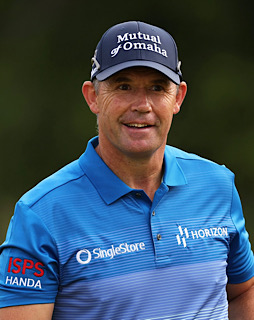
Pádraig Peter Harrington, one of the most accomplished professional golfers in history, is born in Dublin on August 31, 1971.

Raised in Rathfarnham, a suburb of Dublin, Harrington grows up in a sports‑oriented family — his father, Patrick Harrington, is a Gaelic footballer, boxer, and amateur golfer with a five‑handicap. He attends Coláiste Éanna secondary school and studies accountancy, balancing academics with a passion for golf.

Harrington begins playing golf with his family at age five and develops his skills at nearby Stackstown Golf Club. As an amateur, he represents Great Britain and Ireland in the Walker Cup three times (1991, 1993, 1995), winning the 1995 edition. He turns professional in 1995 at the age of 24, quickly winning the Peugeot Spanish Open in 1996.

Harrington has won 43 professional tournaments across the PGA European Tour, PGA Tour, Japan Golf Tour, Asian Tour, and PGA Tour Champions. His career highlights include: three major championships (the 2007 and 2008 Open Championship and the 2008 PGA Championship). He is the winner of the European Tour Order of Merit in 2006 and PGA Tour Player of the Year in 2008. He is a member of six consecutive Ryder Cup teams (1999–2010), winning four (2002, 2004, 2006, 2010). He reaches his career‑high world ranking of No. 3 in July 2008. In October 2024, he wins the inaugural Simmons Bank Championship at Pleasant Valley Country Club in the author’s hometown of Little Rock, Arkansas.

In 2024, Harrington is inducted into the World Golf Hall of Fame, cementing his status as one of golf’s legends. Known for his meticulous play and consistency, he remains a respected figure in the sport, with a net worth estimated at around $40 million.

In summary, born on August 31, 1971, in Dublin, Pádraig Harrington’s career spans over three decades, marked by major wins, Ryder Cup success, and Hall of Fame recognition, making him a defining name in modern golf.

Leave a comment

The 36th Ryder Cup Matches Come to Ireland

The 36th Ryder Cup Matches officially open on September 22, 2006, at the Palmer North Course of the K Club in Straffan, County Kildare, west of Dublin. It is the first time golf’s premier team tournament has come to Ireland and to date it is the biggest sporting event ever staged in the country.

Europe wins by 18-1⁄2 to 9-1⁄2 points, equalling their record winning margin of two years earlier for their third consecutive win, a first for Europe. Swedish rookie Henrik Stenson makes the winning putt, just moments after Luke Donald sinks a putt to ensure Europe retains the trophy.

The K Club has two Arnold Palmer-designed championship courses and the 36th Ryder Cup is held on the Palmer North Course (also known as the Old Course). The course is a parkland course located on the banks of the River Liffey, threaded through mature woodlands on the Straffan country estate.

Domestically, Sky Sports provides live coverage of all sessions. In the United States, coverage of the first day is recorded live, but presented on tape-delay by USA Network. Bill Macatee hosts from the 18th tower. On Saturday, NBC Sports presents coverage on tape, but recorded live. NBC then airs the singles live on Sunday morning. Dan Hicks and Johnny Miller host from the 18th tower, Gary Koch and Bob Murphy call holes, while on-course reporters are Mark Rolfing, Roger Maltbie, and Dottie Pepper. To provide a European perspective, NBC uses former European team player Nick Faldo as a guest analyst on the Saturday afternoon session. Faldo had worked in the same role for NBC at the 2002 Ryder Cup, and at the time of the 2006 edition is in between jobs, having worked as an analyst for ABC Sports from 2004 to 2006, but having signed with CBS Sports for 2007 and beyond.

The Ryder Cup is a match play event, with each match worth one point. The competition format used in 2004 and 2006 is as follows:

  • Day 1 (Friday) – 4 four-ball (better ball) matches in a morning session and 4 foursome (alternate shot) matches in an afternoon session
  • Day 2 (Saturday) – 4 fourball matches in a morning session and 4 foursome matches in an afternoon session
  • Day 3 (Sunday) – 12 singles matches

With a total of 28 points, 14-1⁄2 points are required to win the Cup, and 14 points are required for the defending champion to retain the Cup. All matches are played to a maximum of 18 holes.