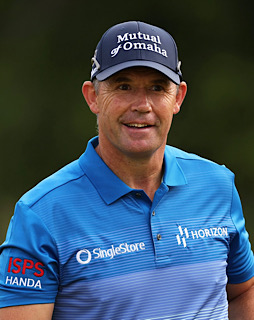
Raised in Rathfarnham, a suburb of Dublin, Harrington grows up in a sports‑oriented family — his father, Patrick Harrington, is a Gaelic footballer, boxer, and amateur golfer with a five‑handicap. He attends Coláiste Éannasecondary school and studies accountancy, balancing academics with a passion for golf.
Harrington begins playing golf with his family at age five and develops his skills at nearby Stackstown Golf Club. As an amateur, he represents Great Britain and Ireland in the Walker Cup three times (1991, 1993, 1995), winning the 1995 edition. He turns professional in 1995 at the age of 24, quickly winning the Peugeot Spanish Open in 1996.
In 2024, Harrington is inducted into the World Golf Hall of Fame, cementing his status as one of golf’s legends. Known for his meticulous play and consistency, he remains a respected figure in the sport, with a net worth estimated at around $40 million.
In summary, born on August 31, 1971, in Dublin, Pádraig Harrington’s career spans over three decades, marked by major wins, Ryder Cup success, and Hall of Fame recognition, making him a defining name in modern golf.
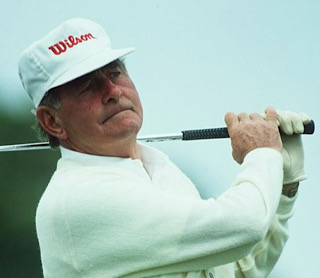
Christy O’Connor Snr, an Irish professional golfer born Patrick Christopher O’Connor, dies in Dublin on May 14, 2016. He is one of the leading golfers on the British and Irish circuit from the mid-1950s.
O’Connor wins over twenty tournaments on the British PGA and finishes in the top 10 in The Open Championship many times. Later he has considerable success in senior events, twice winning the World Senior Championship. In team events he plays in ten successive Ryder Cup matches and plays in fifteen Canada Cup/World Cup matches for Ireland, winning the Canada Cup in 1958 in partnership with Harry Bradshaw.
O’Connor is born in Knocknacarra, a village in Galway, on December 21, 1924. He catches his first glimpse of golf at the nearby Galway Golf Club, and from the age of 10 spends most of his spare time there. His foray into professional golf begins with caddying, first at Galway and then over at Tuam Golf Club.
In 1951, O’Connor turns professional with Tuam members funding his first tournament at The Open Championship at Royal Portrush Golf Club in County Antrim, Northern Ireland, that same year. His 19th-place finish garners a membership invitation from Bundoran Golf Club in Bundoran, County Donegal, which he accepts.
O’Connor’s first professional win is at the Swallow-Penfold Tournament held in 1955, the first £1,000 prize to be offered in British golf. He goes on to win the 1956 and 1959 British Masters. In 1958, he helps Ireland to win the Canada Cup in Mexico City playing with Harry Bradshaw. A year later, he moves to Dublin and joins The Royal Dublin Golf Club. Throughout the 1960s he wins at least one professional event during each year on the British Tour, a level of consistent success matched by very few other players. He rarely plays professional tournaments outside Britain or Ireland, at one stage saying he forwent playing at the Masters Tournament in Augusta, Georgia, because he could not afford to participate.
The only major championship O’Connor plays is The Open Championship. He plays the event twenty-six times between 1951 and 1979. His best performance comes at the 1965 Open Championship where he ties for second place with Brian Huggett, two behind five-time winner Peter Thomson. He easily outplays international stars like Jack Nicklaus, Arnold Palmer, Sam Snead, and Gary Player. He receives an astonishing twenty invitations to play in the Masters Tournament but rejected all of them, citing prohibitive financial costs.
O’Connor plays in every Ryder Cup from 1955 to 1973, setting a record of ten appearances in the event which stands until it is surpassed by Nick Faldo in 1997. He is the Irish professional champion on ten occasions, including in 1978 (at the age of 53), and is twice (1961 and 1962) recipient of the Harry Vardon Trophy for leading the British Tour’s “Order of Merit.”
In the 1966 Carroll’s International at The Royal Dublin Golf Club, O’Connor finishes 2-3-3 (eagle-birdie-eagle) to win the tournament by two strokes. At the par-4 16th, he drives the green and holes a 20-foot putt. He then holes a 12-foot putt at the 17th and, at the par-5 18th, hits a 3-iron to eight feet and holes the putt. A plaque by the 16th tee commemorates the achievement. In 1970, he wins the John Player Classic, at the time its £25,000 first prize is the richest offered in golf (in 1970, even The Open Championship winner receives just a little over £5,000), making him the season’s leading money-winner, although not “Order of Merit” leader, which is decided by a points system not directly related to prize money.
Later in his career, O’Connor becomes the leading “senior” (over-50s) professional player of his day, just before the lucrative U.S.-based Senior PGA Tour, now known as the PGA Tour Champions, takes off. He wins the PGA Seniors Championship six times and the World Senior Championship in 1976 and 1977. He is elected to the World Golf Hall of Fame in 2009 in the Veterans category.
O’Connor meets his wife, Mary Collins, in Donegal while he is a member of Bundoran Golf Club. They marry in 1954 and have six children together. During his early career he is known simply as Christy O’Connor, but his nephew of the same name also becomes a prominent golfer, and from that point forward they are referred to as Christy O’Connor Senior and Christy O’Connor Junior, respectively. He is known as “Himself” among his golfing peers. He dies at the age of 91 in Dublin’s Mater Misericordiae University Hospital, on May 14, 2016.
In 1987 Clarke plays collegiate golf at Wake Forest University in the United States. He is a junior member of Dungannon Golf Club, whose junior section also includes three others who are current PGA Golf Professionals: Alistair Cardwell, Barry Hamill and Gary Chambers. He represents his school, Royal School Dungannon, together with Cardwell and Chambers.
A stalwart of the European Tour since 1991, Clarke is no stranger to firsts. In the 1999 Smurfit European Open he becomes the first player on the European Tour to shoot 60 for a second time, having achieved it first in the 1992 European Monte Carlo Open. In 2002 he becomes the first player to win the English Open three times and in 2003 becomes the first player outside Tiger Woods to capture more than one World Golf Championships title.
Three weeks after the untimely death of his wife, Heather, to cancer in August 2006, Clarke is picked as one of the wild cards for the Ryder Cup at K Club. In an emotionally charged week he produces one of his most memorable performances, winning all three of his matches.
Clarke assures his place in history by earning a place in the renowned ‘Who’s Who‘ guide for 2008, and in 2005 he even appears on an Irish postage stamp. A difficult 2007, where he juggles looking after his two sons with his golf regime, sees him slip down the rankings, but he begins to find his form again in South Africa before the winter break.
In 2010 Clarke beats a world-class field in the J. P. McManus Invitational Pro-Am at Adare Manor in Ireland where he has a one-shot victory over Luke Donald. He secures his spot in the 139th Open Championship at the Old Course at St. Andrews by finishing second in the Barclays Scottish Open. He finishes 30th in the European Tour Race. He rounds off 2010 in great style with the announcement of his engagement to Alison Campbell.
In February 2015, Clarke is named as Europe’s Ryder Cup captain and dedicates the next 18 months to the role. Ultimately, Europe is beaten 17-11 by the United States at Hazeltine National Golf Club.
A dedicated worker for charity, Clarke sets up his own Darren Clarke Foundation, which not only helps further the development of junior golf in Ireland, but also now raises money for Breast Cancer Awareness.


 seamus dubhghaill