
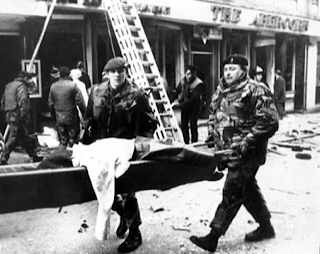
The Abercorn Restaurant bombing is a bomb attack that takes place in a crowded city centre restaurant and bar in Belfast, Northern Ireland, on March 4, 1972. The bomb explosion claims the lives of two young women and injures over 130 people. Many of the injuries are severe and include the loss of limbs and eyes. The Provisional Irish Republican Army is blamed, although no organisation ever claims responsibility and nobody is ever charged in connection with the bombing. According to Ed Moloney, an Irish journalist who has written extensively about the IRA, republican sources have unofficially confirmed the group’s involvement.
The Abercorn is on 7-11 Castle Lane in central Belfast and houses a ground-floor restaurant and upstairs bar. It is owned by 45-year-old Bill O’Hara, a Catholic businessman. On Saturday, March 4 1972, it is packed with late afternoon shoppers when an anonymous caller issues a bomb warning to 999 at 4:28 p.m. The caller does not give a precise location, but advises that a bomb will go off in Castle Lane in five minutes’ time. The street, located in the busy Cornmarket area, mills with crowds of people shopping and browsing as is typical on a Saturday in Belfast.
Two minutes later, at 4:30 p.m., a handbag containing a five-pound gelignite bomb explodes under a table inside the ground-floor restaurant. Two young Catholic friends are killed outright: Anne Owens (22), who is employed at the Electricity Board, and Janet Bereen (21), a hospital radiographer. The young women have been out shopping together and have stopped at the Abercorn to have coffee. They are seated at the table nearest the bomb and take the full force of the blast. Owens had survived a previous bombing at her workplace. More than 130 are injured in the explosion, which overturns tables and chairs, and brings the ceiling crashing down onto the ground floor restaurant. Many people are severely maimed. Some have their limbs blown off while others suffer terrible head and facial injuries, burns, deep cuts and perforated eardrums. Three have eyes destroyed by shards of flying glass. Two sisters, Jennifer and Rosaleen McNern (one of whom is due to be married), are both horrifically mutilated. Jennifer loses both legs and Rosaleen, the bride-to-be, loses her legs, right arm and one eye.
Witnesses describe a scene of panic and chaos as the bloodied survivors stumble through the smoke, broken glass, blood, and rubble, crawling over one another to get away, while firemen attempt to bring out the injured, many of whom lay with their bodies mangled, unable to move. A Royal Ulster Constabulary (RUC) officer is one of the first people to arrive on the scene. He describes the carnage that greets him as something he will never forget. “All you could hear was the moaning and squealing and the people with limbs torn from their bodies.”
A woman who had been inside the restaurant before the blast later tells an inquest that she had seen two teenaged girls walk out of the Abercorn leaving a handbag behind shortly before the explosion. This same woman was waiting at a bus stop when the bomb went off. A detective-sergeant establishes that the explosion’s epicentre is to the right of the table where the two girls had been sitting. The bomb is reportedly left behind inside a handbag.
Nobody is ever charged in connection with the bombing and no paramilitary organisation ever claims responsibility for it. Both wings of the IRA deny involvement and condemn the bombing. However, the RUC and British Military Intelligence blame the Provisional IRA First Battalion Belfast Brigade and it is now widely accepted that it was responsible. There is a public backlash against the organisation in Irish nationalist and Catholic areas such as West Belfast. The two dead women were both Catholic, along with many of the injured including the McNern sisters, and the Abercorn Bar was a popular venue with many young Catholics and nationalists.
Provisional IRA Chief of Staff Seán Mac Stíofáin claims the bombing is the work of loyalist paramilitaries. According to Mac Stíofáin, the Woodvale Defence Association (WDA) had made threats against the Abercorn in its weekly newsletter after the Abercorn management refused to play the British national anthem. The WDA denies the allegations, adding that one of its members had a friend who was badly injured in the blast. The day after the bombing, a leaflet allegedly circulated by the loyalist Vanguard Unionist Progressive Party (VUPP) declares: “We make no apologies for Abercorn. No apologies were made for Aldershot […] These premises were being used extensively by Southern Irish shoppers for the transmission of information vital to the terrorist campaign…” Vanguard leader Rev. Martin Smyth dismisses the statement as fake.
According to Ed Moloney in his book Voices from the Grave, IRA sources have since confirmed, albeit unofficially, that the Provisional IRA was responsible. Moloney suggests that, based on eyewitness accounts, two teenaged IRA girls were probably the bombers. Unnamed republican sources suggest that the Abercorn was targeted because the upstairs bar was frequented by off-duty British Army soldiers.
The detonation of a bomb in a city centre restaurant on a Saturday afternoon packed with shoppers, and the severity of the injuries—inflicted on mostly women and children—ensures that the attack causes much revulsion and leaves a lasting impression on the people of Belfast. It is condemned by both unionist and Irish nationalist politicians and also by church leaders. Ian Paisley calls on the government “to mobilise and arm every able-bodied volunteer to meet the enemy.” The extent of the injuries the blast inflicts results in the Royal Victoria Hospital implementing a “disaster plan” for the first time.
The sculptor F. E. McWilliam produces a series of bronzes (1972–73) known as Women of Belfast in response to the Abercorn bombing.
Unrelated to the bombing, the Abercorn features in a sectarian attack in July 1972, when Michael McGuigan, a Catholic working in the bar, is abducted by loyalist paramilitaries, shot and left for dead, but survives. He had been dating a Protestant waitress who also worked in the Abercorn, which is why the loyalist group targets him.
The Abercorn is demolished in 2007.
(Pictured: A victim’s body being removed from the scene by members of the security forces following the bomb explosion)
 seamus dubhghaill