
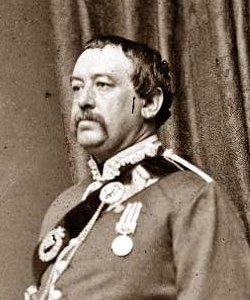
Sir William Howard Russell, reporter with The Times and considered to be one of the first modern war correspondents, is born at Lily Vale, Tallaght, County Dublin, on March 28, 1820.
As a young reporter, Russell reports on a brief military conflict between Prussian and Danish troops in Denmark in 1850. Sent by editor John Delane to Malta in 1854 to cover British support for the Ottoman Empire against Russia, Russell despises the term “war correspondent” but his coverage of the conflict brings him international renown. Florence Nightingale later credits her entry into wartime nursing to his reports. The Crimean medical care, shelter, and protection of all ranks by Mary Seacole is also publicised by Russell and by other contemporary journalists, rescuing her from bankruptcy.
Russell is described by one of the soldiers on the frontlines as “a vulgar low Irishman, who sings a good song, drinks anyone’s brandy and water, and smokes as many cigars as a Jolly Good Fellow. He is just the sort of chap to get information, particularly out of youngsters.” This reputation leads to Russell being blacklisted from some circles, including British commander Lord Raglan who advises his officers to refuse to speak with the reporter.
His dispatches are hugely significant. For the first time the public is able to read about the reality of warfare. Shocked and outraged, the public’s backlash from his reports leads the Government to re-evaluate the treatment of troops and lead to Florence Nightingale’s involvement in revolutionising battlefield treatment.
On September 20, 1854, Russell covers the battle above the Alma River. The story, written in the form of a letter to Delane, is supportive of the British troops though pays particular attention to the battlefield surgeons’ “humane barbarity” and the lack of ambulance care for wounded troops. He later covers the Siege of Sevastopol.
Following Russell’s reports of the appalling conditions suffered by the Allied troops conducting the siege, including an outbreak of cholera, Samuel Morton Peto and his partners build the Grand Crimean Central Railway, which is a major factor leading to the success of the siege. Russell leaves Crimea in December 1855.
In 1856, Russell is sent to Moscow to describe the coronation of Tsar Alexander II and in the following year is sent to India where he witnesses the final re-capture of Lucknow.
In 1861, Russell goes to Washington, returning to England in 1863. In July 1865, he sails on the SS Great Eastern to document the laying of the Transatlantic Telegraph Cable and writes a book about the voyage with color illustrations by Robert Dudley. He publishes diaries of his time in India, the American Civil War, and the Franco-Prussian War, where he describes the warm welcome given him by English-speaking Prussian generals such as Leonhard Graf von Blumenthal.
He is awarded the title of Commander of the Royal Victorian Order by King Edward VII. Russell later accuses fellow war correspondent Nicholas Woods of the Morning Herald of lying in his articles about the war to try to improve his stories.
In the 1868 General Election, Russell runs unsuccessfully as a Conservative candidate for the borough of Chelsea. He retires as a battlefield correspondent in 1882 and founds the Army and Navy Gazette. He is knighted in May 1895.
Russell dies on February 11, 1907, and is buried in Brompton Cemetery, London.

 seamus dubhghaill