seamus dubhghaill

Promoting Irish Culture and History from Little Rock, Arkansas, USA


Leave a comment

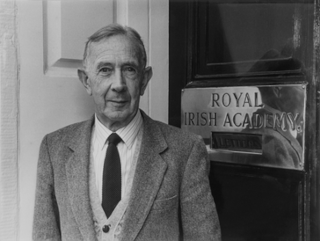
Birth of Tomás de Bhaldraithe, Irish Language Scholar

Tomás Mac Donnchadha de Bhaldraithe, Irish scholar notable for his work on the Irish language, particularly in the field of lexicography, is born on December 14, 1916, in Ballincurra, County Limerick. He is best known for his English-Irish Dictionary, published in 1959.

De Bhaldraithe is born Thomas MacDonagh Waldron, one of five children of Pádraig de Bhaldraithe, civil servant from Nenagh, County Tipperary, and Eilís Nic Conmara from near Kilkee, County Clare. He is named after Thomas MacDonagh, one of the signatories of the Proclamation of the Irish Republic, who had been executed after the Easter Rising earlier that year. He moves to Donnybrook, Dublin, with his family at the age of five. He is enrolled in Muckross Park school in 1923. He receives his secondary education at Belvedere College in Dublin (1926-34). He adopts the use of the Irish language version of his name in both Irish and English.

De Bhaldraithe’s stance on standard forms and spellings is supported by Éamon de Valera despite opposition from traditionalists in the Department of Education, and the work is widely seen as an important benchmark in Irish scholarship.

In 1942, de Bhaldraithe is appointed a professor at the Dublin Institute for Advanced Studies (DIAS) in the department of Celtic Studies. In 1960 he is appointed professor of modern Irish language and literature at University College Dublin (UCD), where he develops an impressive archive of material on Irish dialects. Much of the material in this archive is later used as the basis of Niall Ó Dónaill‘s Foclóir Gaeilge-Béarla, published in 1978, for which he is consulting editor. Also, during the 1970s, de Bhaldraithe translates the Irish language diary of Amhlaoibh Ó Súilleabháin, Cín Lae Amhlaoibh, into English. It is then published by Mercier Press as The Diary of an Irish Countryman.

The language laboratory which de Bhaldraithe sets up in UCD is the first of its kind in any university in Ireland. His interest in seanchas (folklore) leads to his publication of Seanchas Thomáis Laighléis in 1977, while his earlier work includes the ground-breaking study of the Cois Fharraige dialect (a variety of Connacht Irish), Gaeilge Chois Fharraige: Deilbhíocht. In later years he works extensively on the definitive Irish dictionary, Foclóir Stairiúil na Nua-Ghaeilge, which remains unfinished at the time of his death, but which is still in progress today.

De Bhaldraithe dies in Dublin on April 24, 1996, after launching a collection of a friend’s writings entitled The words we use. He marries Vivienne Ní Thoirdhealbhaigh in 1943 and they have nine children.


Leave a comment

Birth of Amhlaoibh Ó Súilleabháin, Author, Draper & School Master

Amhlaoibh Ó Súilleabháin, Irish language author, linen draper, politician, and one-time hedge school master, is born on May 1, 1780. He is also known as Humphrey O’Sullivan.

Ó Súilleabháin is deeply involved in Daniel O’Connell‘s Catholic emancipation movement and in relief work among the poor of County Kilkenny. He is also an avid bird watcher and a collector of manuscripts in the Irish language. His diary, published later as Cín Lae Amhlaoibh, is kept between 1827 and 1835. It remains one of the most important sources for 19th-century Irish life and one of the few surviving works from the perspective of the Roman Catholic lower and middle classes. (A translation has been published in English and an abridged and annotated edition in Irish, both edited by Tomás de Bhaldraithe.) He also composes verse and stories.

Ó Súilleabháin is born in Killarney, County Kerry. He comes to live at Callan, County Kilkenny, when he is nine years old, joining his father, Donncha Ó Súilleabháin. Father and son establish themselves as teachers in the surrounding towns. They begin by teaching under the hedges, but eventually a cabin is built as a school. He takes over the post of teacher there when his father dies in 1808. He remains a resident of Callan until his death. At the time, County Kilkenny is one of the most strongly Irish-speaking areas in Leinster.

As a teacher, Ó Súilleabháin is well versed in mathematics and Latin, and likely teaches English to a high standard. His diary shows him to have a deep interest in the natural world, and there are daily references to the weather.

Though Ó Súilleabháin is clearly a master of English, his diary is mostly in Irish, with occasional business-related entries in English, likely so that such transactions can be verified by others. He mostly eschews the archaisms favoured by other writers in Irish, writing in a fluent, flexible, colloquial style which could encompass both concision and literary elaboration. His diary shows him to be deeply involved in the life of the poor but to also be well acquainted with local notables. He is fond of occasional revelry and a good meal.

Ó Súilleabháin has an impressive collection of Irish language manuscripts, both prose and verse, which are supplemented by books. As a businessman, he deals in linen, corn and meal, and often has to make long trips to Dublin, Clonmel and Waterford.

Ó Súilleabháin marries a woman named Máire Ní Dhulachanta, not often mentioned in his diary. They have six or seven children, four of whom survive into adulthood. Her death, however, causes him great grief, and he never remarries.

Ó Súilleabháin dies on November 20, 1838, in Callan and is buried in the family plot in St. Brigid’s graveyard.

Amhlaoibh’s original manuscript is currently in the possession of the Royal Irish Academy. An edition of the complete manuscript is published as Cinnlae Amhlaoibh Uí Shúileabháin by M. McGrath in 1936-37 and an abridged and annotated edition, Cín Lae Amhlaoibh, by Tomás de Bhaldraithe in 1970–1973. A translation, The Diary of an Irish Countryman, is published by de Bhaldraithe (Mercier Press) in 1979.

(Pictured: The Seal of Milesius, the official seal of the Ó Súilleabháin Clann of Munster)