Agar is the second son of Henry Agar, a former MP for Gowran, and Anne Ellis, and is probably born at Gowran Castle in County Kilkenny. On March 20, 1760, he marries Lucia Martin, widow of Henry Boyle-Walsingham. Together they have three children: Henry-Welbore Agar-Ellis (b. January 22, 1761), John Ellis (b. December 31, 1763), and Charles-Bagnell (b. August 13, 1765).
In addition to being a Member of Parliament (MP) for Gowran, for which he sits three times, from 1753 to 1761, again from 1768 to 1769 and finally from 1776 to 1777, Agar controls three other borough seats through the strength of his family holdings. He represents Kilkenny County between 1761 and 1776 and Thomastown between 1768 and 1769. He holds the post of joint Postmaster General of Ireland with William Ponsonby, 1st Baron Ponsonby between 1784 and 1789.
James Agar dies on January 1, 1789. His eldest son, Henry-Welbore Agar-Ellis, becomes 2nd Viscount Clifden and Baron Mendip.
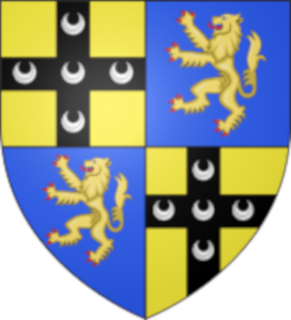
(Pictured: Arms of Agar-Ellis: 1st and 4th quarter: a cross sable charged with five crescents argent for Ellis; 2nd and 3rd quarter: azure with a lion rampant for Agar)
Melesina Trench (née Chenevix), Irish writer, poet and diarist, is born in Dublin on March 22, 1768. During her lifetime she is known more for her beauty than her writing. It is not until her son, Richard Chenevix Trench, publishes her diaries posthumously in 1861 that her work receives notice.
Melesina Chenevix is born to Philip Chenevix and Mary Elizabeth Gervais. She is orphaned before her fourth birthday and is brought up by her paternal grandfather, Richard Chenevix (1698–1779), the AnglicanBishop of Waterford and Lismore. The family is of Huguenot extraction.
After the death of Richard Chenevix she goes to live with her other grandfather, the Archdeacon Gervais. On October 31, 1786, she marries Colonel Richard St. George, who dies only four years later in Portugal, leaving one son, Charles Manners St. George, who becomes a diplomat.
On March 3, 1803, in Paris she marries her second husband, Richard Trench, who is the sixth son of Frederick Trench and brother of Frederick Trench, 1st Baron Ashtown.
After the breakdown of the Peace of Amiens, Richard Trench is detained in France by Napoleon‘s armies, and in August 1805 Melesina takes it upon herself to petition Napoleon in person and pleads for her husband’s release. Her husband is released in 1807, and the couple settles at Elm Lodge in Bursledon, Hampshire, England.
Their son, Francis Chenevix Trench, is born in 1805. In 1807, when they are on holiday in Dublin, their son Richard Chenevix Trench is born. He goes on to be the Archbishop of Dublin, renowned poet and contemporary of Alfred, Lord Tennyson. Her only daughter dies a few years later at the age of four.
Trench corresponds with, amongst others, Mary Leadbeater, with whom she works to improve the lot of the peasantry at her estate at Ballybarney. She dies at the age of 59 in Malvern, Worcestershire on May 27, 1827.
Melesina Trench’s diaries and letters are compiled posthumously by Richard Chenevix Trench as The remains of the late Mrs. Richard Trench in 1861 with an engraving of her taken from a painting by George Romney. Another oil painting, The Evening Star by Sir Thomas Lawrence, has her as a subject, and she is reproduced in portrait miniatures – one in Paris by Jean-Baptiste Isabey and another by Hamilton that is copied by the engraver Francis Engleheart.
After acting as chaplain to Seth Ward, Bishop of Exeter and then Bishop of Salisbury, and Lord Chancellor Clarendon, he is elected principal of St. Alban Hall, Oxford, in 1673. In 1679 he is appointed provost of Trinity College, Dublin, where he does much to encourage the study of the Irish language. He helps to found the Dublin Philosophical Society and contributes to it a paper entitled Introductory Essay to the Doctrine of Sounds (printed in Philosophical Transactions, No. 156, Oxford, 1684).
In 1683 Marsh is consecrated Bishop of Ferns and Leighlin, but after the accession of James II he is compelled by the turbulent soldiery to flee to England in 1689, when he becomes Vicar of Gresford, Flintshire, and Canon of St. Asaph. Returning to Ireland in 1691 after the Battle of the Boyne, he is made Archbishop of Cashel, and three years later he becomes Archbishop of Dublin. About this time, he founds Marsh’s Library in Dublin, which is the oldest public library in Ireland. He becomes Archbishop of Armagh in 1703. Between 1699 and 1711 he is six times a Lord Justice of Ireland.
Narcissus Marsh dies on November 2, 1713. His funeral oration is pronounced by his successor at Dublin, Archbishop William King. A more acerbic account is provided by Jonathan Swift.
Many oriental manuscripts belonging to Narcissus Marsh are now in the Bodleian Library in Oxford.
The amendment deletes the entirety of Article 44.1.2 which allowed the State to recognise the special position of the Holy Catholic Apostolic and Roman Church as the guardian of the Faith professed by the great majority of the citizens.
In drafting the Irish constitution in 1936 and 1937, Éamon de Valera and his advisers choose to reflect what has been a contemporary willingness by constitution drafters and lawmakers in Europe to mention and in some ways recognise religion in explicit detail. This contrasts with many 1920s constitutions, notably the Constitution of the Irish Free State of 1922, which, following the secularism of the initial period following World War I, simply prohibits any discrimination based on religion or avoids religious issues entirely.
De Valera, his advisers, and the men who put words to de Valera’s concepts for the constitution face conflicting demands in his drafting of the article on religion. In contemporary terms, the Amendment marks a defeat for conservative Catholics and Pope Pius XI explicitly withholds his approval from it.
Though perceived in retrospect as a sectarian article, Article 44 is praised in 1937 by leaders of Irish Protestant churches, notably the Church of Ireland Archbishop of Dublin, and by Jewish groups. Conservative Catholics condemn it as “liberal.”
When the contents of Article 44 are put to Pope Pius XI by Cardinal Eugenio Pacelli, then Cardinal Secretary of State, later Pope Pius XII, the pope states in diplomatic language, “We do not approve, nor do we not disapprove – we will remain silent.” It is said that the Vatican is privately more appreciative of the constitution, and Pius XII later praises it.
The Fifth Amendment is introduced by the Fianna Fáil government of Jack Lynch and supported by every other major political party. The Catholic Church does not voice any objection to the amendment, but it is opposed by some conservative Catholics. Some leading members of the Church of Ireland and the Jewish Community say during the campaign that while they appreciate the Article’s recognition of their existence in 1937, it is no longer needed in the 1970s and has lost its usefulness.
The referendum on the amendment occurs on the same day as the referendum on the Fourth Amendment which lowers the voting age to eighteen. The Fifth Amendment is approved by 721,003 (84.4%) in favour and 133,430 (15.6%) against.
Having completed its passage through the Oireachtas and been adopted by the people, it is enacted by being signed into constitutional law by the President of Ireland, the man who had drafted the original article, Éamon de Valera.