seamus dubhghaill

Promoting Irish Culture and History from Little Rock, Arkansas, USA


Leave a comment

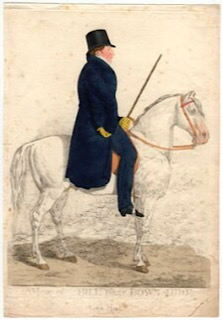
Death of Arthur Hill, 3rd Marquess of Downshire

Arthur Blundell Sandys Trumbull Hill, 3rd Marquess of Downshire KP, an Anglo-Irish peer, styled Viscount Fairford from 1789 until 1793 and Earl of Hillsborough from 1793 to 1801, dies on September 12, 1845, in Blessington, County Wicklow.

Hill is born in Hanover Square, on October 8, 1788, the eldest son of Arthur Hill, 2nd Marquess of Downshire, and his wife, Mary Sandys. He becomes Marquess of Downshire on the early death of his father in 1801. He is educated at Eton College and Christ Church, Oxford, gaining his MA in 1809 and a DCL in 1810.

During his early political career, Hill is identified with the Whigs and supports the reform of Parliament. After the Grey Ministry comes to power, he receives a succession of appointments, becoming Colonel of the South Down Militia on March 25, 1831, and carrying the second sword at the coronation of William IV on September 8. He is appointed a deputy lieutenant of Berkshire on September 20, Lord Lieutenant of Down on October 17 (a new office replacing the Governor of Down), and finally a Knight of the Order of St Patrick on November 24, 1831. He receives an honorary LL.D. from the University of Cambridge on July 6, 1835.

Hill is a very strong supporter of the Irish language, and is president of the Ulster Gaelic Society (est. 1830). In this capacity he plays an important role in helping preserve records of the language, poetry, folk and song collections and much else.

Hill is disliked by Elizabeth Smith, diarist at Baltyboys HouseCounty Wicklow, who feels snubbed by him when she and her husband first move into the area. Writing of him after his death she recalls “The late Lord never called upon me when I first came here although the Colonel waited upon him. The Colonel never went near him again.”

High-minded, if also at times high-handed in manner and self-important, Hill works hard himself and expects all his employees and tenants to be equally conscientious. Naturally, he is often disappointed. He is particularly concerned about his failure, despite all efforts and exhortations, to make his southern estates as efficient and well behaved as those in the north. Though an absentee owner in the south, he visits both Blessington and Edenderry regularly. It is during one of these periodic tours of inspection that he drops dead at Blessington on September 12, 1845. He is buried in St. Malachy Parish Churchyard at Royal Hillsborough, County Down. The funeral attracts an enormous crowd of mourners and is reported at some length in The Illustrated London News. His memory is perpetuated in an impressive pillar monument, with his statue on top, erected at Hillsborough in 1848.


Leave a comment

Birth of Ninette de Valois, Dancer & Choreographer

ninette-de-valois

Dame Ninette de Valois, Irish-born British ballet dancer, choreographer, and founder of the company that in October 1956 becomes the Royal Ballet, is born Edris Stannus at Baltyboys House in Blessington, County Wicklow on June 6, 1898. She is influential in establishing ballet in England.

In 1908, at the age of ten, de Valois starts attending ballet lessons. At the age of thirteen she begins her professional training at the Lila Field Academy for Children. It is at this time that she changes her name and makes her professional debut as a principal dancer in pantomime at the Lyceum Theatre in the West End.

In 1919, at the age of 21, de Valois is appointed principal dancer of the Beecham Opera Company, which is then the resident opera company at the Royal Opera House. She continues to study ballet with notable teachers, including Edouard Espinosa, Enrico Cecchetti and Nicholas Legat.

In 1923, de Valois joins Sergei Diaghilev’s Ballets Russes as a soloist. At age 26, however, she quits performing after learning she is suffering from an undiagnosed case of childhood polio. In 1926 she founds her own school, the Academy of Choreographic Art, in London. She also produces dances for Lennox Robinson at the Abbey Theatre in Dublin and for Terence Gray at the Cambridge Festival Theatre.

The success of de Valois’s ballet Job: A Masque for Dancing for the Camargo Society in 1931, followed by her association with Lilian Baylis, director of the Old Vic Theatre, leads to the founding in 1931 of the Vic-Wells Ballet Company and the Sadler’s Wells School. She traces the history of the company, from its founding until it becomes the Royal Ballet in 1956, in Invitation to the Ballet (1937) and Come Dance with Me (1957).

Besides directing the company that she created, de Valois choreographs numerous ballets, including Checkmate (1937) and Don Quixote (1950). By drawing from English tradition for her choreographic material, as in The Rake’s Progress (1935), inspired by William Hogarth’s series of engravings, and The Prospect Before Us (1940), modeled on Thomas Rowlandson’s caricature of the same name, she creates a uniquely national ballet company. Her narrative ballets include prominent roles for male dancers, giving them artistic opportunities often neglected by other choreographers.

In 1963 de Valois retires as director of the Royal Ballet, although she remains head of the school until 1972. She is created a Dame of the British Empire in 1951 and is named Companion of Honour in 1980.

de Valois keeps her private life very distinct from her professional life, making only the briefest of references to her marriage to Dr. Arthur Blackall Connell, a physician and surgeon from Wandsworth, in her autobiographical writings. In April 1964 she is the subject of This Is Your Life, when she is surprised by Eamonn Andrews at the home of the dancer Frederick Ashton in London. She continues to make public appearances until her death in London on March 8, 2001 at the age of 102.

(Pictured: Ninette de Valois, circa early 1920s)