
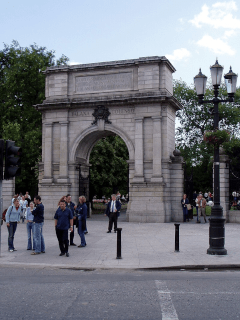
The Fusiliers’ Arch, a monument which forms part of the Grafton Street entrance to St. Stephen’s Green in Dublin, is dedicated on August 19, 1907, to the officers, non-commissioned officers and enlisted men of the Royal Dublin Fusiliers who fought and died for “King and country” in the Second Boer War (1899–1902).
Funded by public subscription, the arch is designed by John Howard Pentland and built by Henry Laverty and Sons. Thomas Drew consults on the design and construction.
The proportions of the structure are said to be modelled on the Arch of Titus in Rome. It is approximately 8.5 m (28 ft.) wide and 10 m (33 ft.) high. The internal dimensions of the arch are 5.6 m high and approximately 3.7 m wide (18 by 12 ft.). The main structure of the arch is granite, with the inscriptions carried out in limestone and a bronze adornment on the front of the arch.
The arch is commissioned to commemorate the four battalions (two regular and two militia) of the Royal Dublin Fusiliers that served in the Second Boer War. The names of 222 dead are inscribed on the underside of the arch.
The construction of the arch coincides with a time of political and social change in Ireland, and the colonial and imperial background to the dedication are anathema to a burgeoning nationalist movement – who label the structure “Traitor’s Gate.” Though damaged in a crossfire between the Irish Citizen Army and British forces during the 1916 Easter Rising, the arch remains “one of the few colonialist monuments in Dublin not blown up” in Ireland’s post-independence history.
Engraved on the western face of the monument is the Latin text, Fortissimis suis militibus hoc monumentum Eblana dedicavit MCMVII, “To its strongest soldiers, Dublin dedicates this monument, 1907.” (Eblana is a name that appears on Ptolemy‘s 2nd century AD map of Ireland, traditionally taken as a Latin name for Dublin, although it more likely refers to a site further north, around Loughshinny.) Six battlefields are inscribed on the arch:
- Talana: Battle of Talana Hill, 20 October 1899
- Ladysmith: Battle of Ladysmith, 30 October 1899
- Colenso: Battle of Colenso, 15 December 1899
- Tugela Heights: Battle of the Tugela Heights, 14–27 February 1900
- Hartshill: Hart’s Hill, 23 February 1900, part of the Relief of Ladysmith
- Laings Nek: Laing’s Nek was the scene of intense fighting, 2–9 June 1900. Not to be confused with the more famous Battle of Laing’s Nek (1881)
 seamus dubhghaill