seamus dubhghaill

Promoting Irish Culture and History from Little Rock, Arkansas, USA


Leave a comment

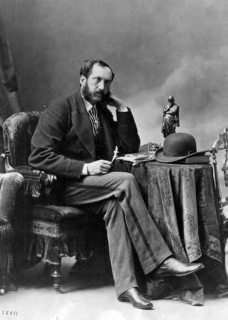
Death of Lieutenant General Sir Frederick William Stopford

Lieutenant General Sir Frederick William Stopford, KCB, KCMG, KCVO, British Army officer, dies in Marylebone, City of Westminster, Greater London, England, on May 4, 1929. He is best remembered for commanding the landing at Suvla Bay in August 1915, during the Gallipoli campaign, where he fails to order an aggressive exploitation of the initially successful landings.

Stopford is born in Dublin on February 2, 1854, a younger son of James Stopford, 4th Earl of Courtown, and his second wife Dora Pennefather, daughter of Edward Pennefather, Lord Chief Justice of Ireland.

Stopford is commissioned into the Grenadier Guards on October 28, 1871. He is appointed aide-de-camp to Sir John Miller Adye, chief of staff for the Egyptian Expeditionary Force, and takes part in the Battle of Tell El Kebir in 1882. He goes on to be aide-de-camp to Major General Arthur Fremantle, commander of the Suakin Expedition in 1885. He is then made brigade major for the Brigade of Guards, which has been posted to Egypt.

He returns to England to be brigade major of the 2nd Infantry Brigade at Aldershot in 1886. He becomes deputy assistant adjutant general at Horse Guards in 1892, and deputy assistant adjutant general at Aldershot in 1894. He takes part in the Fourth Anglo-Ashanti War in 1895 and becomes assistant adjutant general at Horse Guards in 1897.

Stopford takes part in the Second Boer War as military secretary to General Sir Redvers Buller and later military secretary to the general officer commanding Natal, for which he is knighted as a Knight Commander of the Order of St. Michael and St. George in November 1900. After his return to Britain, he is appointed deputy adjutant general at Aldershot in 1901, and chief staff officer for I Corps with the temporary rank of brigadier general, on April 1, 1902. Two years later, he is appointed director of military training at Horse Guards. Promoted to major general in February 1904, he is Major-General commanding the Brigade of Guards and general officer commanding (GOC) of the London District from 1906. He is promoted to lieutenant general in September 1909.

In October 1912, Stopford is made Lieutenant of the Tower of London, taking over the post from General Sir Henry Grant.

On August 5, 1914, a day after the British entry into World War I, he is appointed GOC First Army, part of Home Forces, a position he holds until he takes command of IX Corps the following year.

As GOC of IX Corps, Stopford is blamed for the failure to attack following the landing at Suvla Bay in August 1915, during the Gallipoli campaign. He chose to command the landing from HMS Jonquil, anchored offshore, but sleeps as the landing is in progress. He is quickly replaced on August 15 by Major-General Sir Julian Byng.

After almost 50 years of military service, Stopford retires from the army in 1920.

Stopford dies at the age of 75 on May 4, 1929, at Marylebone, City of Westminster, Greater London, England. He is buried in the Holy Trinity and St. Andrew’s Churchyard in Ashe, Basingstoke and Deane borough, Hampshire, England.

Leave a comment

Birth of William Francis Butler, Army Officer & Writer

william-francis-butler

William Francis Butler, 19th-century British Army officer, writer, and adventurer, is born on October 31, 1838, at Ballyslatteen, Golden, County Tipperary.

Butler is the son of Richard and Ellen Butler. The great famine of 1847 and scenes of suffering and eviction are amongst his earliest recollections. He is educated chiefly by the Jesuits at Tullabeg College.

Butler enters the army as an ensign of the 69th Regiment of Foot at Fermoy Barracks in 1858, becoming captain in 1872 and major in 1874. He takes part with distinction in the Red River expedition (1870–71) and the Ashanti operations of 1873–1874 under Garnet Wolseley, 1st Viscount Wolseley and receives the Companion of the Order of the Bath in 1874.

On June 11, 1877, Butler marries Elizabeth Thompson, an accomplished painter of battle scenes, notably The Roll Call (1874), Quatre Bras (1875), Rorke’s Drift (1881), The Camel Corps (1891), and The Dawn of Waterloo (1895). They have six children. His daughter, Elizabeth Butler, marries Lt.-Col. Randolph Albert Fitzhardinge Kingscote (1867-1940) on July 24, 1903.

Butler again serves with General Wolseley in the Anglo-Zulu War, the Battle of Tell El Kebir (after which he is made an aide-de-camp to Queen Victoria) and the Sudan in 1884–1886, being employed as colonel on the staff in 1885 and brigadier general in 1885–1886. In the latter year, he is made a Knight Commander of the Order of the Bath. He serves as brigadier general on the staff in Egypt until 1892 when he is promoted to major general and stationed at Aldershot, subsequent to which he is given command of the South-Eastern District in March 1896.

In 1898 Butler succeeds General William Howley Goodenough as commander-in-chief in South Africa, with the local rank of lieutenant general. For a short period (December 1898 – February 1899), during the absence of Sir Alfred Milner in England, he acts as high commissioner, and as such, and subsequently in his military capacity, he expresses views on the subject of the probabilities of war which are not approved by the home government. He is consequently ordered home to command the Western District and holds this post until 1905. He also holds the Aldershot Command for a brief period from 1900 to 1901. He is promoted to lieutenant general in 1900 and continues to serve, finally leaving the King‘s service in 1905.

In October 1905, having reached the age limit of sixty-seven, Butler is placed on the retired list. The few years of life which remain to him he spends at Bansha Castle in Ireland, devoted chiefly to the cause of education. He is a frequent lecturer both in Dublin and the provinces on historical, social, and economic questions. He is known as a Home Ruler and an admirer of Charles Stewart Parnell. He is a member of the Senate of the National University of Ireland, and a commissioner of the Board of National Education. In June 1906, he is appointed Knight of the Grand Cross of the Order of the Bath, and in 1909 he is made a member of the Privy Council of Ireland.

William Butler dies at Bansha Castle in Bansha, County Tipperary, on June 10, 1910, and is buried at the cemetery of Killaldriffe, a few miles distant and not far from his ancestral home.

Butler had long been known as a descriptive writer, since his publication of The Great Lone Land (1872) and other works and he was the biographer (1899) of Sir George Pomeroy Colley. He had started work on his autobiography a few years before his death but died before it was completed. His youngest daughter, Eileen, Viscountess Gormanston, completes the work and has it published in 1911.

(Pictured: William Francis Butler, Source: Archives of Manitoba, Personalities – Butler, W. F. 1, N10492)